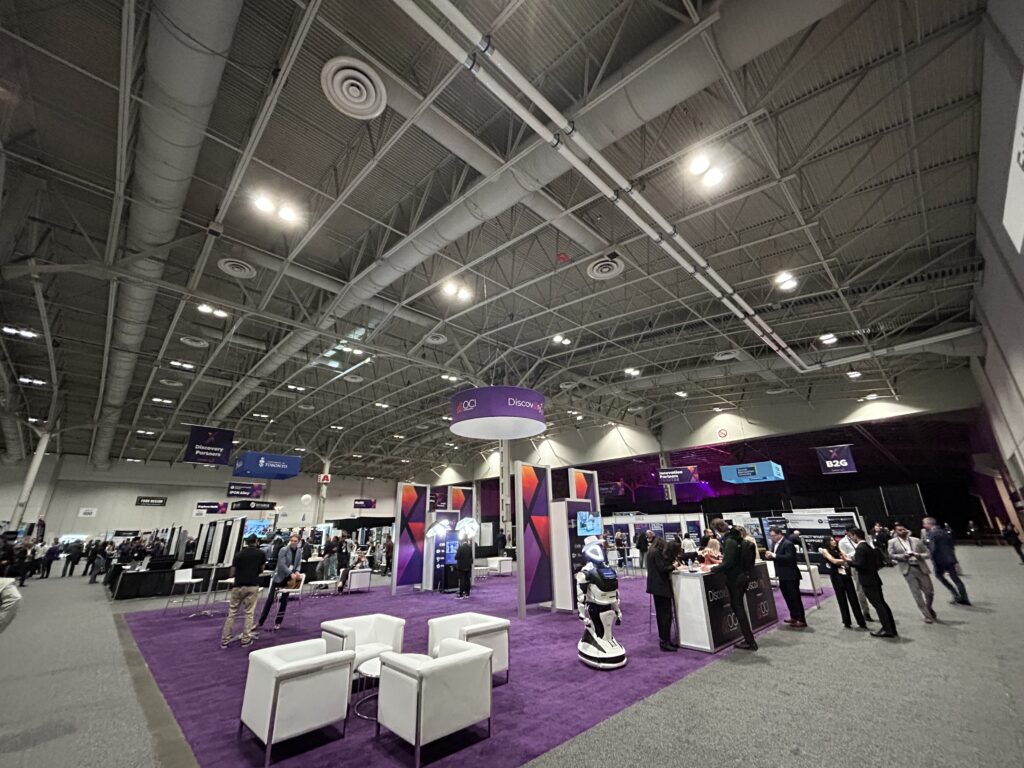
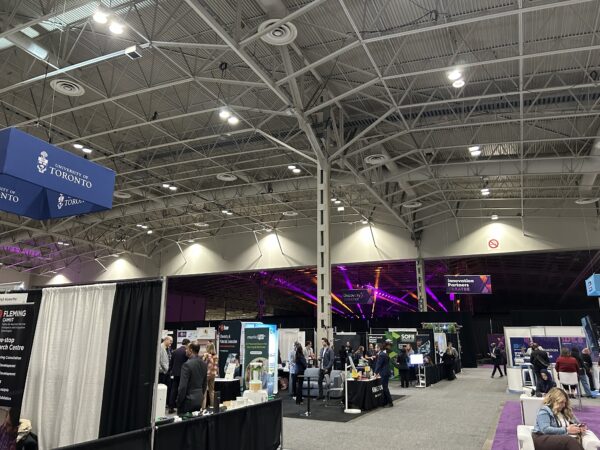

The show floor was full of a diverse group of booths including advanced technologies, investors, educational institutions, government and regional representatives, cleantech companies, life science organizations, and transportation startups focused on Ontario’s Northern Corridor, among others.
Ontario Centre of Innovation’s DiscoveryX 2026 event took place on Apr. 29-30 at the Enercare Centre in Toronto, Ont., bringing together startups, researchers, educational institutions, investors and industry leaders.
The 17th edition of the show, DiscoveryX 2026 featured over 160 exhibitors, 26 sessions and just under 2,000 attendees across the two-day event.
The show floor was full of a diverse group of booths including advanced technologies, investors, educational institutions, government and regional representatives, cleantech companies, life science organizations, and transportation startups focused on Ontario’s Northern Corridor, among others.
DiscoveryX also featured an Ask-An-Investor program that allowed for 1-on-1 meetings between investors and entrepreneurs to ease connections and discover new products and technologies. OCI stressed the importance of these meetings happening on the show floor.
“We like to think that DiscoveryX is the physical representation of Ontario’s innovation ecosystem,” said Claudia Krywiak, president and CEO, Ontario Centre of Innovation. “If you are a researcher, innovator, investor or entrepreneur you will meet anyone and everyone who is active in our innovation ecosystem, who is interested in new technology development and who is looking for potential collaborators, it’s a platform to bring those collaborators together so we can get the next great Ontario-based technologies developed and scaled-up.”
With the show being focused on innovation and emerging technologies, OCI has seen dramatic changes from show to show, “The biggest change is how quickly technology development is accelerating,” Krywiak told Canadian Manufacturing. “You can see it on the show floor, you’re seeing robotics and robots, five years ago you weren’t seeing that kind of bleeding edge technology happening so quickly.”
“Year over year now, especially with AI, the leaps we’re seeing in technology development are truly phenomenal. Not only will you see bleeding edge and leading-edge technologies, but where next technologies on the show floor and the and the pace of technological change and development is accelerating very, very rapidly.”
As it has been over the last several months, AI and different ways to incorporate it continued to dominate discussions at the show, both on the floor and in the various sessions.
“If you look at most of the technologies on the show floor, they are being enabled by AI in some way. Either the AI is being integrated into the actual products, or the startup companies are actually using AI to scale and build their companies,” said Krywiak.
Researchers from York University’s Mobility innovation Centre also told Canadian Manufacturing that AI was a focus of theirs at the conference and in their research.
On top of AI, Krywiak cited quantum computing and the convergence of AI and quantum computing as a technology that she believes will be very important in the future, noting that expected timelines on advanced technologies are continually being moved forward, with many believing significant quantum breakthroughs can occur in the next 10 years.
Keynotes and sessions
In a keynote fireside chat, Christian Weedbrook, founder and CEO of Toronto-based photonic quantum computing company Xanadu, broke down his company’s IPO that took place in March 2026 before diving into what quantum computing is and the Canadian technologies landscape.
“Our biggest challenge and why we don’t have large-scale quantum computers today is the fact that we need to get loss under a certain level, and one of the reasons why we went public is to raise more capital as quickly as possible, but also to put more of that money into foundries,” he said.
Weedbrook expressed his desire to receive as much Canadian investment as possible and addressed concerns around founders leaving Canada.
“Hopefully it sets the trend that you don’t have to leave Canada or Toronto to actually raise money,” he said. “So, the more that people can stay here and show that you can do it, the less the initial reaction of Canadian investors and Canadian entrepreneurs is ‘we’ve got to go to the valley.’”
Day one’s keynote panel saw Natasha Walji, Managing Director, Google Canada, Nina Tangri, Associate Minister – Small Business and MPP for Mississauga-Streetsville, James White, President & CEO at Wellmaster and Gillian Batcher, Founder & Goldsmith at Jewel Envy, sit down to discuss AI and SMEs.
Tangri advocated for digital adoption as a way for Ontario to stay competitive, while Walji cited AI as a tool for SMEs to handle areas like sales and marketing to help stay competitive.
Day two’s keynote address saw the godfather of AI, Dr. Geoffrey Hinton, dive into understanding the ever-changing world of AI, as well as the societal risks that the technology may pose.
After expressing concerns regarding the threat AI poses to humanity, one of Hinton’s recommendations was that humans treat AI as a maternal figure and humans as babies to ensure AI keeps our bests interests as a priority.
In a panel on defence and dual use technologies, Kanwhar Johal, CSO Superwake, Geoff Johnstone, Director, GM Defence Canada, Steven Thornton, Strategic Advisor, PwC and Uriel Marantz, Senior Policy Advisor, Department of National Defence, discussed procurement, policy and the federal government’s new defence focus.
Thornton stressed that defence procurement is a process, and that building relationships with defence officials is extremely important so that you can understand “the ask” when an RFP is released.
“For SMEs, this is a really good time right now, defence wants to hear from you, that wasn’t always the case,” Thornton said. “People often get seduced by the big capital acquisitions, for the small and medium businesses there’s a role in that, but the Netflix subscription is in the operation and maintenance of that entity,” he added.
There was also some debate over how long this focus on defence would last, but Thornton noted that the world has changed, and that this is an essential moment for Canada.
Marantz said that Canadian companies and suppliers should demonstrate their domestic supply chains and partnerships, noting that it can increase competitiveness by 20-25 per cent when bidding on a contract.
Johnstone discussed the cost of dual use technologies, “We’ve got to get to that line that’s good enough and not chasing perfect because perfect will blow up cost and schedule every single time and really take you away from your heritage and create something that is effectively a bespoke military product and not truly dual use anymore, you’re undermining the advantage of commercial scale in your supply chains.”
Defence panels and booths were big attractions on the floor, including to Adam Hepburn, founder and CEO of ELO Gaming, a dual use company that produces controllers and augmented reality glasses for both gaming and defence.
“Theres government funding agencies, defence industry people, and representatives from cities and colleges,” he said “Defence is a big industry right now, we’ve had a lot of contacts and people follow-up.”
“We’ve been able to execute to the consumer, and we know that we can execute for Canada and we want to be a part of that growth.”
Regarding new technologies in the defence industry, he referenced AI’s ability to map out situations on the battlefield as something his company is focused on.
Other panels during the event including topics on critical minerals, advanced manufacturing, Northern development and AI sovereignty.
Source link