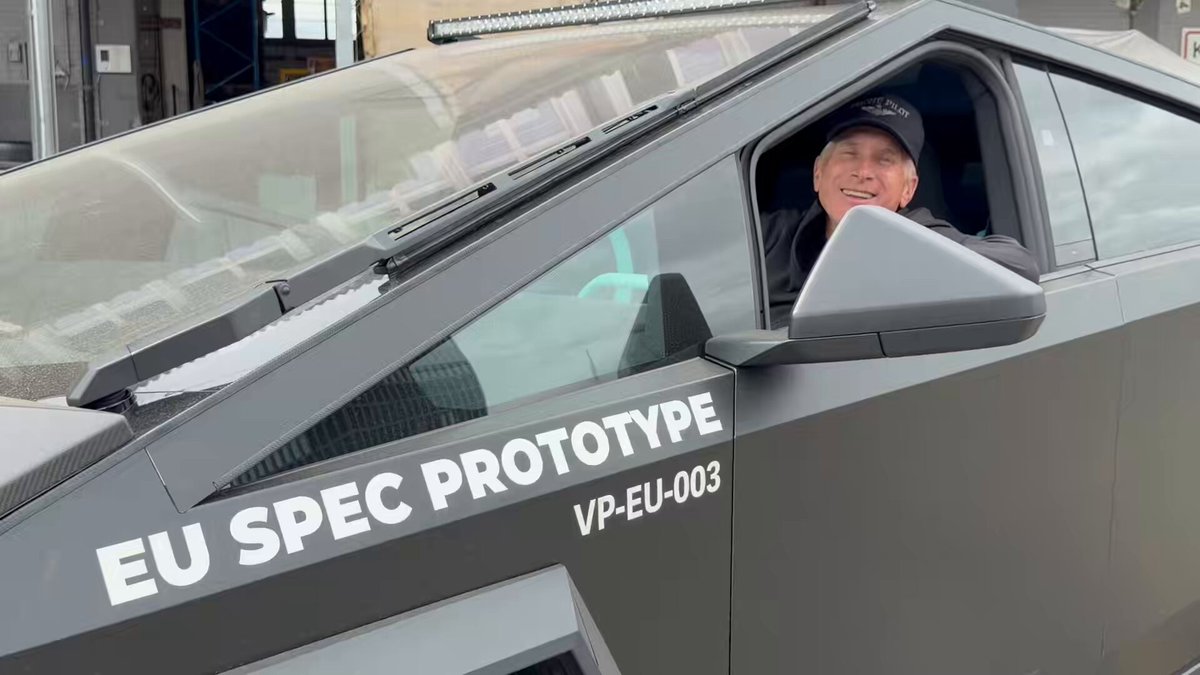
A small Swiss independent Tesla dealer called Teslab is doing what Tesla itself hasn’t attempted: engineering the Cybertruck into compliance with European road regulations. Spotted during a visit by Tesla enthusiast Joe Tegtmeyer, the effort is being led by a young entrepreneur named Raven Seeholzer — and it’s further along than most people realize.
What Homologation Actually Requires
The Cybertruck’s factory design runs into several hard walls in Europe. Its rigid stainless-steel exoskeleton and sharp angles conflict directly with EU pedestrian safety regulations, which require vehicles to absorb impact energy in ways that protect people outside the car. On top of that, the truck’s dimensions — nearly 2.1 meters wide and over 5.6 meters long — and its gross vehicle weight push against EU limits for standard passenger vehicles.
To get around these barriers, Teslab has undertaken a serious re-engineering effort. According to verified reports, the modifications include replacing the factory front bumper with a safer, compliant design, covering the Cybertruck’s sharp exterior edges with rubber trims, and rewiring the vehicle’s electronics to conform with local Swiss legislation. The truck was reportedly fully disassembled during this process — this isn’t a cosmetic job.
How Far Along Is Teslab?
Further than you’d expect for a single-shop operation. As of December 2025, Teslab’s owner Raven Seeholzer told media that the modified Cybertruck had passed numerous government tests in Switzerland and that receiving a Swiss number plate was “a matter of time” — the company described itself as in the “final stage” of getting the vehicle road-legal in the country.
Switzerland’s position outside the EU gives Teslab a meaningful regulatory advantage here. Swiss type approval is a distinct process from EU-wide approval, and clearing it is a more achievable near-term target. Broader EU approval — which would require satisfying UNECE regulations across member states — is acknowledged by Teslab as a significantly longer and more complex undertaking.
On December 31, 2025, Teslab posted on social media claiming the Cybertruck had cleared all UNECE regulations for European approval. That claim has not been independently verified by Tesla or European authorities, and should be treated as unconfirmed for now.
There’s Already Demand
The commercial case for this effort isn’t purely enthusiasm-driven. According to reports from late 2025, Teslab had already sold three Cybertruck units and secured 400 preorders within Switzerland alone — a notable number for a vehicle that isn’t yet street-legal there. Unofficial imports of the Cybertruck have been circulating in Europe at steep premiums; a Dutch dealer listed one in October 2024 for €295,000 before tax, or roughly €356,950 with VAT. A compliant, legally registered Cybertruck would be a very different proposition for European buyers.
Tesla Has No Official European Plans
Tesla has made no public commitment to pursue European type approval for the Cybertruck in its current form. Elon Musk has hinted at a potential smaller “Cybertruck Lite” designed for European markets, but no confirmed development progress has emerged on that front. For now, Teslab is operating entirely independently — this is not a Tesla-sanctioned program.
That independence cuts both ways. It means Teslab can move faster and take regulatory risks that a public company wouldn’t, but it also means any approval would be limited in scope and scale compared to an official Tesla launch. Still, if Raven’s team gets a Swiss plate on that truck, it becomes a proof of concept that’s hard to ignore — for regulators, for other importers, and potentially for Tesla itself.
David Hartley
Contributing Writer — Industry & Markets
David covers the EV industry, regulatory developments, and accessory ecosystem. 15+ years writing about consumer tech. Based in London.
Sources verified at publish time. Spotted an inaccuracy? Email [email protected].