India’s transition to electric mobility is gaining momentum, but commercial four-wheeler fleets continue to face significant challenges. The high cost of batteries and long charging times remain major barriers to EV adoption.
Fleet operators and taxi drivers cannot afford to keep their vehicles parked for hours while charging, as every minute of downtime directly impacts their earnings and operational efficiency.
To address this problem, Blinq Mobility, a deep-tech EV startup, is working to transform the four-wheeler segment through fast battery swapping.
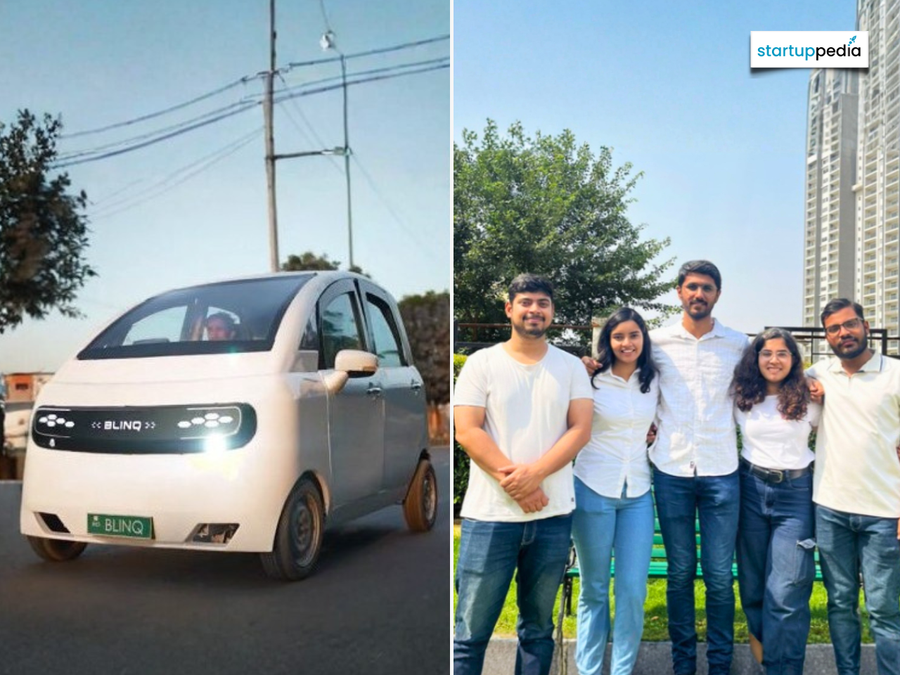
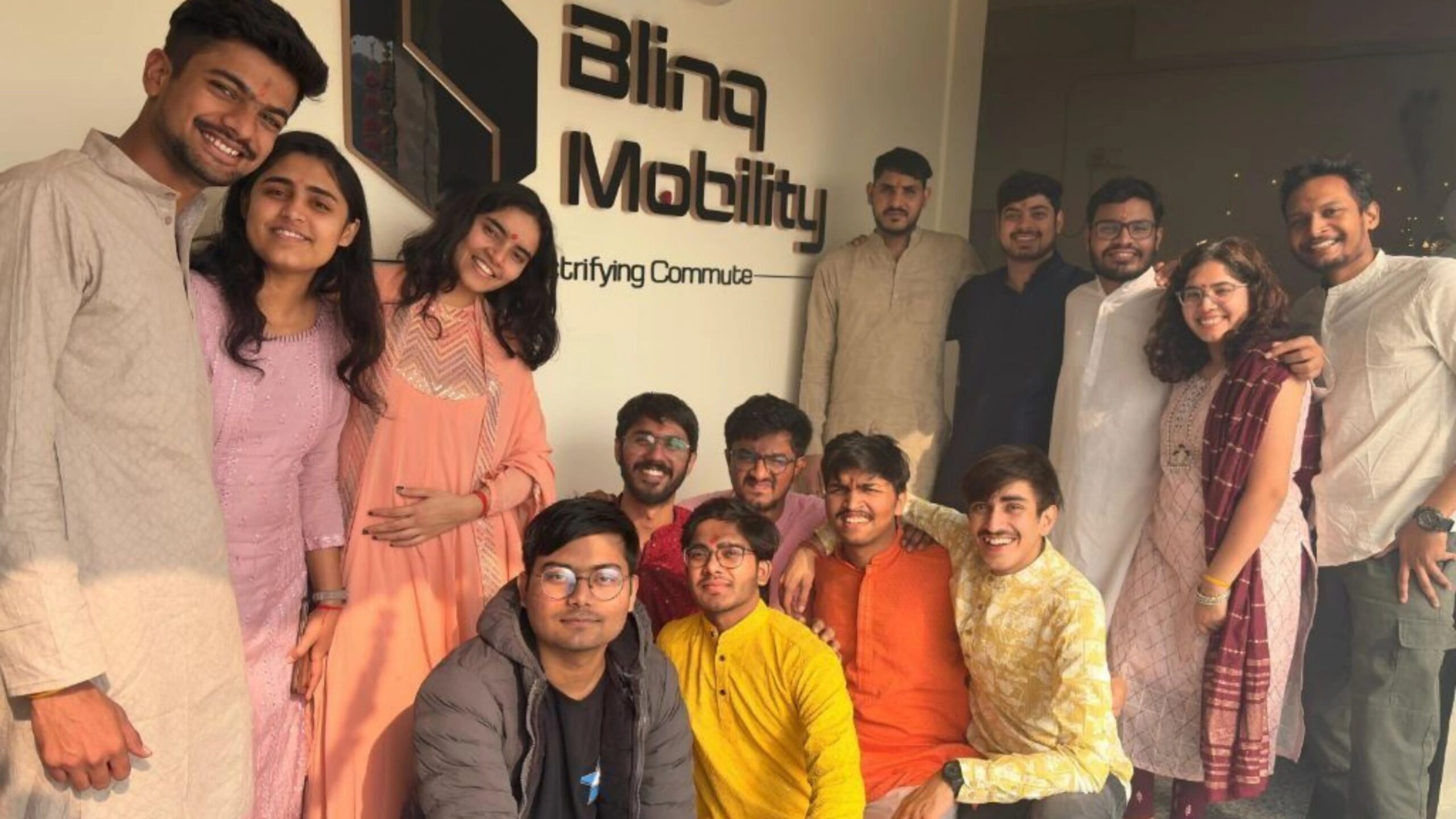
Founded in 2024, Blinq Mobility is led by 5 IIT Delhi alumni. The co-founders have worked together for more than a decade, starting with building Formula electric race cars during their college years, later scaling EV component startups, and now developing EV battery-swapping solutions to make electric mobility more practical and accessible.
“For commercial vehicle owners, charging downtime is the biggest challenge. If the vehicle is parked for charging, it is not earning money. By owning and managing the battery ourselves, we remove that problem. Customers only pay for the energy they consume, get a fully charged battery within minutes, and can immediately get back on the road,” Nikesh Bisht tells Startup Pedia in an exclusive interview.
Background of Blinq Mobility Founders
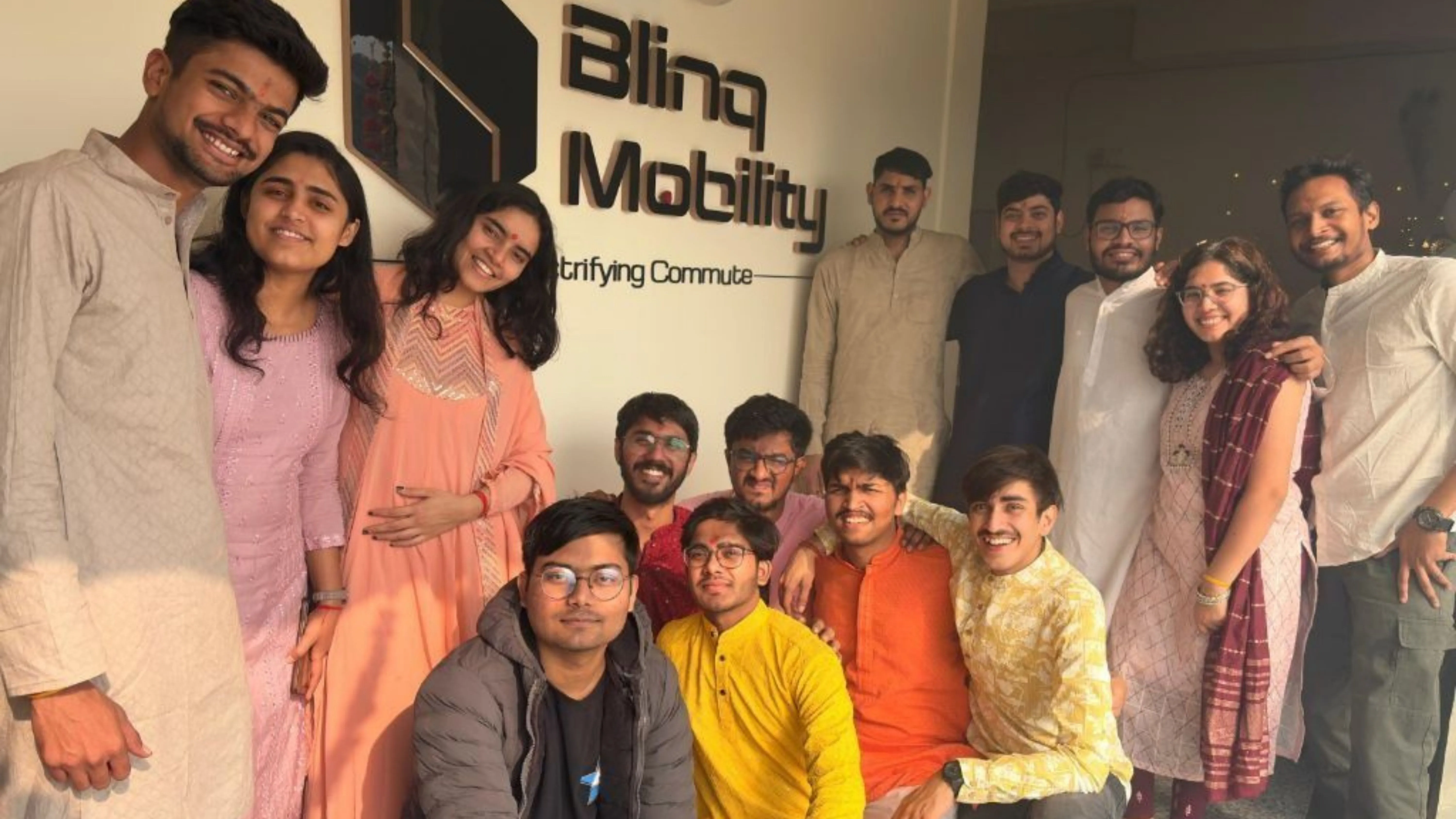
Nikesh Bisht is an engineer and an IIT Delhi alumnus who developed a passion for electric vehicles while building Formula electric race cars during his college years. After helping scale the EV component startup Vekmocon, he co-founded Blinq Mobility in 2024.
Ankit Kumar is an engineer, an IIT Delhi alumnus, and a long-time collaborator of Nikesh. He was part of the same Formula electric racing team in college and now uses his deep hardware expertise to develop Blinq Mobility’s technology and products.
Abhilasha is a deep-tech specialist with previous experience at Chakra Innovation. Her hands-on knowledge of lithium-ion batteries and advanced cell chemistries plays a key role in developing Blinq Mobility’s battery technology.
Sushmita is an operations professional who earlier managed sponsorships for the IIT Delhi Formula racing team. Driven by her entrepreneurial mindset, she was one of the first among the co-founders to start conversations about building a business in the EV sector.
Yashdeep is a mechanical engineer with extensive experience in manufacturing and product development. His expertise in production processes and composite materials is crucial for designing and building Blinq Mobility’s hardware.
Nikesh’s First Venture
Nikesh’s interest in electric vehicles began during his time at IIT Delhi. As a member of a student team that built Formula electric race cars, he worked in a demanding environment where the team designed and built a completely new vehicle every year.
After graduating in 2016, Nikesh decided to start his own venture.
He founded Vekmocon, even though he had limited knowledge of entrepreneurship and fundraising at the time.
Along with his team, he developed products for the growing two- and three-wheeler EV market, including battery management systems, chargers, IoT devices, and smart batteries. Over time, the company secured major customers, including Bajaj.
Over the following years, Vecmocongrew into a well-established business with a team of around 60 to 70 people.
However, by 2021–22, as the company became more structured and daily operations settled into a routine, Nikesh felt he was losing the excitement that had initially driven him.
“Our product was stable, but I realized that you cannot transform the entire ecosystem by only building components based on customer requirements. After eight years, everything had become very predictable. I was deeply passionate about EVs, and I felt that adoption in India was not growing as fast as it could. I wanted to solve the problems holding the industry back, and that is what motivated me to move on,” Nikesh says.
Meeting the Co-Founders and Building Blinq Mobility
The foundation of Blinq Mobility can be traced back to IIT Delhi, where Nikesh and his co-founders first came together through the college’s Formula electric racing team.
Nikesh’s junior, Ankit Kumar, brought strong hardware expertise from his time as an engineer at Tesla in the US, where he worked on projects such as the Cybertruck and Robotaxi.
Sushmita managed sponsorships and other non-technical activities for the racing team, helping run it much like a small business.
The team was joined by Abhilasha, who had experience working on advanced battery chemistries at Chakr Innovation, and Yashdeep, a mechanical engineer with expertise in manufacturing and composite materials.
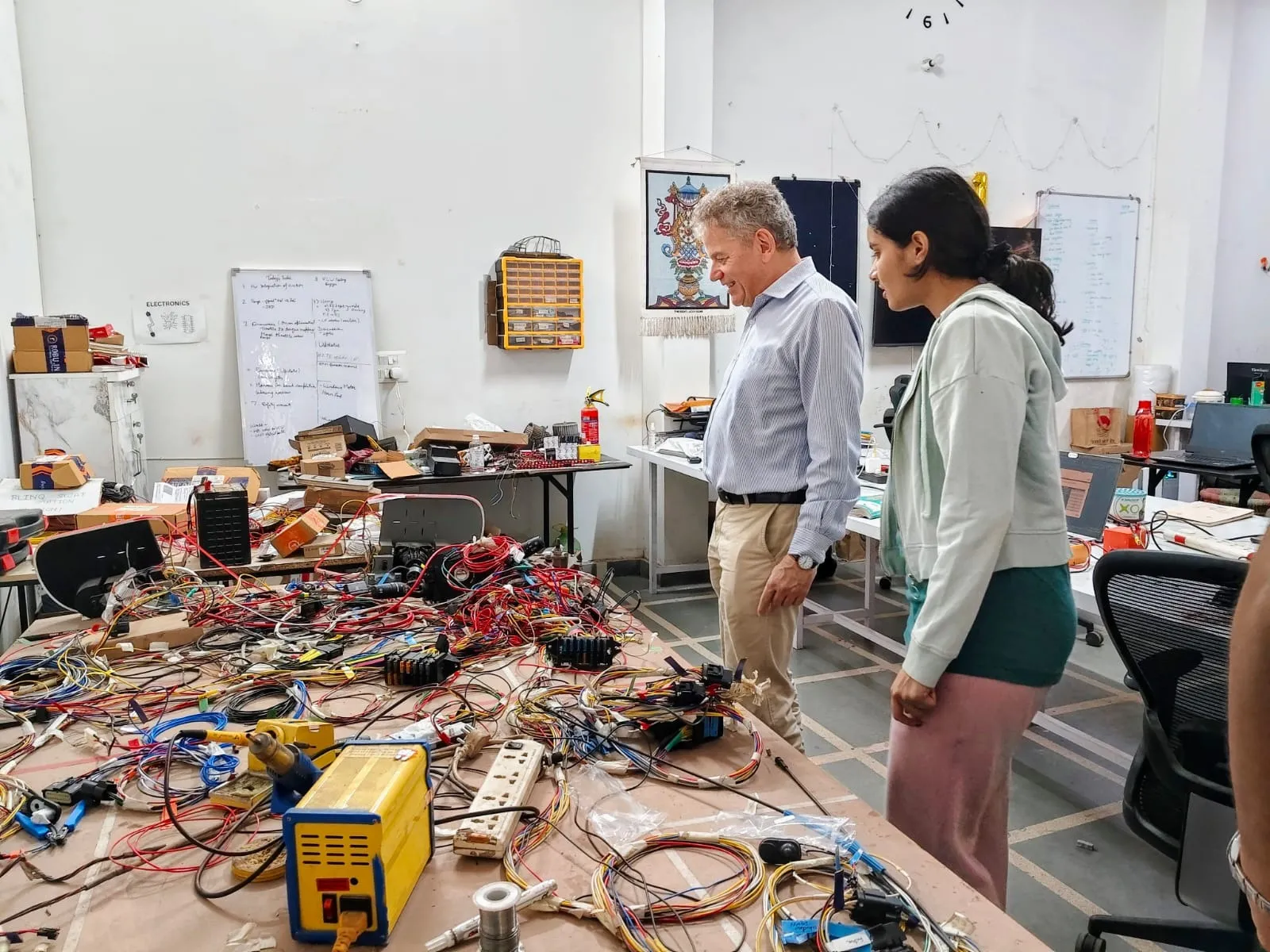
As they began working on their idea, the founders realised they needed a dedicated space to build and test vehicles. Initially, they all were working at Nikesh’s home, who was living in Saket, Delhi.
The team chose to move their operations to the outskirts of Gurugram. There, they rented a warehouse for Rs 45,000 per month, which gave them enough room to carry out mechanical work and prototype development.
Early Days & Prototype Development
In the early days, the founders operated on a very lean budget and spent most of their time at the workshop.
With no outside investment, they relied heavily on their own resources and even borrowed tools from their old college friends for tasks such as cutting, welding, and grinding.
To pay the warehouse rent and cover day-to-day expenses, the team used their personal savings. A large part of the initial funding (around 3-4 lakhs) came from Ankit’s earnings during his time at Tesla in the United States.
The founders pooled their resources to keep the company running while they focused on developing the technology.
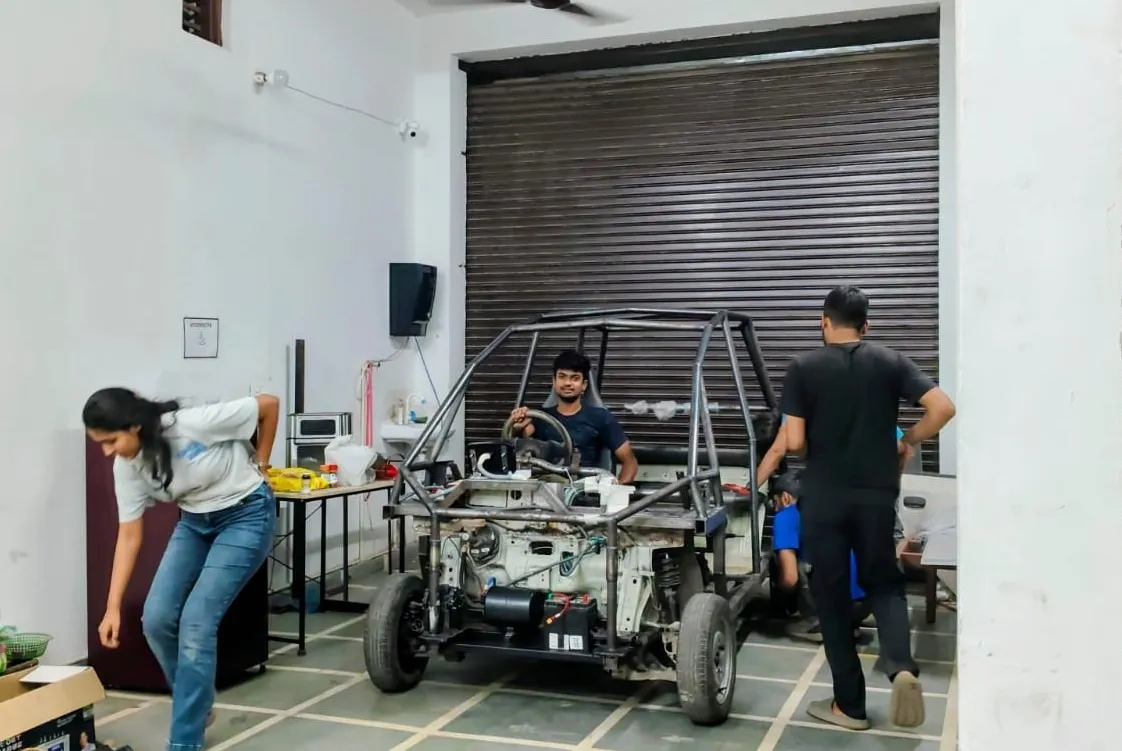
The team started developing their battery-swapping technology through a raw, hands-on process.
Because their battery was designed to fit under the car, their Phase 1 prototype was just a simple physical ramp where the car would be elevated, and they had to manually push the battery underneath.
In Phase 2, they introduced a basic hydraulic jack to push the battery up into the car. Through constant iteration, they reached Phase 3, where the mechanism became fully automated.
With the push of a single button, the battery could be swapped, and they built a complete enclosed structure around the station, equipped with screens and electronics.
By March 2025, this relentless hardware development resulted in support from the government in the form of grants.
Grants & Investments
With a working prototype and support from government programs, Blinq Mobility began attracting investor interest.
By April 2025, the company was in discussions with IIM Ahmedabad Ventures and later with Mumbai-based 8i Ventures.
A few months later, in October 2025, Blinq Mobility raised Rs 4.3 crore ($480,000) in its first pre-seed funding round, providing the capital needed to expand beyond its small Gurugram warehouse and accelerate growth.
“There is no point wasting years trying to perfectly refine something on paper. We built a fast prototype with the resources we had. Getting those initial government grants and institutional backing proved helped us build faster” Nikesh tells Startup Pedia.
About EV Battery Swapping & How it Works?
The main idea behind Blinq Mobility is to increase the adoption of electric four-wheelers in India by building a battery-swapping ecosystem.
Instead of treating the battery as a permanent part of the vehicle, the company views it as a replaceable energy source that can be swapped whenever needed.
The concept also gets validation from successful battery-swapping models in China, where drivers can replace a discharged battery with a fully charged one in less than three minutes, often faster than refueling a petrol or CNG vehicle.
The battery-swapping process works through a fully automated system:
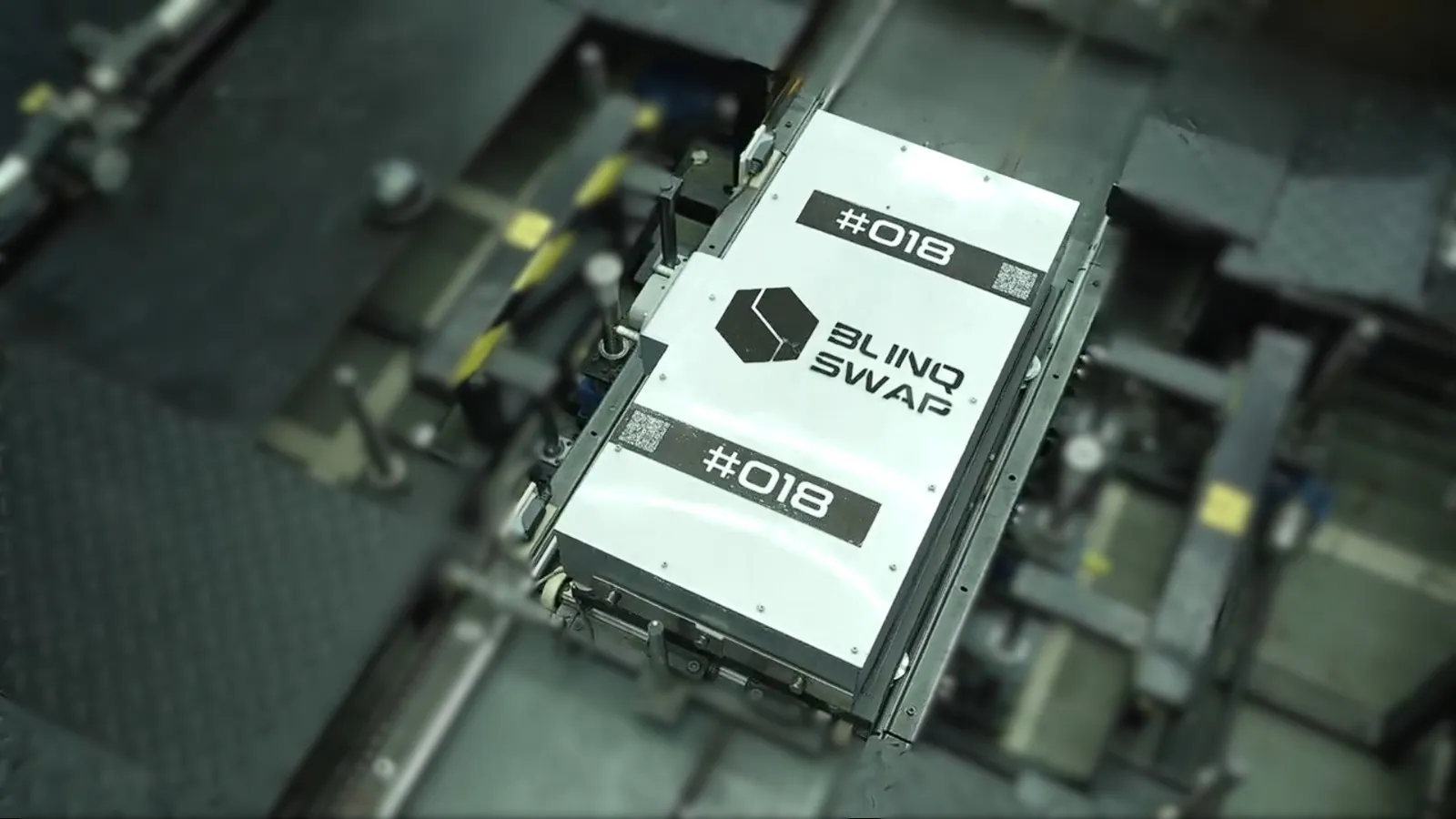
Battery Mounted Under the Vehicle: The battery pack is designed to fit flat underneath the vehicle’s chassis. Its standardised dimensions allow it to be used across different vehicle categories, including hatchbacks, micro-SUVs, and standard SUVs.
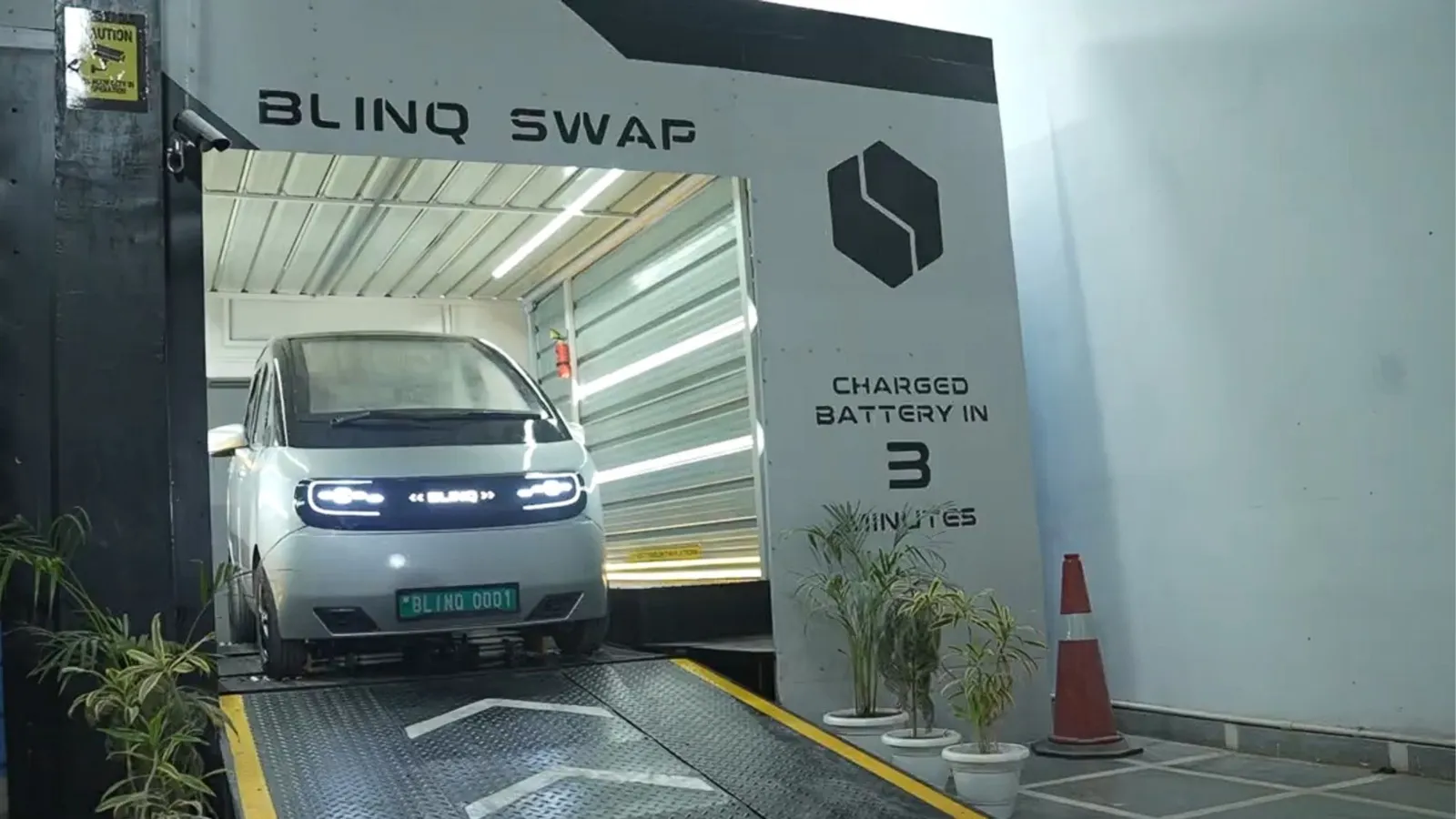
Specialised Swapping Platform:The vehicle is driven onto a dedicated battery-swapping station. An automated lifting mechanism positioned below the platform aligns directly with the battery mounted under the car.
Automated Battery Exchange: The system safely unlocks and removes the discharged battery, lowers it into the station for charging, lifts a fully charged battery into position, and securely locks it underneath the vehicle without requiring any manual handling.
Battery-as-a-Service (BaaS) Business Model
| Feature | Conventional EV Model | Blinq Swapping Model |
| Asset ownership | The operator buys a vehicle and an expensive battery up front. | The operator buys the car shell; Blinq retains battery ownership |
| Downtime | Hours spent parked at a plug or fast-charger. | Under 3 minutes to swap and return to the road. |
| Payment structure | Massive capital expenditure on the battery asset. | Pay-per-use subscription based on kilometres driven. |
| Degradation risk | The operator bears the cost of battery health decline. | Blinq manages battery lifespans in the back-end circulation |
About Blinq Cars
Blinq Mobility’s flagship electric microcar is officially known as the Blinq RYDE (previously referred to during prototype testing as the “Blinq Pod” or “Car 1”).
It is a purpose-built electric vehicle engineered specifically for the dense, chaotic environment of Indian city traffic.
Unlike standard passenger cars, the RYDE is designed with urban ride-hailing and commercial fleet operations in mind, focusing on maximising space, reducing downtime, and keeping running costs aggressively low.
Blinq Mobility Vehicle Features & Specifications
Design & Capacity: A compact, standard passenger car framework deliberately optimised for 2-3 commercial passengers, which significantly reduces required motor power and production costs.
Performance: Top speed is strictly locked at 80 km/h to prevent rash driving, ensure driver safety, and maximise energy efficiency on highways.
Core Tech: A proprietary electronic communication module (ECU) acts as a universal translator between the battery and the vehicle.
AI Intelligence: Built-in AI continuously monitors driver fatigue, response times, harsh acceleration, and erratic steering angles to generate real-time safety scores.
Also Read: After his dessert brand closed, this B’luru boy built Helmio; takes 4.5 mins to clean dirty helmets
The 3-Minute Automated Swap Process
When a Blinq vehicle is on the road, the swapping process is designed to be entirely frictionless.
The batteries are built in a standard size and shape, allowing them to fit underneath the chassis of different types of vehicles, including hatchbacks, compact SUVs, and other passenger cars.
Smart Navigation: When the battery charge starts running low, the vehicle’s dashboard alerts the driver and automatically guides them to the nearest Blinq Mobility battery-swapping station, helping eliminate concerns about running out of power.
Drive-In Station: The driver simply brings the vehicle onto a specially designed swapping platform located inside the station.
Automated Battery Replacement: Once the vehicle is in position, an automated lifting mechanism rises from below. At the push of a button, it removes the discharged battery from the underside of the vehicle, lowers it safely, positions a fully charged battery, and securely locks it into place.
Quick Turnaround Time: The entire battery-swapping process is completed in less than three minutes, allowing drivers to get back on the road faster than they would after refuelling many CNG or petrol vehicles.
The batteries are built in a standard size and shape, allowing them to fit underneath the chassis of different types of vehicles, including hatchbacks, compact SUVs, and other passenger cars.
Also Read: Watchout Wearables: How Mumbai kids’ smartwatch biz with GPS & fever alerts made Rs 3 Crore in FY26?
Current Status & Operational Launch
Blinq Mobility is currently transitioning from its core technology development phase into live road deployments.
The startup is operating its two initial vehicles on the road strictly for the purposes of continuous testing, data collection, and refinement of the automated swapping platform.
Full commercial operations are scheduled to commence within the next two months. This will begin with a small, focused pilot program executed in direct partnership with regional commercial fleet operators.
Also Read: After 16 years at sea, this captain built VerifyU, a safety app that could recognise you in a crisis
Future Goals
By the end of the upcoming phase (targeting March), the company plans to establish and go live with two fully operational, automated battery-swapping stations.
Alongside the infrastructure launch, Blinq will supply and deploy a commercial pilot fleet of approximately 50 vehicles on the road to thoroughly validate the efficiency, throughput, and financial benefits of the Battery-as-a-Service model for both drivers and operators.
Also Read: Delhi man builds GreenVize, offering India’s first hydrogen cooking stove powered by distilled water
FAQ
Who are the founders of Blinq Mobility?
Blinq Mobility was founded by five IIT Delhi alumni, Nikesh Bisht, Ankit Kumar, Abhilasha, Sushmita, and Yashdeep.
When was Blinq Mobility founded?
Blinq Mobility was founded in 2024 with the goal of accelerating electric four-wheeler adoption in India through a Battery-as-a-Service (BaaS) model and a fast battery-swapping ecosystem.
How does Blinq Mobility’s EV battery swapping system work?
Blinq Mobility uses standardized batteries mounted underneath the vehicle chassis. When the battery charge runs low, drivers can visit a battery-swapping station where an automated system removes the discharged battery and installs a fully charged one in less than three minutes.
Source link