As Europe looks to strengthen its Artificial Intelligence (AI) ecosystem and deepen ties with India following the conclusion of negotiations on the India-European Union Free Trade Agreement (FTA) earlier this year, India is emerging as a crucial partner for talent, innovation and entrepreneurship. Growing collaboration between the two regions is creating fresh opportunities for students, researchers and startups, while also prompting universities to rethink how they prepare graduates for an AI-driven economy.
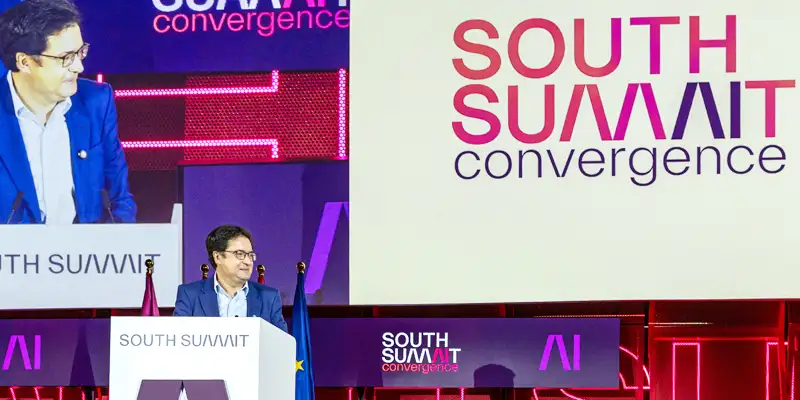
This year’s South Summit Madrid 2026 in Spain, co-organised by IE University, reflected that shift, with its second day bringing together global leaders in AI, robotics, mobility, education and digital infrastructure to examine how technology is reshaping sectors and redefining the future of work and learning. From AI-powered healthcare and autonomous mobility to AI-native digital systems and reimagined learning models, the discussions repeatedly returned to a central theme: the need for education systems to produce adaptable, entrepreneurial and future-ready talent.
Speaking exclusively to Education Times on the sidelines of the summit, Spain’s Minister for Digital Transformation and Public Administration, Óscar López, said India and Europe are exploring multiple avenues of cooperation in technology and innovation. “Europe and India are discussing agreements and collaborations in several areas. We participated in the AI Summit in India and have been working closely with Prime Minister Narendra Modi’s government on a number of initiatives,” López said.
Highlighting growing economic and technology ties between the two regions, he added, “There are Spanish companies operating in India and Indian companies in Spain. We are collaborating with the Government of India because there is a huge opportunity for both Spain and India.”
López’s remarks come as India and the EU seek to translate the recently concluded FTA into deeper cooperation across technology, innovation, talent mobility and digital transformation. The developments could create new opportunities for Indian students, researchers, entrepreneurs and AI professionals seeking access to European innovation ecosystems.
Rise of Indian Entrepreneurs
For universities, however, the implications go beyond mobility and market access. Juan José Güemes, senior vice-president of strategy and corporate development and chairman, Entrepreneurship and Innovation Centre, IE University, said that Indian students have emerged as one of the most entrepreneurial groups on international campuses. Currently, over 250 Indian students are enrolled at IE University. “India is a very important country for us and is strongly represented at IE University. Many Indian students come specifically because of the entrepreneurial culture. A significant number of these students go on to become entrepreneurs and launch companies, many of them in areas related to AI,” Güemes said.
Indian students consistently rank among the university’s largest international cohorts. While some return to India to build businesses, others use Europe as a base to expand into global markets. “Some students return to India to start companies, while others stay and build connections with European and Latin American markets. What stands out is their entrepreneurial mindset and their willingness to create new ventures,” he said.
Güemes also noted that many of these ventures are increasingly centered on AI and emerging technologies, supported by highly international classrooms that encourage cross-border collaboration. “In a typical classroom of 60 students, you may find 50 different nationalities. That diversity creates an environment where entrepreneurship, innovation and global thinking thrive,” he said.
The challenge for universities extends beyond producing entrepreneurial graduates to embedding innovation more deeply into the education system itself. María Benjumea, founder and president, South Summit, stressed that higher education institutions must rethink their fundamental approach to entrepreneurship. “I believe the most important factor is that universities must have innovation and entrepreneurship embedded in their DNA. That is critical,” Benjumea said.
She said that entrepreneurship should not remain confined to incubators or elective courses but must be integrated across disciplines. “Innovation and entrepreneurship should not be treated as a separate subject. They must be transversal and integrated across the entire educational experience,” she said.
Benjumea added that education must go beyond knowledge delivery to focus on initiative, confidence and problem-solving. “Education today should focus on developing skills, initiative and the confidence to pursue your goals,” she said.
She added that the absence of an entrepreneurial mindset continues to limit student-led research and innovation from attracting investment. “What we need is a mindset where students see themselves as entrepreneurs, regardless of the career path they choose,” she said. “When universities cultivate that mindset, students are better equipped to build companies, attract investment and transform ideas into real-world ventures.”
Benjumea also urged emerging startup ecosystems across Asia to prioritise internationalisation, stressing that exposure to global investors and networks is essential for young founders.
(The journalist was invited by IE University to attend the South Summit 2026)