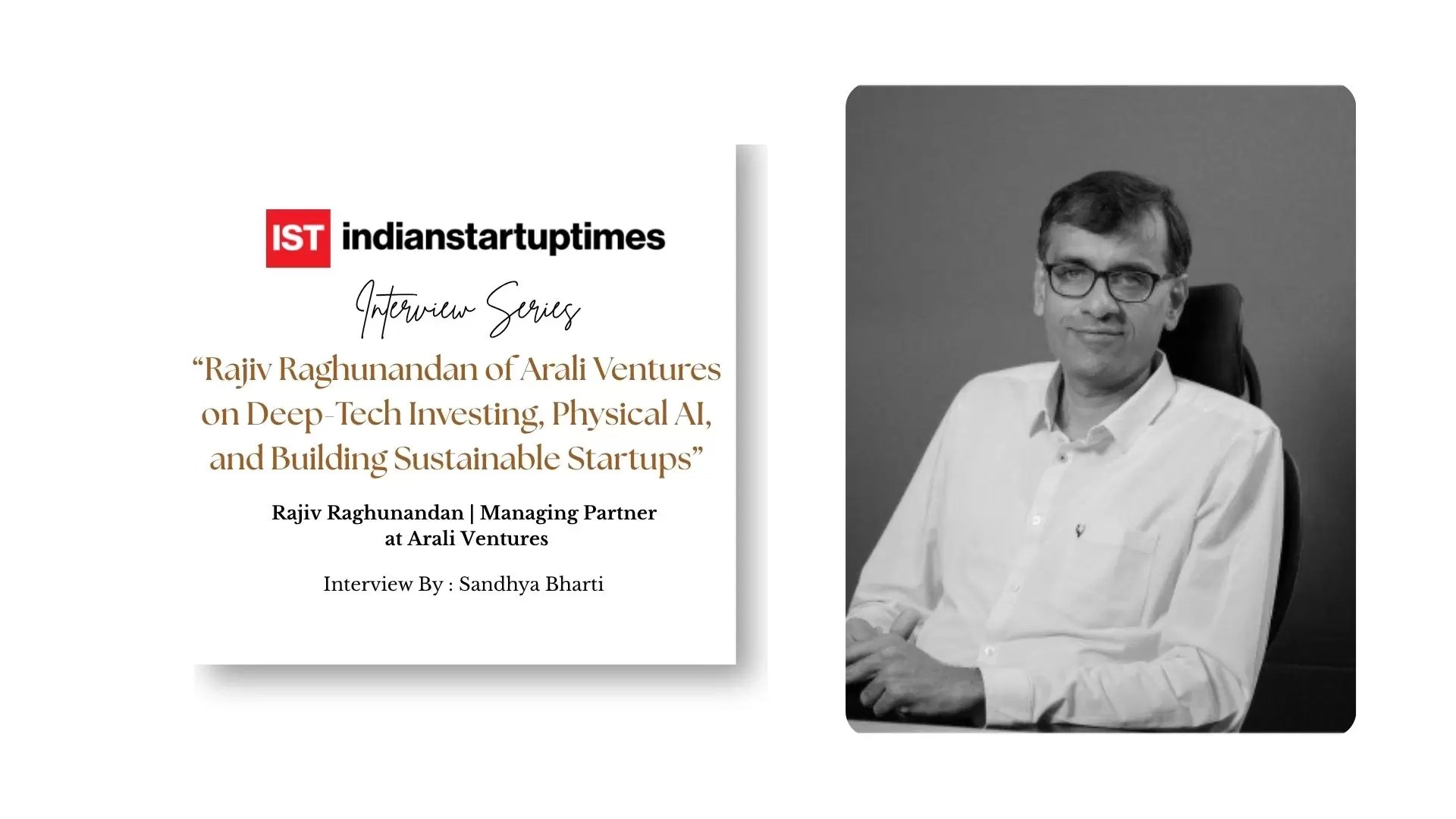
India’s startup ecosystem has evolved significantly over the past decade, with enterprise technology, deep-tech, and AI-led innovation emerging as some of the most promising areas for venture investment. Among the investors who have witnessed and contributed to this transformation is Rajiv Raghunandan, Managing Partner at Arali Ventures.
With over two decades of experience spanning finance, consulting, enterprise technology, operations, and venture investing, Rajiv brings a unique perspective to identifying and nurturing high-potential startups. In this conversation with Indian Startup Times, he shares insights on the evolution of India’s deep-tech ecosystem, the rise of physical AI and industrial automation, investment trends, founder qualities that drive success, and the future of enterprise innovation.
From Enterprise Leadership to Venture Capital
Rajiv’s professional journey began in finance before moving into consulting and later spending more than a decade at Infosys, where he worked across sales, operations, solutions, and business leadership roles. His experience selling and building solutions for Fortune 2000 companies provided him with a deep understanding of enterprise technology adoption and business transformation.
After a stint in a fintech startup, he co-founded a boutique advisory and investment banking firm focused on startups before launching Arali Ventures. According to Rajiv, this diverse background has significantly shaped his investment philosophy.
Having spent years understanding enterprise buying behavior, technology adoption cycles, and talent development, he believes venture investing is ultimately about enabling founders to unlock value and scale businesses. He also highlights that decades of experience across multiple business cycles have helped him develop a healthy balance of optimism and skepticism, both essential qualities for successful investing.
The Evolution of India’s Deep-Tech and Enterprise-Tech Ecosystem
Reflecting on the ecosystem’s growth, Rajiv notes that enterprise technology and deep-tech startups received limited investor attention when he began working with founders around 2015.
At the time, most venture capital flowed toward consumer internet, e-commerce, and aggregation platforms. Today, however, the landscape has transformed dramatically.
He attributes this shift to three key factors:
Maturing Talent Pool
India now benefits from a rich talent ecosystem emerging from global technology companies such as Google, Microsoft, Amazon, Adobe, and Cisco, alongside successful Indian product companies like Freshworks, Zoho, InMobi, and Flipkart.
These professionals have gained hands-on experience building products, scaling organizations, and solving complex business challenges before becoming entrepreneurs themselves.
Increased Capital Availability
The availability of venture capital across stages has expanded considerably, encouraging more founders to build technology-first businesses and pursue ambitious opportunities.
Enterprise Willingness to Innovate
Perhaps the most significant change has been the growing openness of Indian enterprises to adopt external innovation.
Organizations across sectors such as manufacturing, financial services, healthcare, and energy are now actively collaborating with startups through pilots, partnerships, and technology deployments. Enterprises have become far more receptive to investing in innovative solutions than they were a decade ago.
Emerging Opportunities Capturing Investor Interest
While Arali Ventures remains disciplined in focusing on its core sectors, Rajiv identifies several areas that are generating significant excitement.
HealthTech
One of the most promising sectors, according to Rajiv, is HealthTech.
He believes the quality of entrepreneurs entering medical technology, biotechnology, and life sciences has improved significantly over the past few years. As entrepreneurial activity accelerates in these domains, Arali expects to increase its investments in healthcare innovation.
Industrial Tech and Physical AI
Rajiv is particularly enthusiastic about industrial technology and what he describes as the “physical AI” opportunity.
The convergence of AI, robotics, sensors, computer vision, and affordable hardware is enabling startups to solve long-standing industrial problems in entirely new ways.
Areas such as manufacturing automation, logistics, quality control, construction technology, and agricultural robotics are becoming increasingly attractive due to their ability to generate measurable business value.
Why Physical AI and Robotics Are Becoming Major Investment Themes
Long before robotics became fashionable among investors, Arali Ventures backed companies operating in this space.
The firm invested in companies such asCynLr, Jidoka, Unbox Robotics, Harvested Robotics and Flo Mobility.
Rajiv believes several factors are driving the rapid growth of industrial robotics:
- Shortages of skilled labor across industries.
- Increasing demand for predictable productivity and operational efficiency.
- Growing enterprise interest in digitization and automation.
- Falling costs of sensors, cameras, and hardware components.
- Rapid improvements in AI models that significantly reduce development timelines.
While global investor attention has recently focused on humanoids and general-purpose robotics, Rajiv believes vertical robotics, robots designed for specific industrial applications, will create substantial value, particularly in the Indian market.
Finding Opportunity in Under-Invested Sectors
Rajiv observes that venture investing often moves through cycles, creating opportunities in overlooked sectors.
He believes broader industrial technology remains under-invested despite its enormous long-term potential.
Many traditional industries still face inefficiencies that can be solved through AI, automation, and advanced hardware solutions. However, because these industries are often perceived as less glamorous than consumer technology, they tend to attract less attention from both founders and investors.
For Arali, this creates an opportunity to identify high-potential businesses before broader market interest emerges.
Capital Efficiency Remains Non-Negotiable
One of Rajiv’s strongest beliefs is that startups should be built with capital discipline regardless of market conditions.
According to him, there should never be two versions of a business model, one for abundant capital environments and another for challenging markets.
As a B2B-focused investor, he prioritizes businesses with fundamentally sound economics and clear pathways to cash-flow generation.
Many Arali-backed founders have extensive industry experience, often ranging from ten to twenty years. This operational maturity naturally encourages prudent decision-making, financial discipline, and sustainable growth strategies.
Common Mistakes Founders Make During Fundraising
Rajiv identifies several recurring challenges among founders raising early-stage capital.
Overemphasizing Technology Instead of the Problem
Founders sometimes become so focused on their technology that they fail to clearly articulate the business problem they are solving. While such companies may still attract funding, they risk building products without strong market demand.
Being Too Attached to the Original Vision
Startups must remain adaptable. Markets evolve, customer needs change, and new opportunities emerge. Founders who refuse to adjust their approach can limit their chances of success.
Telling Investors What They Want to Hear
Rajiv cautions against exaggerating market size, growth potential, or scaling plans simply to appeal to investors.
Such behavior often creates misalignment between founders and investors, leading to challenges later in the company’s journey.
What Successful Founders Have in Common
After investing across numerous startups, Rajiv highlights four qualities consistently present among exceptional founders:
Deep Domain Understanding
The best founders possess an intimate understanding of the industries they serve and are genuinely passionate about solving meaningful problems.
Ambition and Vision
They aspire to create significant impact and build category-defining companies.
Flexibility
Successful entrepreneurs continuously learn, adapt, and evolve their products based on market feedback.
Relentless Execution
They maintain momentum, move quickly, make decisions, and consistently push their businesses forward.
AI Will Shape the Next Generation of Startup Success
Rajiv believes the future will not be defined by a choice between AI and industrial innovation. Instead, the most valuable companies will combine both.
For enterprise startups, AI-first thinking is rapidly becoming the default. However, he stresses that technology alone is not enough.
The startups that create lasting value will be those that use AI to solve meaningful business problems and deliver measurable outcomes for customers.
Whether serving traditional industries or emerging sectors, the focus must remain on business value creation rather than technology for its own sake.
Advice for First-Time Technology Founders
Concluding the conversation, Rajiv offers a simple but powerful piece of advice.
Founders should focus deeply on understanding their industry, developing genuine passion for the problems they are solving, and building solutions that create real value.
Technology trends, regulations, and market conditions will continue to evolve. However, founders who possess deep domain expertise and a strong commitment to solving meaningful problems will always be best positioned to navigate change and build enduring businesses.
Conclusion
As India’s startup ecosystem enters a new phase of maturity, investors are increasingly looking beyond consumer applications toward deep-tech, enterprise software, industrial automation, robotics, and AI-powered infrastructure solutions. Rajiv Raghunandan’s perspective reflects this shift.
Through Arali Ventures, he continues to back founders tackling complex business challenges with scalable technology solutions. His emphasis on capital efficiency, deep domain expertise, adaptability, and long-term value creation offers a compelling blueprint for entrepreneurs building the next generation of technology-driven companies in India and beyond.
-Interview Conducted by Sandhya Bharti