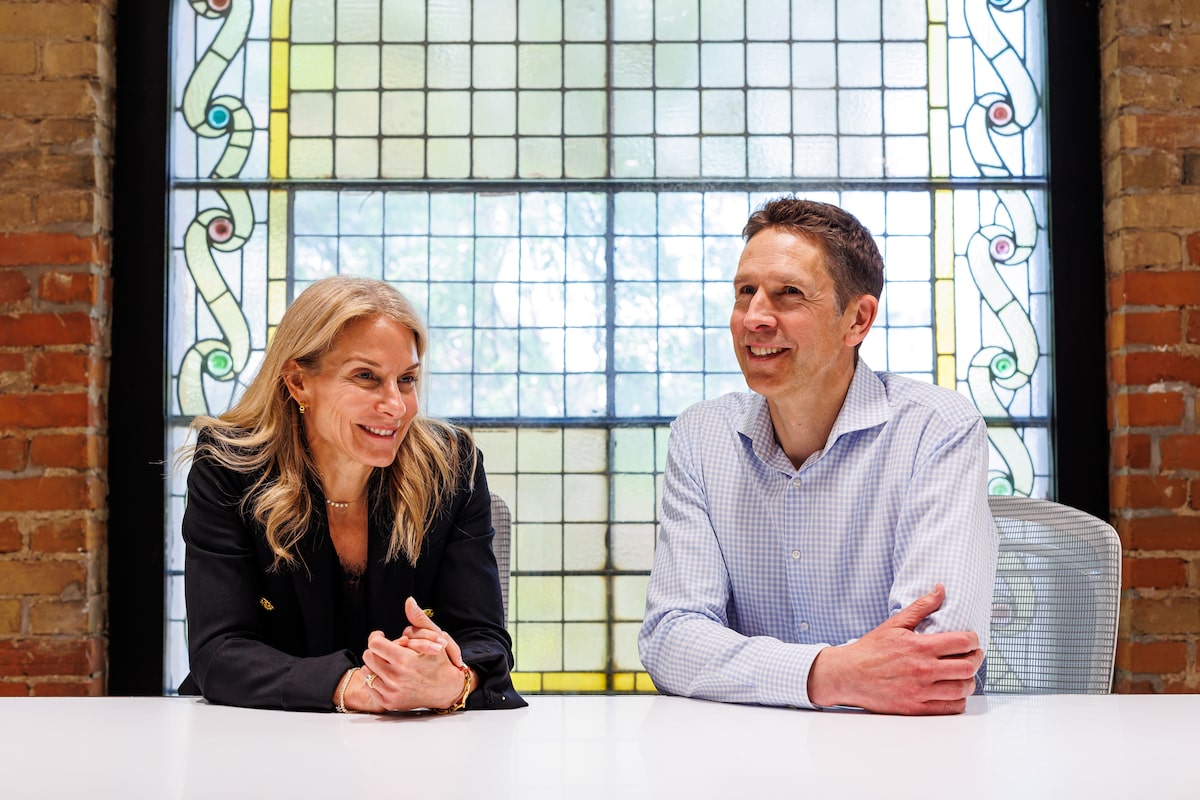
Signal 1 AI co-founders Mara Lederman, left, and Tomi Poutanen in the company’s office in Toronto, on June 17.Keito Newman/The Globe and Mail
Tomi Poutanen and Mara Lederman left high-profile jobs in 2022 to create artificial intelligence tools that would help hospitals save lives, improve health outcomes and reduce costs.
Their startup, Signal 1 AI Inc., developed four applications. One helped predict which hospital patients were at the highest risk and needed immediate intervention. Another helped speed up patient discharges from care. Several Canadian hospitals signed up.
But prospective clients kept saying the same thing: AI applications for health care were proliferating.
Signal 1 was competing in a busy market that included electronic medical records giants, vibe-coding startups and hospitals building tools themselves.
What the hospitals said they really needed was an application to oversee and monitor all those AI programs. There wasn’t anything like that tailored to their needs.
Doctors look to AI to cut burdensome administrative work
Fortunately, Toronto-based Signal 1 already had such a tool, which it used to support its own suite of applications. The hospitals were interested.
“My advice to them,” recalled Robbie Freeman, chief digital transformation officer with New York City’s Mount Sinai Health System, “was that this space was wide open and becoming increasingly important.”
So, in 2025, Signal 1 went all in on commercializing its AI management system (AIMS), emulating seminal pivots by Shopify and Slack to focus on selling infrastructure tools they had developed to support their original businesses.
The shift has paid off. On Monday, Mount Sinai, which has seven hospitals and three schools in the Big Apple, announced it is adopting Signal 1’s AIMS platform. It joined Inova Health System, a hospital group that serves the Washington, D.C., area, plus another large, unidentified East Coast U.S. academic medical centre, which became a customer in 2025. In Canada, Nova Scotia Health and Trillium Health Partners use the platform.
“More and more, we’re going to see organizations realize that to deploy AI at scale and do it safely, you need a monitoring platform to make sure you’re getting the results that you intend,” said Dr. Sam Sabbah, chief of staff at Trillium, which encompasses three Mississauga hospitals. “They’ve been a godsend. Without a partner like Signal 1, we would not have the ability to deploy at scale.”
Ms. Lederman says ‘there’s so much excitement for what we’re doing’ because of the highly complex nature of how the company’s AI interacts with data systems, makes phone calls, drafts notes and sends orders to pharmacies.Keito Newman/The Globe and Mail
AIMS uses its own AI agents to help customers assess what AI tools to add to their systems, then builds the structure for governing, overseeing and optimizing their use. “We have to be deliberate” with spending, said Nova Scotia Health chief information officer Scott McKenna. “Their platform helps us decide which AI products will be the best investments.”
The platform automatically monitors the AI applications running through a health-care system, including predictive tools, diagnostic imaging products and generative AI agents, like a digital nanny to ensure they do what they’re supposed to, and reports back to the customer.
“If we don’t measure how the AI tools are working, we won’t know if they’re adding value,” said Mr. Freeman. Plus, “the surface area for harm can be large with AI agents that have access to millions of patients. Having the right monitoring, governance and tools like this helps ensure we have a handle on that type of behaviour,” and reduces risk.
For example, AIMS can track AI-generated draft emails by doctors to patients to ensure they conform to hospital standards. It flags when AI models “drift,” or produce less accurate results, which requires them to be retrained.
“The idea that you’re running 200 agents dipping in and out of your data systems and making phone calls, drafting notes and sending orders to the pharmacy is a whole different level of complexity,” Ms. Lederman said. “That’s why there’s so much excitement for what we’re doing.”
Mr. Poutanen’s experience as chief AI officer at TD helped build trust among bank leaders and regulators to support the development of dozens of AI tools.Keito Newman/The Globe and Mail
While Canadian hospitals typically use fewer than 20 AI tools (Trillium has 13), the number is much higher in the U.S. Mount Sinai has 120; someday, the number used by leading hospitals could top 1,000, Mr. Poutanen said.
Signal 1 didn’t develop the AIMS platform by chance. The founders had deep industry insights: Ms. Lederman was a business professor at the University of Toronto’s Rotman School of Management and held a leadership role with the Creative Destruction Lab. She took a leave of absence, later resigning and giving up tenure to focus on Signal 1 (she remains an adjunct professor).
Mr. Poutanen, meanwhile, is one of Canada’s leading AI entrepreneurs. He studied computer engineering at U of T under future Nobel laureate Geoff Hinton, and in 2017 co-authored Canada’s first AI policy and co-founded Toronto’s Vector Institute, a non-profit dedicated to AI research.
A year later, Toronto Dominion Bank bought his startup Layer 6 AI and made him chief AI officer. He helped build trust among bank leaders and regulators to support the development of dozens of AI tools, including for high-risk applications such as credit underwriting.
“We built a lot of capability around monitoring and ensuring the AI algorithm was running properly and not introducing bias,” Mr. Poutanen said. “The health-care market had no comparable solution. We built that from day one” at Signal 1. “A lot of these things were borrowed from my experience at TD.”
Why Canada’s largest pediatric hospital is betting on artificial intelligence
Signal 1 raised US$10-million in seed capital from Inovia Capital, TD, Prof. Hinton, Radical Ventures (where Mr. Poutanen serves as a partner) and others. It started by commercializing the intervention care tool, developed at Toronto’s St. Michael’s Hospital.
But its underlying platform appealed most to hospitals as they put AI to work. Trillium wanted a Canadian partner to support and monitor its various AI apps. It became Signal 1’s first platform client in December, 2024. AI was developing at such a rapid pace that Trillium didn’t want to lock in with specific apps. It did want “infrastructure to plug in solutions as they evolve,” Dr. Sabbah said.
At a Signal 1 offsite meeting in March, 2025, “the debate was, ‘Do we go all in on the platform or on applications,’” Mr. Poutanen said. “It was stressful. We were stretched thin. The market was confused about our identity.”
So far, it looks like they made the right choice. Revenue is now running at the mid-single-digit millions level annually, and “our business has been on a rocket ship ever since,” Mr. Poutanen said.