
AI regenerative medicine has become one of healthcare’s biggest ambitions. From cancer treatments tailored to a patient’s DNA to AI models that help doctors make more informed decisions, the industry has spent years moving away from one-size-fits-all care.
But when it comes to repairing connective tissue, much of the field still relies on products designed for an “average” patient.
Smartweave, a Cambridge-based biotech startup, believes that’s where the next wave of innovation lies—not in creating another implant or scaffold, but in redesigning the entire process around the biology of the individual receiving it.
It’s an ambitious vision, one that combines AI, regenerative medicine, and digital twin technology to personalize therapies before they’re ever manufactured.
Looking Beyond the Average Patient
Every person’s body heals differently.
Age, inflammation, genetics, existing medical conditions, and tissue quality all influence recovery after surgery. Yet many connective tissue repair devices are still developed to serve broad patient populations rather than accounting for those biological differences.
-
CEO Raj Malhotra (Image Credit: Smartweave)
That disconnect is what led founder and CEO Raj Malhotra to launch Smartweave.
“The biology is already there. Every patient carries the blueprint for their own repair. Smartweave was built to read it,” he says.
Instead of developing standardized regenerative therapies, Smartweave’s goal is to use AI to understand each patient’s biological profile and build treatments that are matched to it.
If successful, it would represent a significant shift in how connective tissue repair is approached across multiple specialties.
AI With a Different Job
Artificial intelligence has quickly become part of healthcare conversations, but much of the attention has focused on administrative efficiency or diagnostics.
Smartweave is applying AI somewhere less familiar: the design of regenerative therapies.
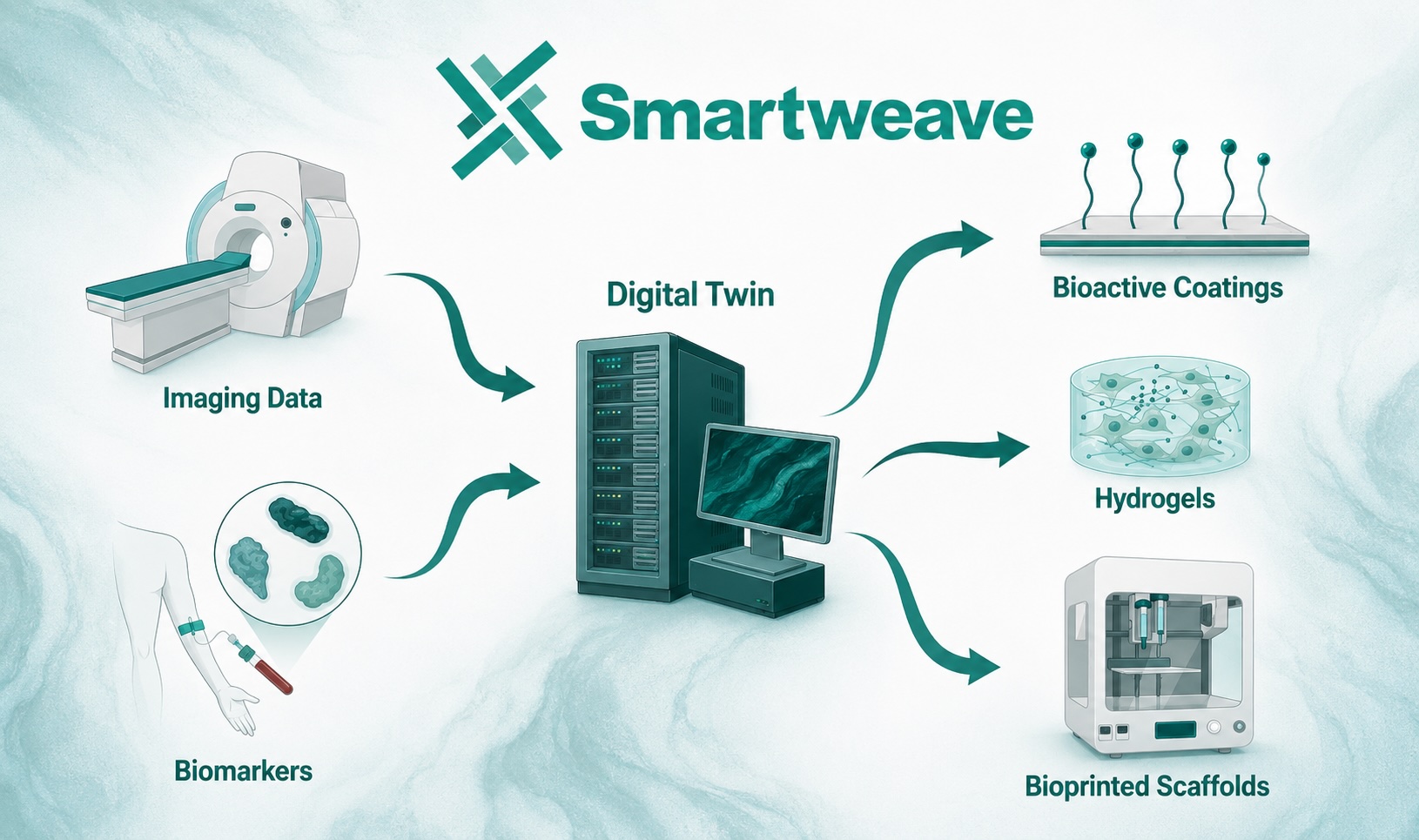
Its SMARTS™ platform—Specific Matrix Assisted Regenerative Tissugenic Scaffold—brings together three key capabilities.
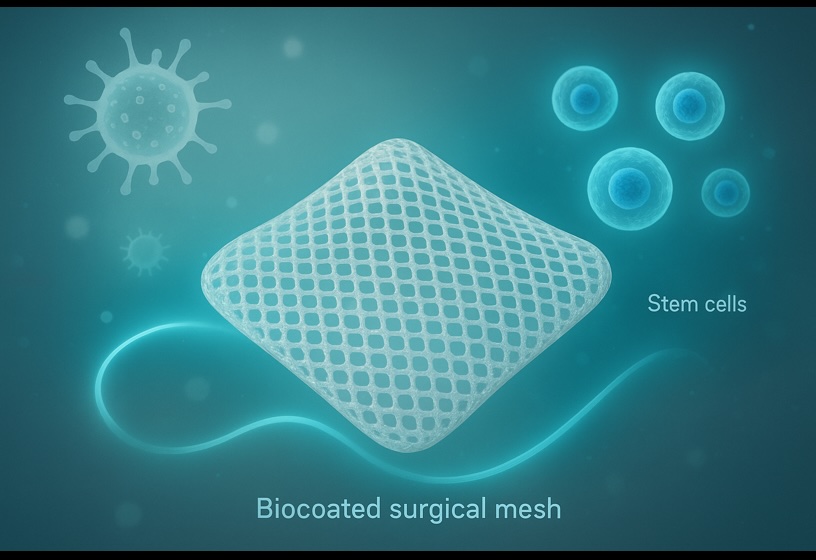
The platform first analyzes a patient’s inflammation profile before treatment decisions are made. It then recommends a personalized combination of hydrogels, biocoatings, and regenerative agents based on that biological data.
Finally, Smartweave creates a digital twin of the patient’s anatomy using Dassault Systèmes’ 3DEXPERIENCE platform, allowing researchers to simulate how a personalized scaffold could behave before any physical device is produced.
The idea is straightforward. Rather than relying on generalized assumptions about healing, the platform aims to make patient-specific biology part of the design process itself.
One Platform, Multiple Applications of AI Regenerative Medicine
Smartweave isn’t developing a single product.
Instead, the company is building a technology platform that can be adapted across several areas of regenerative medicine.
Its current pipeline includes HeraWeave™ for pelvic floor repair, OrthoWeave™ for tendon and ACL restoration, CardioWeave™ for personalized cardiac valve replacements, and DentaWeave™ for periodontal tissue restoration.
While each application targets a different clinical need, they’re built on the same underlying principle: regenerative therapies should be designed around the patient rather than asking the patient to fit the therapy.
Early Validation From Industry
Like every early-stage biotech company, Smartweave still has important milestones ahead.
Its products have not yet received FDA approval or clearance, and its current efficacy data comes from pre-clinical animal studies.
Still, the AI Regenerative Medicine company has attracted attention from several established organizations.
Smartweave was selected by Dassault Systèmes as one of only three startups worldwide to participate in its BIOVIA and 3DEXPERIENCE innovation programs from a pool of more than 1,000 ventures. It was also chosen as one of 15 startups for the EPFL-affiliated Tech4Eva accelerator, selected from more than 300 applicants globally.
Financially, the company reports securing more than $6.4 million in non-dilutive grants and institutional support. It also generated $2.75 million in revenue during 2024, representing 71% year-over-year growth, while reporting $1.6 million in IP licensing revenue over the past year.
Those numbers suggest Smartweave is pursuing a dual strategy: licensing its technology through its Smartweave Inside™ platform while simultaneously advancing its own therapeutic products toward commercialization.
A Market Ready for Change
Demand for regenerative medicine continues to grow.
According to Grand View Research, the tissue engineering market is projected to reach $43.13 billion by 2030. Separate forecasts from Toward Healthcare estimate the broader regenerative medicine market could approach $139.7 billion by 2034.
Those projections reflect increasing interest in therapies that don’t simply replace damaged tissue but encourage the body to repair itself more effectively.
For startups operating in this space, the challenge isn’t just scientific discovery. It’s translating promising research into treatments that can realistically become part of everyday clinical practice.
That is where Smartweave believes its platform can make a difference.
“We’re not waiting for regenerative medicine to arrive,” says Malhotra. “We’re building it into clinical practice right now.”
Bringing More People Into Biotech Investing
Alongside product development, Smartweave is also inviting the public to participate in its growth of AI Regenerative Medicine through a live Wefunder campaign.
Community funding has become an increasingly common path for startups looking to raise capital while building an engaged network of supporters. For healthcare companies, it also creates an opportunity for patients, clinicians, and everyday investors to back technologies they believe could shape future care.
For Smartweave, that community includes healthcare professionals, accredited investors, and individuals living with connective tissue disorders or chronic pain—people who understand firsthand the limitations of today’s treatment options.
Whether the company ultimately delivers on its long-term vision will depend on clinical validation, regulatory progress, and continued execution. Those hurdles are substantial, particularly in healthcare.
But the question Smartweave is asking feels increasingly timely.
If AI can help us understand each patient’s biology in unprecedented detail, should regenerative medicine continue to rely on solutions designed for an average patient that doesn’t really exist?
Smartweave is betting that the future of connective tissue repair with AI Regenerative Medicine begins with treating every patient as unique.
Peter Salib is a Tech Columnist at Grit Daily. Based in New Jersey, he is an avid participant of events nationwide who’s attended CES in Las Vegas consecutively since 2013. Peter is the host and producer of Show & Tell, a product showcase YouTube channel and also works at Gadget Flow, a leading product discovery platform reaching 31M consumers every month. Peter frequently works with startups on media, content writing, events, and sales. His dog, Scruffy, was a guest product model on the Today Show with Kathy Lee & Hoda in 2018 and was dubbed “Scruffy the Wonder Dog.”
Source link