“There are thousands of supplements companies out there and they care about their sales, but might not care too much about whether their customer actually needs their product,” said Marijn Lewis, scientific representative for NB1, speaking at IPC (19th International Scientific Conference on Probiotics, Prebiotics, Gut Microbiota and Health) in Kraków last week (June 22-24, 2026).
“The gut microbiome and our entire biology is unique to each individual but supplements are not personalized,” she added. “We are trying to create a personalized supplement regime that might actually work for the individual.”
Co-founded and led by Dr. Marcus Traxler, the service is delivered by an interdisciplinary team of physicians, microbiome scientists, AI specialists and nutrition experts and is set to launch commercially later this year.
Microbiome functionality first
Lewis described what made NB1 different to other personalized supplement services.
“By personalized, I don’t mean we ask people to fill out a questionnaire and we put them into one of maybe eight boxes then tell them what supplements people in that box need to take,” she told delegates.
“We start with microbiome sequencing via at home stool testing kits, we don’t care so much about the species that are present but more what they do, whether they are degrading fibers or degrading mucins, producing butyrate, or whatever they do,” she said.
“Then when it comes to probiotic selection, we look at the person’s health concerns or microbiome parameters and choose the biotics that are best evidenced for the specific health benefits we look to provide.”
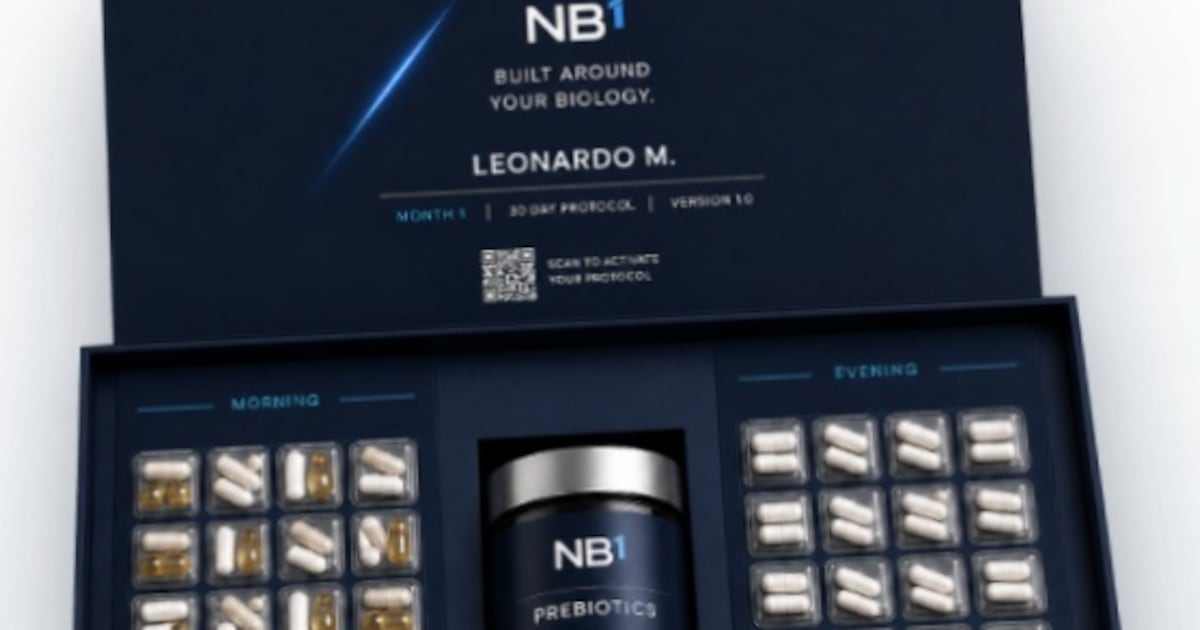
The service also provides a prebiotic powder which is tailored to the individual to ensure no gut irritation.
“Everyone sits on a spectrum of fiber sensitivity,” explained Lewis, “so someone with higher fiber sensitivity will be supplied with low FODMAP fibers.”
As well as microbiome data, the service additionally collects blood biomarkers to check for micronutrient deficiencies and uses an ‘elaborate’ questionnaire to understand the person’s diet, lifestyle, health concerns and goals.
The AI algorithm analyzes the data and cherry picks from around 150 specific nutrients with personalized dosages of each, Lewis explained.
Capsules and powders are formulated and presented for morning and evening use, taking into account the types and timings of medication use.
“When people are on medications that they take in the morning or evening it can affect the uptake of certain nutrients. All of these aspects are taken into consideration and the algorithm knows when to advise these capsules are taken,” Lewis explained.
Supporting scientific discovery
She informed the audience of scientists that NB1 would aim to support the their community through its long-term dataset.
“With ongoing data collection through tests every four months and continuous questionnaires, we will create a massive dataset and will be able to contribute to the scientific community by answering questions such as which probiotic combinations are the best tolerated, which produce the most favorable microbiome shifts, and which generate the best symptom shifts, with real-world evidence.”
Speaking to NutraIngredients about the response from delegates, Lewis said she received a lot of interest in how the company would ensure probiotic viability, leading her to realise another USP for NB1.
“Questions about moisture, light and oxygen exposure are entirely appropriate for any live-culture product,” she said.
“The key difference is that NB1 is not a conventional retail supplement,” she told NI. “It is a made-to-order, personalized protocol, produced in dedicated batches and shipped to each customer every month.
“Each daily dose is individually sealed until the moment it is consumed, rather than sitting in a bottle that is reopened and exposed to air every day,” she added. “This keeps exposure to oxygen, light and moisture to a minimum, unlike products that can spend many months on a retail shelf.”