Princeton University student Charles Muehlberger could have accepted summer internship offers from a major tech company or a rocket engineering firm.
He decided to come to San Francisco and launch an AI startup instead. Four weeks in, Muehlberger is in Barcelona pitching potential customers.
The urgency he feels to build his startup, which aims to bring open-source models offline and onto local devices, made him decide to take a gap year. “Those who are building now get a voice in what the future looks like,” he said.
For decades, the path for many elite students was clear: secure internships in tech, finance or consulting, graduate with a cushy job and climb the corporate ladder.
But more students, including Muehlberger, are turning to a host of new programs—some affiliated with top universities—geared toward helping them join the AI race in Silicon Valley. Some provide free housing, mentorship and networking opportunities. Many of the students who find themselves scaling up big ideas at a breakneck pace aren’t sure they will go back to college when the summer is over.
The rapid advance of artificial intelligence has created a tough job market for recent grads. Fields including software engineering have become far less secure, leading some students to take matters into their own hands.
Some said they are learning more in a single month within the fast-moving startup ecosystem than during an entire semester in lecture halls.
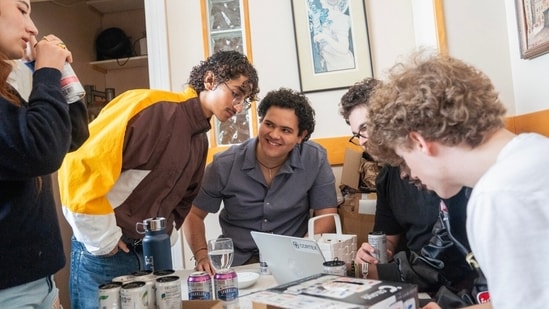
Many of these dorm-room disrupters have set up shop in newly leased properties across San Francisco this summer. The student-run Yale Hacker House, backed by alums and venture firms, nabbed a Nob Hill apartment. The 15 Yale founders live and work together in a space crowded with energy drinks, cardboard boxes from hardware purchases and sneakers by the entrance.
TekTrek, a startup incubator also in its inaugural summer, recruited mainly from the Massachusetts Institute of Technology, Harvard and Princeton. It has set up a temporary campus at the grassy Presidio. Some colleges have hosted programs themselves, such as Lehigh University’s San Francisco-based Startup Academy, which matches students directly with early-stage startups.
At the Yale Hacker House and TekTrek, young founders are spending their days in a blur of coding and networking—including meetings with investors and executives to pitch their ideas. They let loose in the evenings by exploring the city, rock climbing or playing poker.
Unlike such programs as the Thiel Fellowship, which pay students to drop out, TekTrek said it aims to be a bridge between the startup and academic worlds, encouraging students to soak up the Silicon Valley ecosystem before bringing momentum back to campus in the fall.
That is, assuming they choose to return.
Leïa Ryan just finished her sophomore year at Yale and helped create the Yale Hacker House. She walked away from a job offer at a frontier biotech company and her plans to pursue a Ph.D. in genetics and co-founded a startup building knowledge systems for biolabs. Cortex, started in March, raised $600,000 at a $10 million valuation in the spring, and has signed its first commercial contracts.
Ryan is taking a leave of absence from school, which she expects to make permanent. “When you raise money, I think it’s actually quite irresponsible to be in school,” she said, adding that by fundraising, she has made a promise to her investors. “Any serious founder will drop out.”
For students outside traditional startupland, founding a company in lieu of finishing a degree requires a cultural leap. Gauri Kshettry, a rising sophomore at Princeton who founded Strata, an AI tool to streamline industrial reports, still sees education as a necessity for intellectual growth and as a safety net. “You kind of always want to have a degree at the end of the day,” she said.
Ann Miura-Ko, a partner at the venture-capital firm Floodgate, pushes back against the trend of casually dropping out. At a dinner in the Yale Hacker House backyard in June, she encouraged students to stay in school because it is difficult to know whether an idea is the next “unicorn,” a new company with a valuation of $1 billion or more.
Lack of community is a major barrier for students interested in the startup world, said Hacker House co-founder Nicolas Gertler. He just finished his junior year and is building an AI company that provides legal services for land use. Gertler believes if the house didn’t exist, the founders would rarely see each other because of their grueling schedules. “People are having co-founder struggles, equity disputes” and need a support system, he said. “We’re the first call.”
Before her senior year at Harvard, Alice Jacob was sitting in the kitchen at home applying for jobs with a big spreadsheet. She said her father, an immigrant from India, walked into the room and questioned why she was spending her energy filling out corporate applications when she and her co-founder already had a promising business idea building a marketing platform connecting college students with brands.
He told her he would give anything to return to a time when he was young, free of responsibilities and able to chase a passion full time, she recalled. “It was really him who pushed me,” said Jacob, who is spending the summer at TekTrek.
Write to Tina Li at [email protected]