
From cutting-edge research to pilot-scale manufacturing, Cellark Powertech is building next-generation battery materials with higher energy density, faster charging, and longer battery life to accelerate India’s transition towards clean, sustainable, and self-reliant electric mobility
(OdishaPlus Business)
As India accelerates its transition to electric mobility, the demand for batteries that can store more energy, charge faster, and deliver longer-lasting performance is growing rapidly. Building domestic capabilities in advanced battery materials is crucial to reduce import dependence and strengthen the country’s sustainable mobility ecosystem.
Addressing this growing need is Bhubaneswar-based startup ‘Cellark Powertech Private Limited’, an IIT Bhubaneswar spin-off working on advanced materials for lithium-ion batteries. Founded in 2017, the startup is developing advanced battery materials, including silicon-carbon (Si-C) anode powder and alumina powder. The Si-C anode material is focused on improving lithium-ion battery performance by addressing limitations related to energy storage and stability.
One of the major challenges in battery technology is improving energy storage capacity while maintaining battery life and performance. Silicon is considered a promising material because it can store more energy compared to graphite, which is commonly used in batteries. However, silicon expands and contracts during charging and discharging, affecting battery durability. Cellark is working on a silicon-carbon composite material designed to address this limitation by providing better stability and performance.
The startup was founded by Ashwani Pandey and Soobhankar Pati, who have backgrounds in Material Science and Engineering, with M.Tech and PhD qualifications in the field. Their research focus on advanced materials and energy storage technologies led to the development of Cellark as a venture aimed at addressing challenges in lithium-ion battery materials.
“Cellark started its journey as a spin-off from IIT Bhubaneswar with the aim of developing advanced anode materials for lithium-ion batteries. We wanted to develop materials that could address critical problems such as limited energy density and slow charging rates,” said Ashwani Pandey, founder of Cellark Powertech.
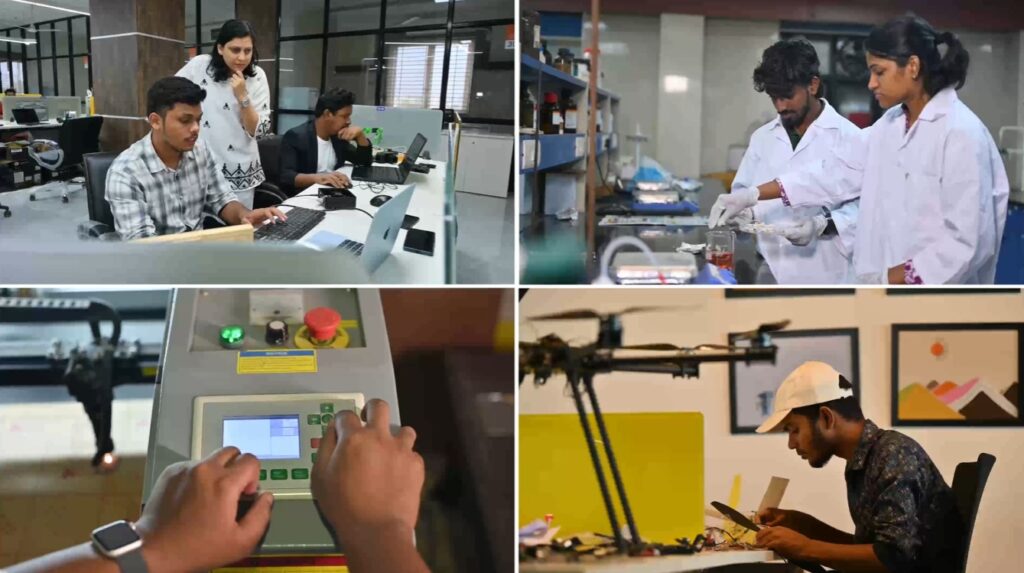
The company has moved from laboratory research to a fully operational pilot-scale facility. It has developed in-house capabilities to manufacture power cells and test its materials, and is preparing for commercial-scale production.
Pandey said support from Startup Odisha initiative through need-based assistance grants helped the company acquire equipment required for testing and validation. “With that equipment, now we have in-house capability to make power cells and test our material,” he said.
Cellark has received around ₹4.5 crore in funding and currently operates a pilot-scale production facility with a capacity of 10 tonnes per year.
The startup’s journey reflects the enabling role of Startup Odisha and the MSME Department, Government of Odisha, in fostering a vibrant innovation ecosystem. Through policy support, mentorship, incubation, market linkages, and access to funding opportunities, they continue to empower entrepreneurs to transform innovative ideas into scalable enterprises, driving employment, economic growth, and technological advancement in the State.
Source link