It started in the middle of class, or during a break between lectures, in my first year of engineering.
“Which programming language should I learn?”
“What’s the right career path for me?”
“I’ve learned this skill. What should I do next?”
“Should I jump into AI?”
Programming was not new to me. I was already freelancing as a frontend developer, so my classmates slowly began treating me like an unofficial career counsellor.
At first, I thought I was simply helping friends. But after answering the same questions week after week, I began noticing a pattern. Every time I guided someone, I was instinctively looking at three things: their skills, their academic background and their behaviour, including how they learned and what genuinely excited them.
That realisation built up slowly after I had personally guided a few hundred students, one at a time.
I began to notice something specific. No two students learned in exactly the same way. Their pace, motivations and learning patterns were different. Generic advice could only take them so far.
Then I started asking myself an uncomfortable question: why was I spending hours guiding one person at a time when I could never reach everyone that way?
I could not scale myself as a person.
So I decided to try building a software version of myself.
THE IDEA BEHIND ZOBIQUE
These were my friends, so the third factor, behaviour, came naturally. I already understood them to some extent.
But it made me wonder: what if a machine could understand these things too?
That question became the seed of Zobique.
I built the first version as a simple system that studied a student’s resume alongside their behavioural profile. I wanted it to answer three questions that almost every student eventually asks:
Where am I today?
What should I do next?
How do I get there?
It was nothing fancy. The first version was a straightforward chatbot that took in a student’s resume and ran them through a short behavioural assessment.
It got things wrong plenty of times. Suggestions were mismatched and some roadmaps were far too generic. But every mistake was useful.
Students told us exactly what confused them, and we rebuilt the logic around that feedback.
I was not trying to build a startup. I was trying to solve a problem that kept appearing in front of me.
Soon, I started telling friends to try the tool first and come to me only if they were still unconvinced.
It worked more often than I expected.
FROM A FRIEND’S PROBLEM TO A STARTUP
That gave me the confidence to take the idea beyond my friend circle.
I started showing Zobique to faculty members, mentors and industry professionals. Their feedback became a turning point. Career and placement guidance, they told me, was still largely manual and rarely personalised.
Around this time, the Manav Rachna Innovation and Incubation Foundation backed us with a pre-seed grant to complete our MVP.
That was when Mohit Kholiya and Vansh Attri came on board, and we went into overnight mode to build out our vision.
Nights went into writing code, talking to students and rebuilding features that had failed the first, second or third time.
Money was tight. Deadlines rarely matched our exam schedules. But what kept us going was watching a student walk away with real clarity instead of more confusion.
BEING A STUDENT AND A FOUNDER
The toughest part was not a failed demo or a funding gap. It was the everyday grind of being a student and a founder at the same time.
Attendance would fall short. Academic pressure would pile up. Some days, there was no clear path forward, just a rollercoaster of small wins and setbacks.
There was almost a moment every week when giving up felt like the easier option.
Professors would remind us that they had seen other students try entrepreneurship before, only to return later asking for placement help. Friends and family were not very different. Most of them kept asking why we were wasting time instead of preparing for placements.
I have come to accept that this emotional rollercoaster is simply part of being an entrepreneur. The uncertainty never fully goes away. You just learn to keep moving even when the next step is not clear.
THE BIGGEST LESSON WAS NOT TECHNICAL
The biggest lesson I learned was not technical.
Startups are not built by writing more code. They are built by understanding people better.
After speaking to hundreds of students about their careers, what surprised me most was how similar their fears were and how different their ways of dealing with those fears could be.
Almost everyone worried about picking the wrong path, wasting time or falling behind their peers.
But the way each person needed to work through that fear was completely individual.
That is exactly where personalisation had to come in. No single piece of advice, however good, could work in the same way for everyone.
One story that stays with me involves a junior who came up to me one day and said, “Bhaiya, I have been trying to learn React.js for a month now, but I still don’t know if I am on the right track.”
I gave him access to Zobique.
Over the next two months, he followed a personalised roadmap built for him, complete with the right courses in the right order.
A few months later, he came back and simply said, “Bhaiya, this worked.”
That one line meant more to me than any metric on a dashboard.
FROM CHATBOT TO AI CAREER PLATFORM
As AI matured, so did our ambition.
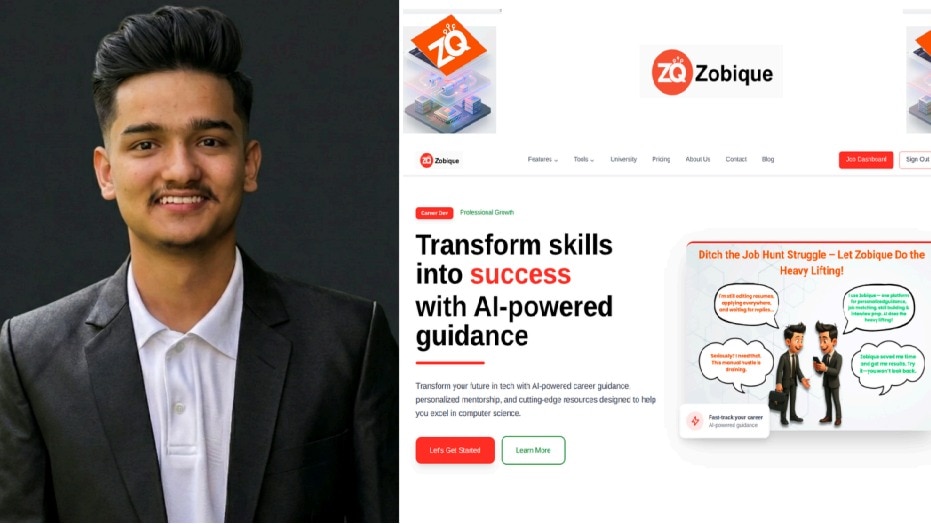
Zobique grew from a static advice tool into an AI career intelligence platform that reads a student’s profile, identifies skill gaps, builds a personalised roadmap and points them towards real opportunities.
One of my proudest moments was seeing Zobique integrate with the Government of India’s National Career Service portal.
Watching an idea that began with a few friends become part of a national effort to widen career access for millions of students was something I will always remember.
Even today, whenever a student finds a little more clarity or confidence because of something we built, I am taken right back to those first-year conversations between classes.
Zobique did not begin with artificial intelligence.
It began with curiosity and with listening to the same questions being asked over and over again.
If I could go back and speak to my first-year self, I would tell him not to worry about having everything figured out.
Stay curious. Keep learning. Keep building.
And never stop asking questions. Sometimes, the smallest questions lead to the biggest ideas.
If I could leave aspiring student entrepreneurs with one message, it would be this: stop hunting for the next billion-dollar idea.
Pay attention to the problems people keep bringing to you.
Your biggest opportunity is often hiding inside the questions your friends will not stop asking.
– Ends