
New York City has always been an interesting place, to say the least. And the New York City subway? The pinnacle of “interesting people” and things, shall we say, that you may not see on just any other street corner.
Earlier this month, some New Yorkers took this a step further, combining humourous social commentary on the current AI climate and startupculture with a series of fake advertisements plastered across subway stations around the city.
In hindsight, they are, undoubtedly, quite funny. But the problem is that for many who first came across the posters, the fact that they don’t actually represent real startups at all may not have been immediately obvious.
That was the whole point.
What If Texas Was Upside Down?
Wow, great question. It’s deep, insightful and totally up for interpretation. It has all the markings of a super modern AI startup powered by a small team, table tennis tables at the office and a promise to be different to be different from everybody else.
Except, it’s not a real question at all, and it means absolutely nothing. Obviously though, right? Because, what the heck does “upsidedown Texas” mean?
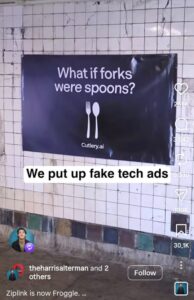
This was just one of the many fake startups and slogans that New York satirists posted in the subways earlier this month, with others popping up with similarly shocking irrelevance and meaninglessness. Like, “Are you poor? Sell your possessions. SellYourPossessions.com” or, my personal favourite, “”What if the Rizzler was purple? PurpleRizzler.AI.”
According to reports, the campaign was created by comedians looking to poke fun at the increasingly bizarre world of AI startups, where companies often promise to revolutionise things that nobody was really asking to be revolutionised in the first place.
The joke isn’t that the ideas are absurd. Rather, it’s that these silly fake startups actually aren’t that much more absurd than some of the things we’ve seen funded over the past few years.
When Satire Starts Looking Like A Pitch Deck
The satirists in question took a bet on the fact that this is exactly what would make these jokes land, and they were right. After all, if somebody told you there was an AI startup using machine learning to optimise your emotional relationship with cutlery, would you immediately dismiss it? Or would a small part of you think, “honestly, I’ve heard worse”? Perhaps that depends on your current relationship status or how long you’ve been using dating apps, but the overall sentiment holds true: that is, we’re allowing AI and technology to optimise and/or automate just about every part of our lives. Is there even a line we wouldn’t cross anymore?
That’s what we’ll call the awkward genius of the campaign. The fake startups sit in a strange middle ground where they’re clearly nonsense, but they’re aslo not. Rather, they should clearly be nonsense, but so much of our reality has become entwined with rubbish, it’s becoming difficult to distinguish between what’s real and what’s not. Indeed, these crazy ideas are just close enough to reality that they don’t feel entirely impossible, even though they probably should.
We’ve spent years hearing pitches about AI-powered toothbrushes, AI companions, AI therapists, AI recruiters, AI note-takers and AI assistants for almost every conceivable task. Somewhere along the line, many of us lost our ability to distinguish satire from a genuine product launch.
And that’s not necessarily because people have become less intelligent. It’s because startup culture has become more and more comfortable with solving problems that may or may not exist, and so have we.
From Friend To Forks: This Is Why The Jokes Are Landing
We should probably also acknowledge the timing. Just last year, New Yorkers found themselves staring at giant advertisements for AI companion startup “Friend”, a company whose marketing campaign generated almost as much confusion as curiosity. The backlash wasn’t necessarily because people hated AI; it was because many people seemed tired of being told that absolutely every aspect of life needed a technological solution.
Lonely? Get an AI friend. Need to increase productivity? No problem, there’s an AI assistant for that. Not feeling creative? This AI co-pilot will take the reigns.
The fake subway adverts seem to tap into a growing feeling that some corners of the tech world have become trapped in a loop of creating solutions first and then desperately searching for problems afterwards. Or, frantically combing through every aspect of our lives to find – and ultimatley, create – problems that we can solve for artificial intelligence.
Have We Finally Reached Peak AI?
And maybe the criticism isn’t totally fair and has been become a bit of a blanket statement, because there’s no denying that plenty of AI companies are building genuinely useful products. Businesses are using AI to automate repetitive tasks, improve healthcare outcomes, improve distribution and quality of educational processes and speed up research. There are countless examples of the technology creating real value.
But, satire tends to work best when it contains at least a grain of truth, and it’s also when it tends to sting a litt more.
Nobody would laugh at UpsideDownTexas.AI if they hadn’t spent the past three years being bombarded with startup pitches that sound suspiciously similar in their ridiculousness.
A question to raise here, though, is whether or not this is a sign of AI fatigue. Not necessarily fatigue with the technology itself, but fatigue with the relentless marketing around it.
Every week seems to bring a new company claiming to be reinventing humanity, changing civilisation or transforming the future of work, and at some point, even the most enthusiastic audiences start rolling their eyes.
If Everything Can Be An AI Startup, Should It Be?
For years, startup culture enjoyed a kind of immunity from mockery, because at the beginning, disruption was exciting., founders were visionaries and every pitch deck promised to change the world.
But when comedians start buying ad space to parody your industry, it usually means you’ve become culturally significant enough to be laughed at.
And that’s not necessarily a bad thing; in fact, in some ways, it may be a healthy part of the process. Indeed, the tech industry has always benefited from people asking difficult questions. Sometimes those questions come from investors, sometimes they come from regulators, and occasionally, they come from a subway poster asking whether forks should be spoons.
Because buried beneath the joke is a surprisingly serious question that most people hav eprobably already been pondering, if even subconsciously, for quite some time. That is, just even if everything could be turned into an AI startup, should it be?