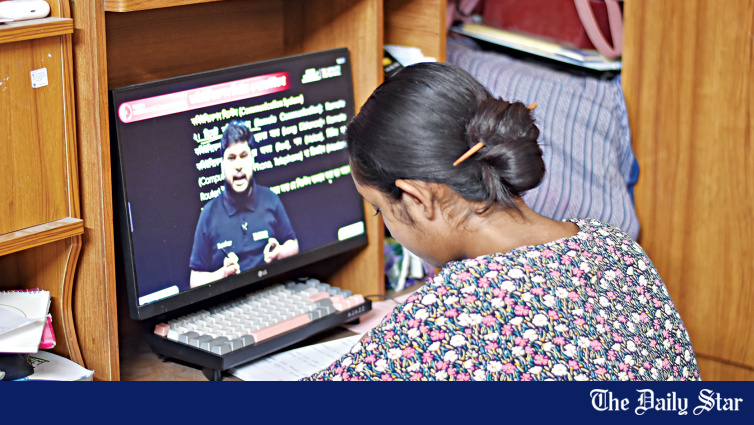
High out-of-pocket spending remains a major burden for families in Bangladesh’s education sector. When students do not learn enough in classrooms, many parents feel compelled to pay for private tutors and guidebooks, adding to the cost of education.
A 2024 report by Education Watch, a civil society platform of researchers, found that guidebook use rose sharply between 2022 and 2023.
By 2023, more than nine in 10 primary and secondary students used commercially available guidebooks, up from around eight in 10 a year earlier. Seven in 10 primary students and more than three-quarters of secondary students also received private tutoring.
Online education platforms are gradually offering another option.
Faria Zaman, an HSC graduate of New Government Degree College in Rajshahi preparing for university admission tests, has spent Tk 3,550 on an online package covering different science subjects through platforms including ACS and Physics Hunter. She is also taking an online admission preparation course rather than finding and paying separate teachers for six subjects.
“These online courses cost less and allow me to study from home in a more organised way,” she said.
Israt Jahan Maliha, a user of 10 Minute School, also turned to online learning after finding conventional coaching inconvenient. Travelling to classes took time away from studying, and she did not always understand the lessons. Scheduled online classes help her organise her studies, while recorded lessons allow her to catch up.
Her mother, Sahanaz Akter, said online learning costs less and saves travel time. Her youngest daughter began using 10 Minute School in Class VIII, performed well in this year’s SSC examination and started taking Class XI courses before being admitted to college.
Their experiences reflect the opportunity for education technology, or EdTech, to make learning more accessible while building a business around demand for affordable educational support.
FROM DEMAND TO INVESTMENT
The spread of 3G internet, which commercially launched in Bangladesh in 2013 and had largely penetrated the country by 2015, helped YouTube reach a wider audience and supported the growth of EdTech.
Other drivers include a young population, increased parental spending on education, geographical disparities in access to learning and a shortage of quality teachers outside urban centres.
These factors were highlighted in “Market-map: The State of EdTech in Bangladesh”, a paper by Ayrin Ria published by Future Startup in March 2023.
The paper estimated the offline coaching market at Tk 25,000 crore, reflecting demand for supplementary support amid classroom shortcomings and examination competition.
The Covid-19 pandemic accelerated the sector’s growth. School closures forced students to learn online in 2020, and user adoption and capital investment rose significantly between 2020 and 2022, helping startups such as 10 Minute School and Shikho gain momentum.
But attracting students does not necessarily translate into a sustainable business.
Sajid Amit, an associate professor at the University of Liberal Arts Bangladesh and director of its Center for Enterprise and Society, estimates that disclosed investments in Bangladesh’s EdTech startup sector total around $16 million to $18 million.
Much of the known funding is concentrated among a small number of companies, while reliable sector-wide figures on paying users and revenues remain difficult to obtain, he said.
10 Minute School says it has raised more than $6.5 million, while Shikho says it has raised over $8 million.
“The question today is not whether Bangladeshis will learn digitally. They clearly will,” Sajid said. “The real question is what they will consistently pay for.”
When classrooms reopened, some pandemic-era demand disappeared. Paid platforms also faced competition from schools, private tutors, coaching centres and free online content. Artificial intelligence has introduced another alternative, allowing students to obtain explanations and answers without buying a course.
“I think we sometimes confuse reach, engagement and willingness to pay,” Sajid said. “Millions of users should not automatically be confused with a commercially sustainable business.”
Nurul Hai, managing director and chief executive officer of Startup Bangladesh Limited, identified a similar challenge.
“Getting users is not always the hardest part. Converting them into paying users is much harder,” he said.
Paying customers, retention, repeat purchases, revenue growth, customer acquisition costs, margins and learning outcomes provide a clearer picture of an EdTech company’s prospects than registered-user numbers alone, he added.
THREE MODELS, ONE CHALLENGE
10 Minute School, Shikho and Chorcha are pursuing different approaches to attracting paying customers.
10 Minute School combines online education with physical centres. The company said it surpassed Tk 50 crore in annual revenue last year, with more than 50,000 paying students. Its revenue is now split roughly evenly between its hybrid English-learning business and fully online academic business.
The online operation continues to record low-double-digit year-on-year growth, said Abdullah Abyad Raied, its co-founder and chief technology officer.
Upskilling courses once accounted for around 40 percent of the company’s revenue but now contribute less than 5 percent and operate largely “on autopilot”, Raied said. He sees room for hybrid learning because online delivery can save time and reduce costs, while face-to-face learning can help improve outcomes.
Shikho, which started in 2019, saw downloads surge during the pandemic before much of that growth faded after educational institutions reopened, said its chief operating officer, Ishmam Chowdhury.
The company says more than four million learners from all 64 districts have registered on its platform, with more than 600,000 using it every month. Around 68 percent are from outside major cities. Its revenue increased more than eightfold between 2022 and 2025, Ishmam said.
“Good content and social media can bring millions of students to an app. Convincing a family to invest in a full year of learning is a question of trust, and trust in education comes from results,” he said.
Shikho said 75 percent of its paid learners who sat for the SSC examination in 2025 achieved GPA 5, while nearly 6,000 of its students achieved GPA 5 in 2026. The figures are based on the company’s own learner records. It also tracks study regularity, lesson and test completion, progress across individual concepts and examination results.
Chorcha has built its model around practice rather than primarily offering lectures.
“People don’t pay for content, because content is now everywhere for free. People pay for experience and results,” said its founder, Sanzid Raihan.
The idea came from his experience preparing for university admission in 2021. Despite having teachers, coaching and guidebooks, he struggled to find an easy way to practise and assess what he had learned.
Chorcha reports more than 2.5 million users and around 500,000 monthly active users. Around 100,000 students take tests on the platform daily, spending an average of 35 minutes there, according to Sanzid. Tests, competitions, leaderboards and its mascot, Cheero, encourage regular practice.
The company reported Tk 2.5 crore in revenue last year and currently generates around Tk 30 lakh a month. More than 100,000 students bought premium subscriptions last year, Sanzid said. The business is bootstrapped apart from a Tk 10 lakh grant under the ICT Division’s iDEA Project.
Sanzid said the sector’s early mistake was assuming that putting classroom lectures online would be enough. Technology alone did not reproduce the enjoyment and social experience of learning with others.
AI AND THE ACCESS GAP
Artificial intelligence is creating new opportunities and challenges. Faria said she had received incorrect answers from AI tools, while Maliha said they sometimes provided wrong information or omitted topics. Neither viewed AI as a replacement for structured learning.
Shikho has introduced Smart Class, which adds an AI layer to lessons, and Shikho AI, a Bangla AI tutor grounded in the national curriculum, Ishmam said.
“The first wave was about putting lessons online. The next wave is about understanding each learner,” he said.
Data generated when students answer questions, practise and seek help can help identify learning gaps and determine what they should study next, he added.
Professor Shamim Al Mamun of Jahangirnagar University’s Institute of Information Technology said much of the sector still relies on video lectures, live classes, multiple-choice questions and quizzes.
He called for greater use of technology to analyse student performance, identify learning difficulties and adapt teaching. He also urged more research into how Bangladeshi students learn and closer collaboration between EdTech companies and educational institutions.
Associate Professor Sajid cautioned against treating AI-generated answers as a substitute for learning.
“The problem is that having an answer is not the same as knowing how to think,” he said, warning that students who delegate difficult intellectual tasks to AI risk missing opportunities to develop independent thinking.
Access remains another barrier.
Goutam Roy, a lecturer in STEM Education at Charles Sturt University in Australia, said online education can help reduce rural-urban learning gaps, lower costs and provide supplementary opportunities for middle- and low-income families. Students can also learn at their own pace.
However, unequal access to reliable, high-speed internet remains a major challenge.
Many students lack laptops or desktop computers, which are often necessary for effective study, while unreliable electricity is another concern in rural areas. Prolonged screen time can reduce physical activity, and online learning may limit face-to-face interaction and socialisation, Roy said.
Looking ahead, 10 Minute School’s Raied sees hybrid learning as a major opportunity over the next three to five years.
Associate Professor Sajid identifies potential in exam and admission preparation, English and employability skills, hybrid education, institutional and employer services, and AI-enabled learning.
Startup Bangladesh Limited’s Nurul expects academic support and exam preparation to remain important alongside personalised AI learning, job-linked skills and institutional software.
For EdTech businesses, the challenge is to attract users who will pay, continue using their platforms and achieve learning outcomes, while generating enough revenue to cover the cost of acquiring and serving them.
Sajid described the sector’s current phase as “consolidation with selective growth”.
“I would not describe EdTech as dying,” he said. “It is growing up.”