On India’s 80th Independence Day, the country’s AI ambitions are entering a new phase, with startups moving beyond the race for foundation models to build the infrastructure, data and applications needed for a more self-reliant AI ecosystem
This month’s cohort of five AI startups to watch includes startups across physical-world data, cinematic AI, enterprise productivity, deeptech healthcare and education, each tackling a different bottleneck in taking AI from experimentation to real-world deployment
As AI funding surges in India, these five startups offer a glimpse of what the next layer of the country’s AI stack could look like, combining India-specific use cases with ambitions to build globally competitive businesses
India’s AI story has grown beyond building an Indian equivalent of ChatGPT. The current phase is about building the infrastructure, data and applications that can make AI work for India and give Indian companies an edge in markets beyond the country.
The government is already doing its bit. The IndiaAI Mission, with an outlay of roughly ₹10,300 Cr, is backing around 20 indigenous sovereign AI model proposals, spanning 12 large and eight small language models. It is also building a public dataset platform and offering subsidised access to GPUs for startups, tackling two of the biggest constraints facing India’s AI ambitions: data and compute.
But the more interesting signs are emerging outside the government programme. A new generation of AI founders is moving beyond the race to build yet another general-purpose model and tackling problems that require deeper domain expertise. Some are building the data infrastructure needed to teach machines how the physical world works. Others are developing sovereign inference platforms, AI systems that can operate across India’s many languages, and tools tailored to the quirks of Indian enterprises and consumers.
This shift matters because India’s AI advantage may not come from building the biggest model, but from building systems around AI that are difficult to replicate — proprietary datasets, local-language capabilities, domain-specific intelligence, and applications designed around problems that Western AI companies have historically overlooked.
The opportunity is already drawing capital. According to Inc42’s Indian Tech Startup Funding Report, H1 2026, Indian AI startups raised $676 Mn in the first six months of 2026, nearly four times the amount raised during the same period last year.
The funding boom, however, is only one part of the story. The more telling signal is where founders are choosing to deploy that capital.
As India marks its 80th Independence Day, we are back with yet another edition of Inc42’s AI Startups To Watch. This edition of the AI Startups To Watch offers a glimpse into what India’s next AI layer could look like — from the data needed to train machines on the physical world and AI-powered cinematic content to enterprise productivity, deeptech healthcare and education.
These are not simply startups using AI as a feature. They are attempting to build businesses around some of the hardest problems that emerge when AI moves from the laboratory into the real world.
With that thought, here are the five emerging ventures that made it to the eleventh edition of Inc42’s AI Startups To Watch.
Editor’s Note: This is not a ranking. The startups featured here are a curated selection by the Inc42 editorial team and are listed alphabetically.
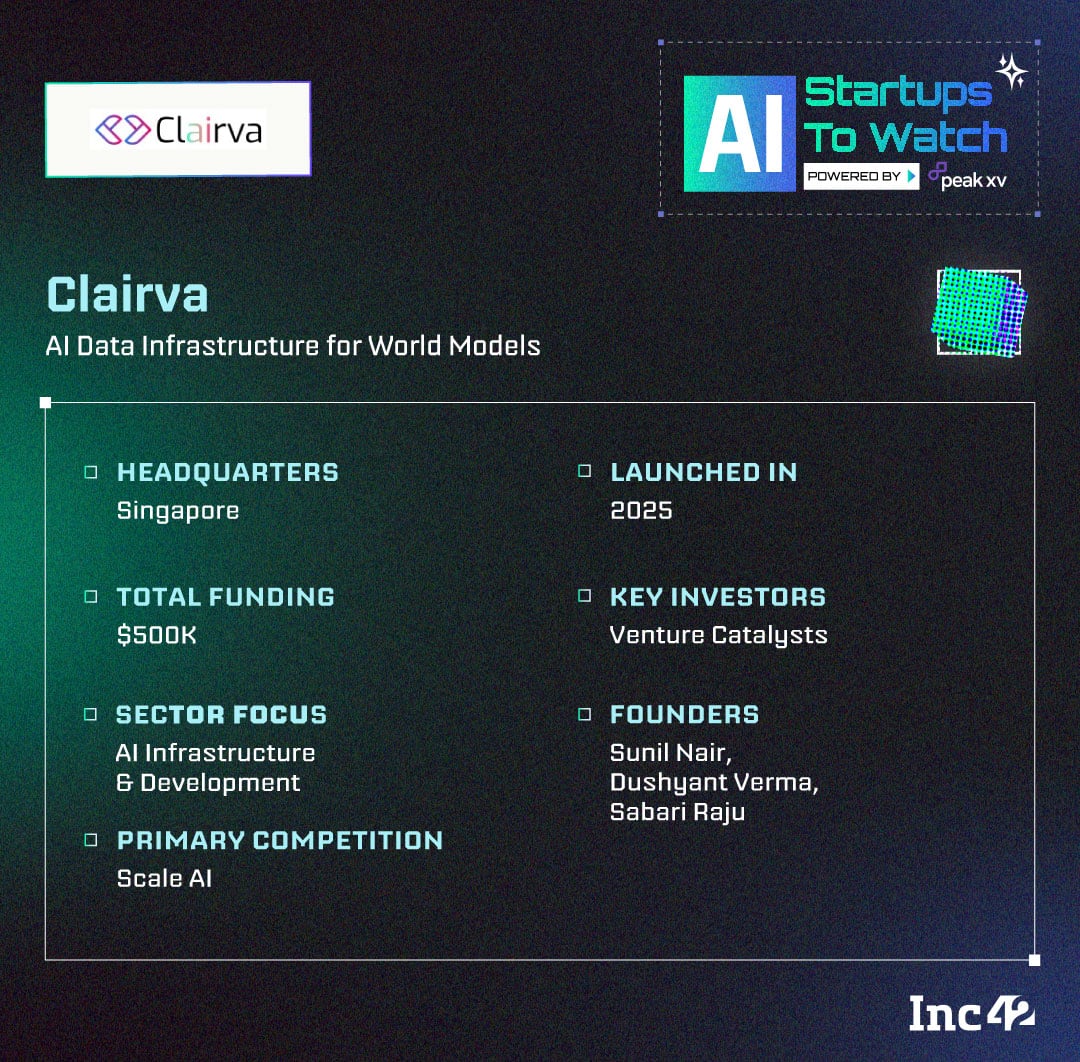
Clairva | Contextual Intelligence For World Models
As AI moves from understanding language to operating in the physical world, the training data behind these systems is changing. A robot learning to navigate a kitchen or a world model trying to understand human movement cannot learn everything it needs from text and internet images.
Clairva converts real-world video into structured behavioural signals that models can use for training, fine-tuning and evaluation. Founded in 2025 by Sunil Nair, Dushyant Verma and Sabari Raju, the startup sits at the intersection of AI training data, multimodal AI and embodied AI.
Its pipeline structures elements such as movement, object interaction, task sequence, gesture, speech and cultural context, combined with consent, licensing, provenance and usage-right information. The output is a model-ready dataset whose origin, permissions and structure are known.
Clairva is deliberately building deep supply in markets where AI training data remains thin: India, Southeast Asia and the wider Global South. It follows a B2B model, licensing datasets to AI labs, robotics companies and multimodal developers, and recently raised $500,000 in pre-seed funding led by Venture Catalysts.
The startup is targeting a combination of markets. Among them, the AI training dataset market is projected to reach $16.3 Bn by 2033, while the embodied AI market is forecast to hit $23.06 Bn by 2030.
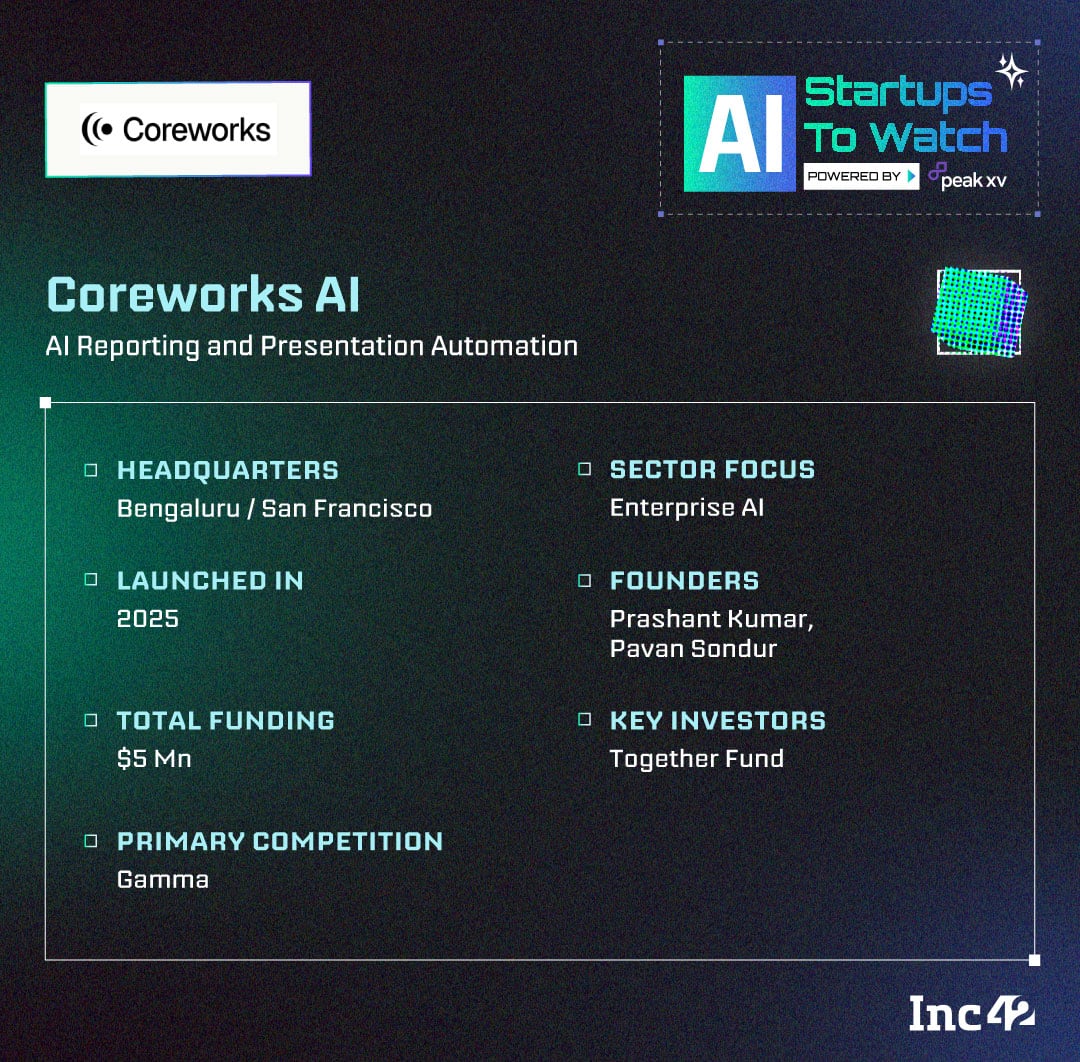
Coreworks | Offering AI-Powered Business Intelligence
Founders, marketers and analysts often spend days assembling presentations, only to have a number questioned in a meeting without being able to trace where it came from. Coreworks is building a platform that connects directly to a company’s data and generates a finished report or presentation, with every figure traceable to its source.
Founded in 2025 by Prashant Kumar and Pavan Sondur, the platform reads data semantically, surfaces the metrics and trends that matter, and produces an editable deck in minutes rather than days. Each metric links to the exact formula, cell, or row behind it, so updating the source automatically updates the output. Users can upload their own brand deck so the output matches their design language.
The startup is targeting the report and presentation automation space, targeting India’s augmented analytics market, which is estimated to reach $2.89 Bn by 2035, growing at a CAGR of 17.6%. It is positioning itself as an alternative to the manual process of assembling and verifying board-ready decks from raw spreadsheets.
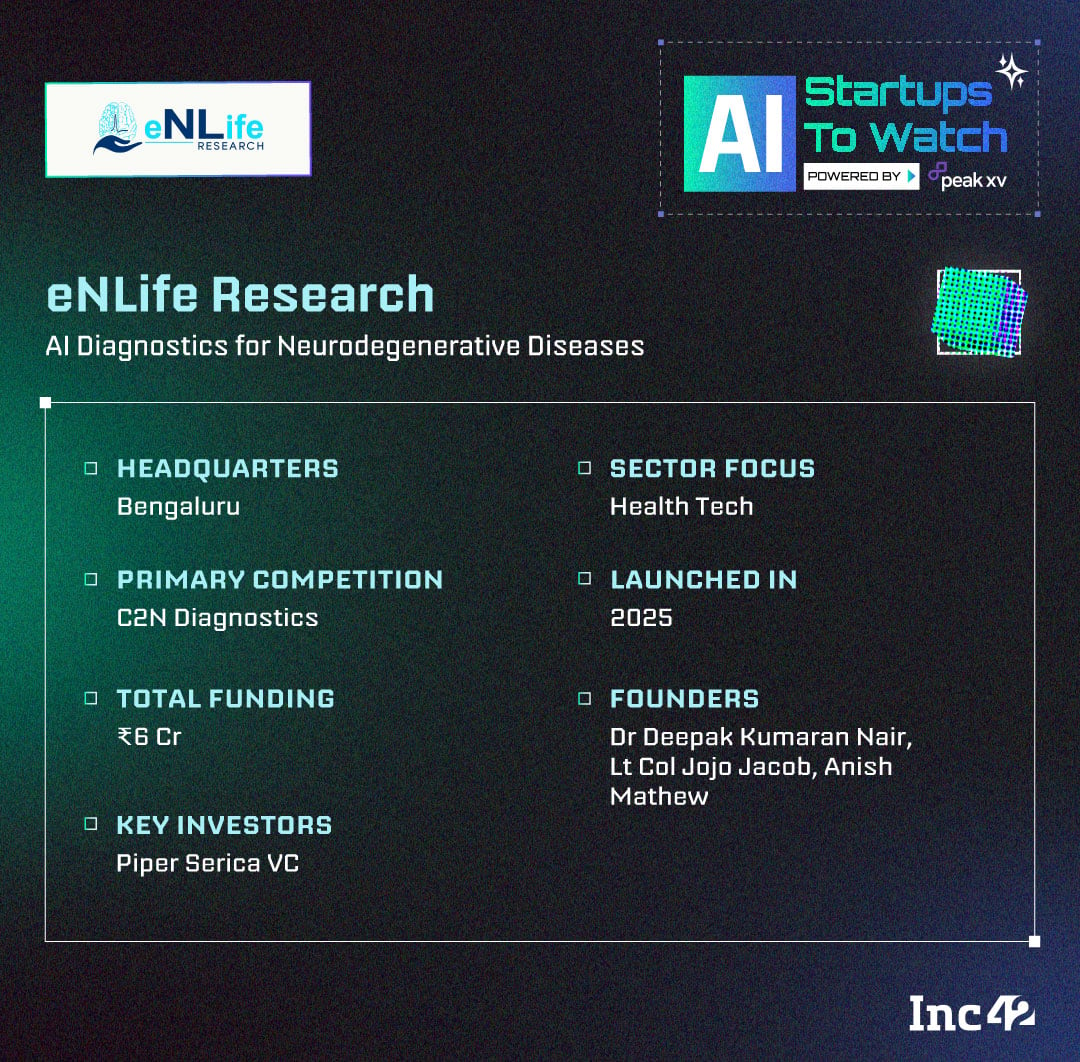
eNLife Research | AI-Powered Early Detection For Neurodegenerative Diseases
Neurodegenerative diseases such as Alzheimer’s are often detected only after symptoms appear, when treatment options have narrowed. India-based eNLife Research is combining biomarker research with AI-powered analytics to build an end-to-end pipeline from detection to personalised intervention.
Founded in 2025 by Deepak Kumaran Nair, Jojo Jacob and Anish Mathew, the research organisation works across biomarker discovery, early detection systems, nanoscale precision therapeutics and personalised treatment protocols based on individual genetic and biomarker profiles.
Its technology platform combines multiple biomarker modalities with AI analytics for early detection and risk assessment, targeting 95% accuracy and a 24-hour turnaround for results.
eNLife’s diagnostics are built on blood-based and neuroimaging biomarkers alongside large population studies, going beyond conventional scans to enable early detection. It is working towards accessible, affordable diagnostics that can be deployed in routine healthcare years before symptoms appear.
The platform says it has more than 28 publications, over 1,700 study participants, six active studies and 15-plus collaborations. eNLife Research is capitalising on the growing push for early diagnosis in neurology, focusing on India’s Alzheimer’s disease diagnostics market, which is projected to reach $600.2 Mn by 2033.
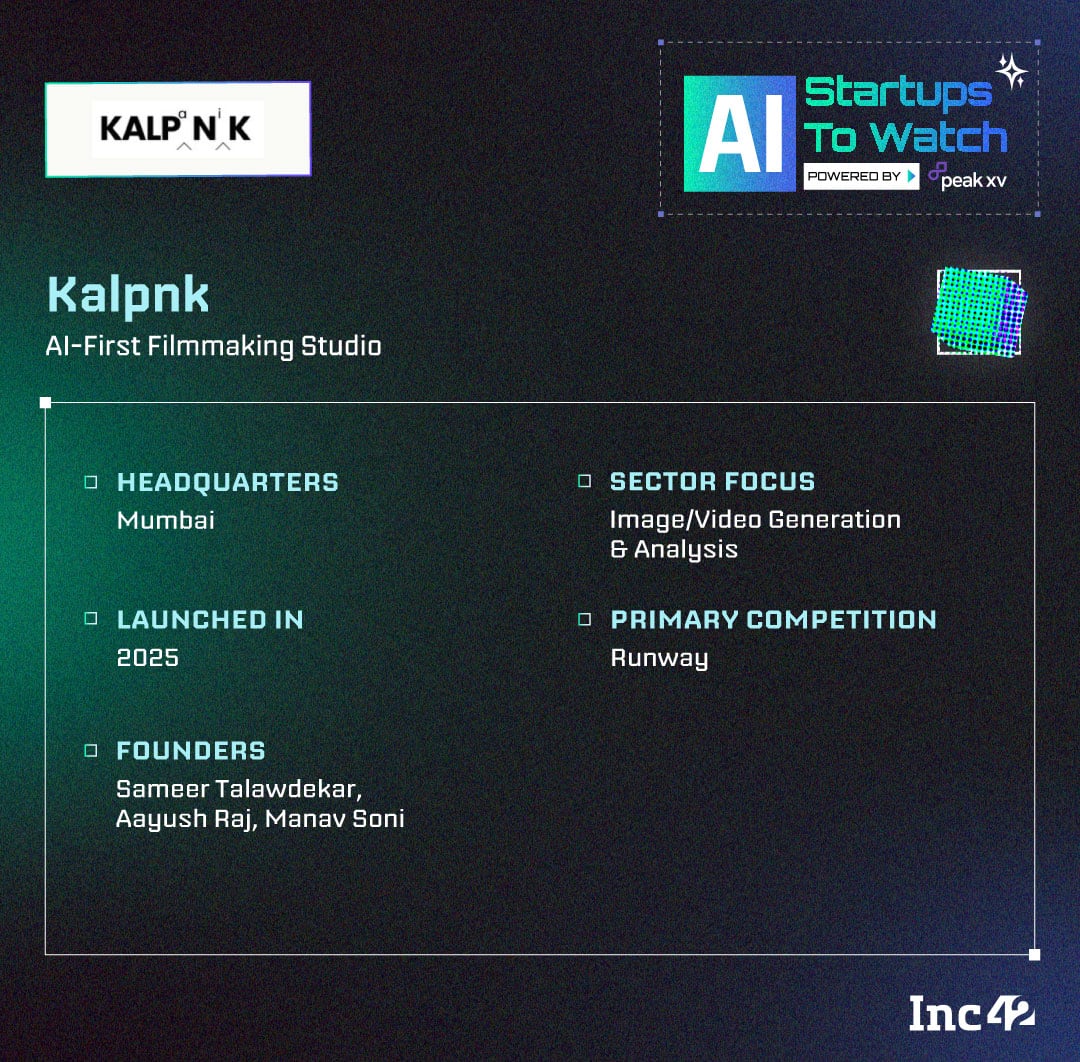
Kalpnk | An AI-First Filmmaking Studio
Filmmaking has long been a slow and expensive process, with commercials taking weeks to produce and costs that put premium content out of reach for many brands and storytellers. Kalpnk is a studio using AI workflows to create cinematic content, from brand visuals and commercials to short-form reels and AI films.
Founded in 2025 by Sameer Talawdekar, Aayush Raj and Manav Soni, the studio is led by filmmakers and writers, with AI enhancing their vision across ideation, moodboards, images, animation, editing, sound and music. It produces high-impact 10- 15-second brand reels, premium commercials and pitch decks and storyboards for studios.
Kalpnk says it delivers a finished commercial in about five days on average, cutting production time by around 85% and cost by roughly 70%. The studio operates on a cloud-based, global-commission model, targeting brands and storytellers seeking faster, more flexible production.
It operates in the AI-generated video market that is becoming an increasingly attractive option for brands in India. The market is projected to grow from about $31.8 Mn in 2025 to $142 Mn by 2033.
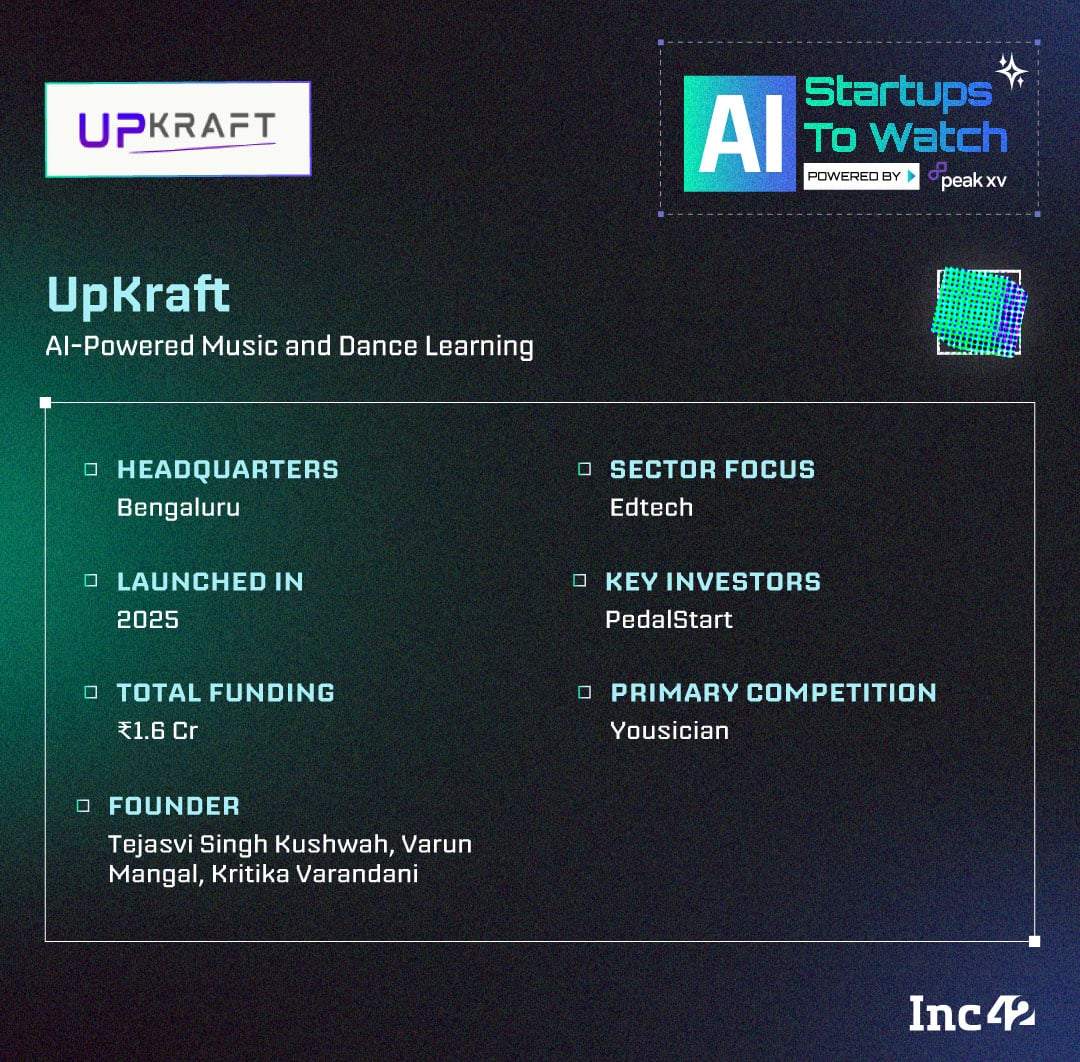
UpKraft | AI-Powered Extracurricular Learning
Music, dance and other extracurricular skills are often taught inconsistently at home or in communities, with little structure or visible progress. UpKraft is building structured extracurricular learning at home, in housing societies and in schools, led by expert tutors and powered by AI.
Founded in 2025 by Tejasvi Singh Kushwah, Varun Mangal and Kritika Varandani, the platform covers guitar, piano, drums, violin, vocals, dance and fitness, with certified and vetted instructors, level-based learning paths and clear progress tracking. Its AI Practice Studio provides real-time feedback to help learners fix practice gaps.
For tutors, UpKraft offers an all-in-one toolkit covering student enrolment, a 2,000+ song library, payments, scheduling and automated parent updates. For schools and academies, it provides admin tools, an AI practice companion and global resources, supporting classroom, hybrid or remote teaching.
The startup is targeting the structured extracurricular learning and edtech space, serving learners, tutors, academies and schools while expanding into certification-aligned music education. UpKraft is targeting the after-school and extracurricular program market, which was valued at about 34.46 Bn in 2026 and is projected to reach $62.38 Bn by 2033.
With inputs from Venu Rathore
Edited by Akshit Pushkarna
Creatives by Abhyam Gusai
Source link