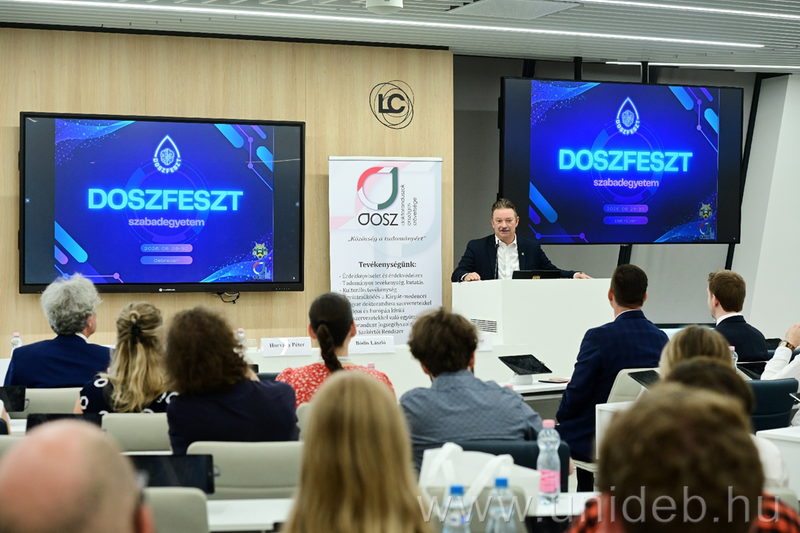
The National Innovation Agency (NIÜ) is launching a new programme for doctoral students. Details of the Hungarian Startup University (HSUP) Doctorate project were presented at the DOSZFeszt event in Debrecen on Saturday.
At a press conference following the event, Péter Horváth, State Secretary for Science and Innovation at the Ministry of Science and Technology, presented Hungary’s science and innovation strategy in detail at DOSZFeszt. He said innovation training would be strengthened both in higher education and doctoral programmes, while education in this field would also begin in secondary schools from the 2026–2027 academic year, involving around 10,000 students.
He also announced that funding for the National Research, Development and Innovation Fund (NKFI Fund) would be doubled over the next three years, potentially reaching HUF 225 billion.
Horváth described one of the country’s biggest weaknesses as the difficulty of turning research results into startups and, subsequently, businesses capable of growth. He said the government therefore plans to simplify company formation and support innovative Hungarian businesses in entering the market.
Horváth Péter highlighted that
the European Union funding available through the GINOP Plus programme over the next two years will be used to provide high-level support for Hungarian innovation, while the infrastructure of the research network and universities will receive tens of billions of forints in funding.
He added that, in connection with Hungary’s “reintegration” into the European Union, a science and technology office will be opened in Brussels to strengthen Hungary’s participation.
Regarding the Debrecen event, he said an important goal was to teach young people about innovation and encourage them to become entrepreneurs. By involving doctoral students in the startup programme, Hungary has begun an innovation training initiative designed to help them become innovators and subsequently launch successful businesses, the state secretary said.
László Bódis, CEO of the NIÜ, pointed out that more than 20,000 people have participated in the HSUP programme so far, which will now be extended to doctoral students.
Students enrolled in doctoral programmes can apply to the programme with their research ideas until September 15. The first phase, called Learning and Discovery, will run until October.
The project launch phase will take place between November and January, followed by project development through June. In July, doctoral students will have the opportunity to present their project ideas to a professional jury, investors, industry experts and potential partners, the CEO explained. He added that participating students will receive both a scholarship and project funding.
Zoltán Bács, rector of the University of Debrecen (DE), which hosted DOSZFeszt, said innovation was not a “silver bullet” but a daily necessity that could also help businesses enter the market.
Péter Vámosi, president of the National Association of Doctoral Students, welcomed the fact that the NIÜ and the supporting Ministry of Science and Technology had chosen DOSZFeszt to present the HSUP Doctorate programme. He also noted that participants were among the first to learn about Hungary’s science and innovation strategy. At the same time, he drew attention to the fact that the monthly allowance for PhD students, currently HUF 140,000, has not been increased for eight years.
In response, State Secretary Péter Horváth told MTI that the issue falls under the competence of the education ministry, but said his ministry supports an increase in the allowance.