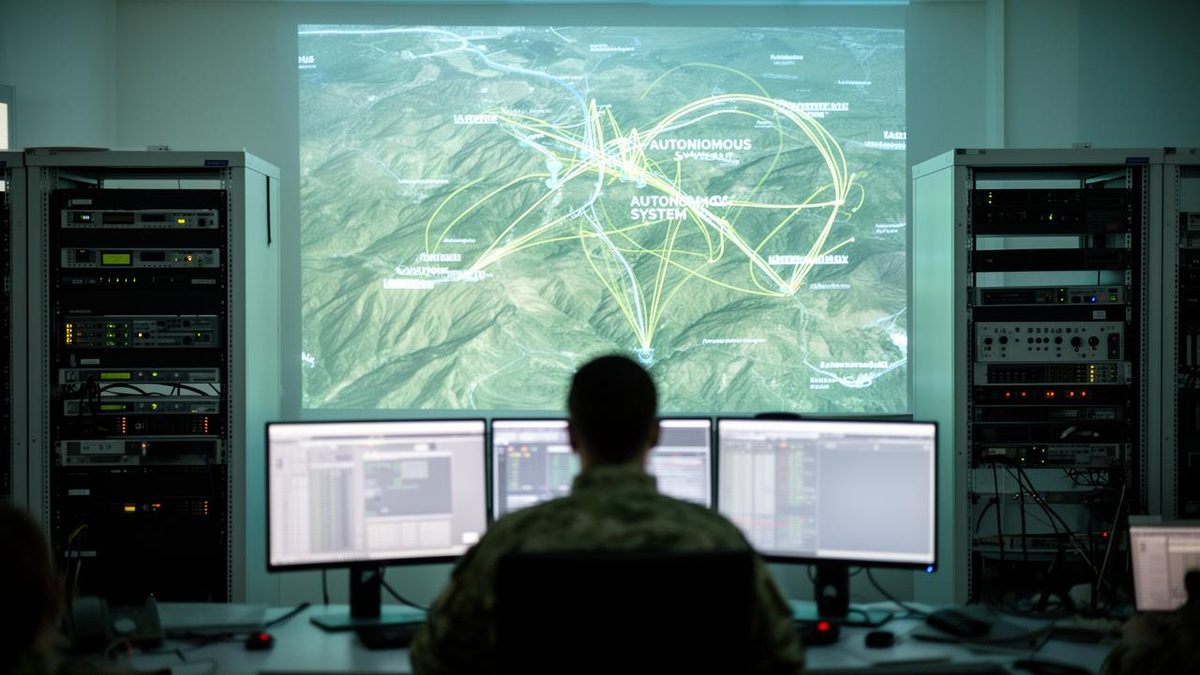
A defense technology startup whose systems have logged more than half a million hours alongside Israeli forces is stepping into the open, armed with $41 million in fresh capital and a pitch that redefines how allied nations acquire robotic combat power.
Aitan, which emerged from stealth on Wednesday, is billing itself as the first company to offer what it calls “Robotic Sovereignty-as-a-Service” — a model that gives governments the infrastructure to field, sustain, and continuously evolve unmanned weapon systems without building everything from scratch.
The funding round was co-led by Deep33 and Dell Technologies Capital, with participation from Gokul Rajaram, a board member at Coinbase and Pinterest, along with Benjamin Ling of Bling Capital and Kevin Weil of Scribble Ventures. The latest injection brings Aitan’s total equity raised to $54 million.
What sets the company apart, its founders argue, is not just software but scar tissue. Aitan’s edge-AI robotic weapon systems have been in operational use by the Israel Defense Forces and Israeli national security agencies since 2023, accumulating over 500,000 combat hours across the full spectrum of robotic missions — from command and control to swarming and autonomous navigation.
“Warfare has totally transformed over the past few years,” co-founder Daniel Almog said in an interview. “In robotics, the adversary is constantly adapting. The radio-frequency environment is adapting, countermeasures changing. Even the batteries are decaying.”
That reality, he said, is why robotic systems cannot simply be stockpiled years in advance like traditional munitions. They evolve during the conflict itself, reshaped week by week by shifting battlefield demands and disrupted supply chains. Militaries need the ability to produce them at massive scale, operate them in contested environments, and coordinate them as a unified force rather than a collection of individual machines.
Aitan’s technology is built specifically for those conditions. The company recently secured a joint contract to develop the command-and-control platform for the IDF’s next-generation attack drone fleet, along with critical design contracts for key robotic weapon systems. It has also landed contracts abroad for similar command-and-control networks and robotic weapons designs.
“A lot of countries look for battle-tested systems,” co-founder Udi Oster said. There is, he added, widespread “skepticism of systems that haven’t actually been used in battle.”
The company’s origins are deeply personal. Oster and Almog first met while serving as officers in Unit 8200, the IDF’s elite intelligence and cyber unit. After leaving the military in 2014, they founded Tapingo, an online food-ordering platform that was acquired by Grubhub for $150 million in 2018.
The events following October 7, 2023, changed their trajectory. A longtime friend and former colleague, Or Levy, was kidnapped from the Nova music festival, where his wife was murdered. Then, in September 2024, Oster’s younger brother Eitan — a captain in the Egoz commando unit — was killed during Israel’s ground operation in Lebanon. The company is named in his honor, and also draws on the Hebrew word “eitan,” meaning resilience.
“With the outbreak of the Swords of Iron War, it was clear to us that the only goal before us was to help our friends and family win and return safely from captivity and the battlefield,” Oster said. “Three years later, with our technology already having a broad operational impact in the field, it is the right time to expand our reach and bring these capabilities to Israel’s allies around the world.”
Aitan was built on technology originally developed by eyesAtop, a veteran Israeli startup founded more than a decade ago by Yinon Atzmon, Idan Yitzhak, Ben Barkay, and Einav Harazi. Oster and Almog acquired the technology in 2025, recognizing the surge in demand for drone capabilities following the war. The company now employs roughly 50 people at its offices in Ramat Gan, with additional operations in New Jersey.
Many of those employees are reservists and veterans of Israel’s defense establishment, a fact that gives Aitan an unusual feedback loop. The proximity to day-to-day military operations means the system is continuously refined based on lessons from the field — an advantage that investors say is difficult to replicate.
“Israel is one of the only places in the world with the combat experience and flight hours to develop robotic weapon systems at scale,” said Lior Prosor, a partner at Deep33. “This gives Aitan a difficult-to-replicate advantage and a significant opportunity to bring that capability to allied nations.”
Yair Snir, managing director at Dell Technologies Capital, framed the investment as a bet on the broader shift toward physical AI. “We believe Physical AI will be one of the most important technology shifts of the coming decade,” he said. “But first, we need to solve the challenge of coordinating highly complex autonomous systems in challenging real-world environments.”
Snir added that Aitan’s team recognized early that the future of defense belongs to intelligent networks of disparate systems operating together — a vision he said has been validated by the company’s proven deployment in real defense environments.
The company’s expansion plans are already taking shape. Aitan is growing its team in the United States and actively eyeing European and Asian markets, where demand for sovereign robotic capabilities is rising rapidly.
The wars in Israel and Ukraine have exposed the operational and logistical gaps that Aitan aims to fill. Unlike conventional weapons, which can be manufactured and stored for years, robotic systems must be produced in large volumes, adapted to evolving countermeasures, and integrated into coordinated force structures — all while supply chains are under strain.
Aitan’s answer is a platform that allows militaries to deploy robotic forces at scale, sustain them through disrupted logistics, and evolve sovereign AI capabilities at the pace of combat itself. It is a proposition that positions the company at the intersection of two accelerating trends: the militarization of artificial intelligence and the growing insistence by nations that critical defense capabilities remain under their own control.
For Oster and Almog, the mission is not abstract. It is measured in the friends and family members they have lost, and in the conviction that robotic forces can execute dangerous missions while keeping warfighters out of harm’s way. That conviction, forged in the crucible of modern ground combat, is now being offered to the world.