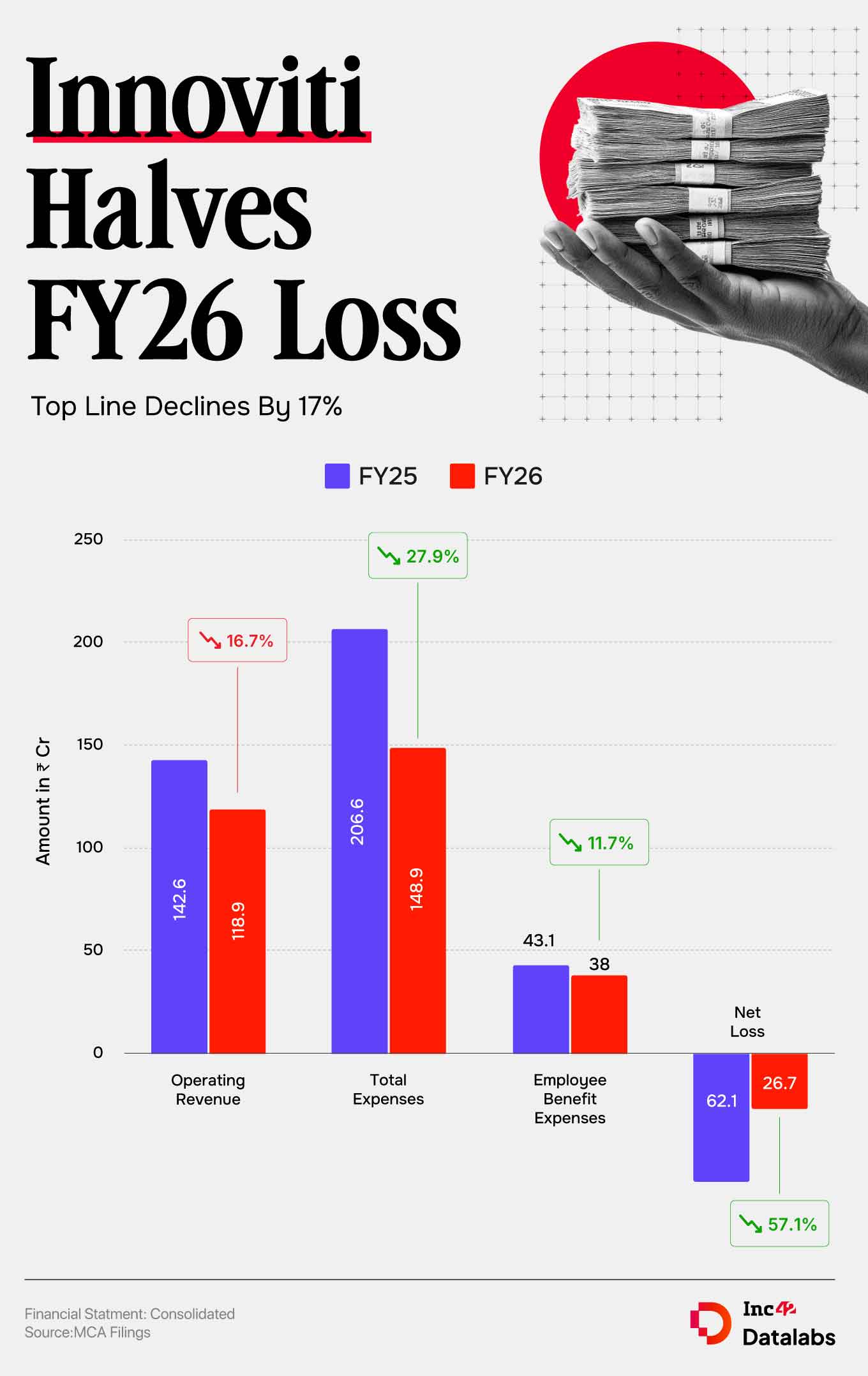

Innoviti reduced its net loss by over 57% YoY to ₹26.7 Cr in FY26, as compared to ₹62.1 Cr in FY25
The startup managed to cut losses even as its revenue from operations fell by 16.7% to ₹118.9 Cr from ₹142.6 Cr in the previous year
Its total expenses for FY26 reduced by nearly 28% to ₹148.9 Cr from ₹206.6 Cr in FY25
Bessemer Venture Partners-backed digital payments startup Innoviti managed to cut its net loss by over 57% YoY to ₹26.7 Cr in FY26 from ₹62.1 Cr loss incurred in the previous fiscal. The startup managed to cull its loss despite its top line taking a hit during the fiscal, falling by 16.7% to ₹118.9 Cr in the year under review as against ₹142.6 Cr in FY25.
During the fiscal, Innovit’s revenue from services fell by 17.8% YoY to ₹101.5 Cr. Of this, ₹97.3 Cr came from offline revenue, which shrank 20% from ₹121.4 Cr in the previous year. Its online revenue doubled to around ₹4.2 Cr.
Additionally, the startup registered an operating revenue of ₹17.4 Cr from lease rentals in FY26. This figure also came down by about 9% from ₹19.1 Cr in the year-ago period.
Apart from its operating revenue, it also reported ₹3.3 Cr in other income, bringing its total income for FY26 to ₹122.2 Cr.
In its filing with the MCA, accessed by Inc42, the startup said that it expects to turn EBITDA positive in FY27, aided by operational improvements, cost-efficiency measures, and new customer additions.
Founded in 2002 by Rajeev Agrawal and Amrita Malik, Innoviti offers three core products: sales acceleration software Innoviti Genie, revenue assurance software Innoviti Unipay and payment collection app Innoviti Link.
The startup claims to process over ₹80,000 Cr of gross transaction volume (GTV) annually from across 2,000 Indian cities and over 20,000 merchants.
Earlier this year, Innoviti received the certificate of authorisation by the RBI to operate as a payment aggregator (PA), permitting it to operate as a PA for both online and offline payments. It had earlier received RBI authorisation for online payment aggregation in March 2024.
It has raised over $115 Mn in funding to date from investors like Bessemer Venture Partners, Catamaran Ventures, Alumni Ventures, FMO, and others. Most recently, it raised a $11.4 Mn Series M funding round in February.
Innoviti has also been looking to make its public market debut for a few years now. In August 2024, it had said it would go for an IPO within a year. It then repeated the sentiment in January 2025 but is yet to make any headway in the public markets direction.
Innoviti managed to slash losses by paring its expenses by nearly 28% in the year under review.
The startup spent ₹148.9 Cr in total during FY26, as against ₹206.6 Cr in the previous fiscal year. Here’s how the fintech startup’s expenditure broke down:
Subvention and Service Fees: Accounting for the largest expense, the startup trimmed its spending under this head by 24% YoY to ₹62.5 Cr.
Employee Benefit Expenses: Innoviti spent 11.7% less on personnel related expenses in FY26 as its employee benefit expenses fell to ₹38 Cr from ₹43.1 Cr.
Depreciation, Amortisation and Impairment Expense: Expenses related to depreciation, amortisation and impairment plunged over 66.5% to ₹10.9 Cr from ₹32.6 Cr in FY25.
Finance Costs: Innoviti’s expenditure on interest and borrowings saw the sharpest reduction, dropping 64.1% YoY to ₹1.5 Cr from ₹4.3 Cr previously.
Source link