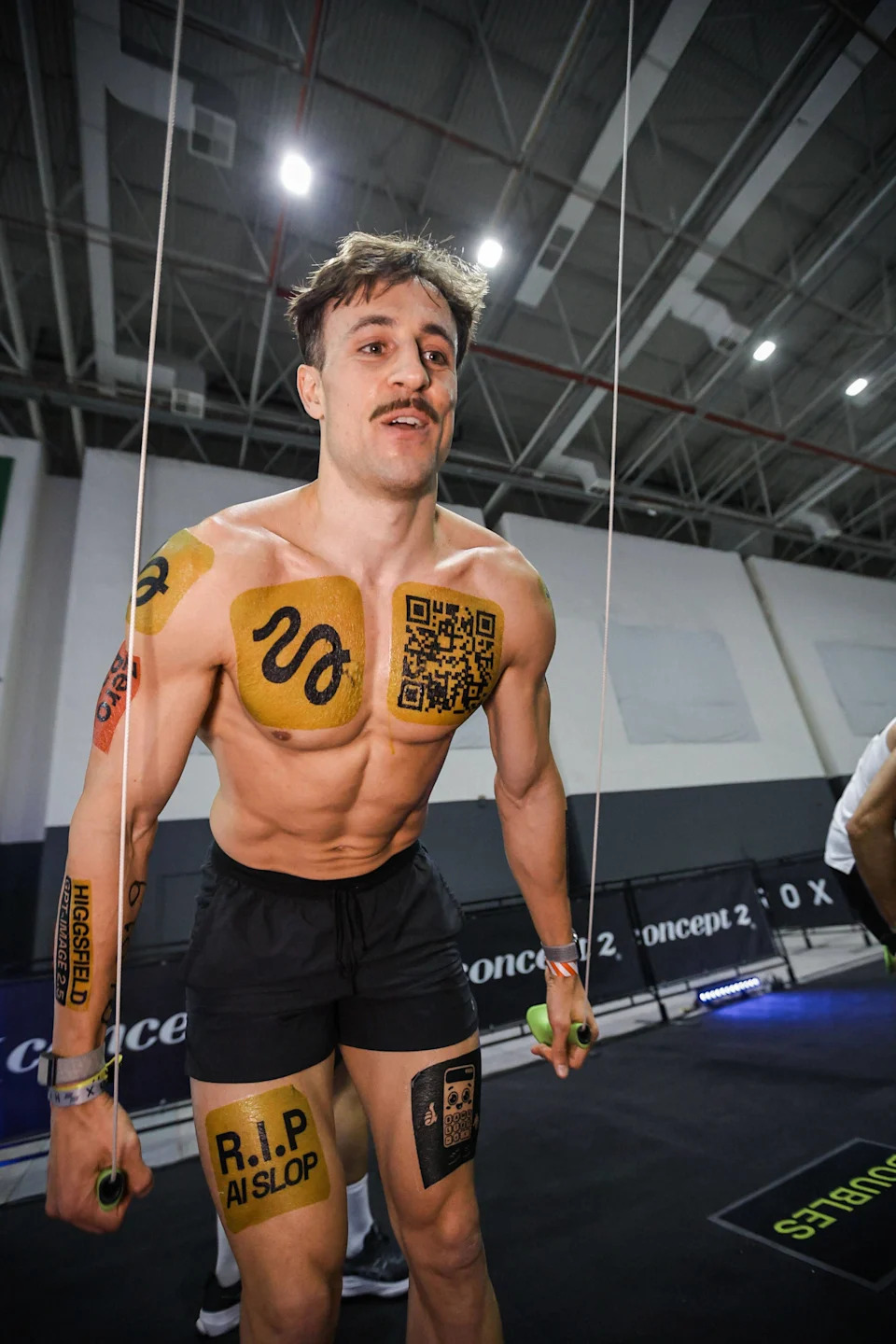
Somewhere around the fifth kilometer of a HYROX race in Izmir, Turkey, on September 19, Marc Lou was pushing a weighted sled with a temporary tattoo of a creator platform stamped across his backside. A startup had paid $20,000 for that spot. It sounds like a joke until you remember the other half of the sentence: he still had to finish the race.
Lou, an indie software founder with a following of more than 600,000 across X, LinkedIn, and YouTube, did something in September that erased the line between fitness and the attention economy. He auctioned advertising space on his own body for race day and turned his glutes, arms, and torso into billboards.
Advertisement
How Marc Lou sold $112,000 of ad space on his body
The idea was borrowed. Lou had watched fellow indie hacker Jonathan Wilke launch Outbid.lol, a viral pay to rank site that reportedly pulled six figures in its first days, and wanted his own version. “Athletes already wear sponsor logos,” Lou says. “I just combined two ideas that inspired me.” He had a HYROX race on the calendar and trained every day, so he put his body up for sale.
He launched with a single post on X. “The first sponsors came within minutes,” he says. “The first spots sold for around $1,000 each, and the total reached $10,000 within a few minutes.” According to Lou and the team coordinating the campaign, AI video company Higgsfield initially bought all available inventory for $80,000, at which point Lou added more spots. The final roster came to six sponsors, Higgsfield, OrcaRouter, Peptide Confidential, ZeroRank, Sam’s List, and the creator platform Stan, for a stated total of $112,000.
Advertisement
The glutes were not in the original plan. “My wife suggested it after the project took off,” Lou says. He opened bidding at $10,000 with $5,000 increments, and Stan took it for $20,000, waiting until just before the auction closed so it could not be outbid. “It felt unreal,” Lou says. “I started HYROX last year, and now I was racing with $112,000 in sponsorships.”
The HYROX race was the real part
HYROX is brutal. The event pairs eight 1 kilometer runs with eight functional stations: ski erg, sled push, sled pull, burpee broad jumps, rowing, farmers carry, sandbag lunges, and 100 wall balls to finish. It is roughly an hour of sustained full body suffering, and it has become one of the fastest growing competitions in fitness.
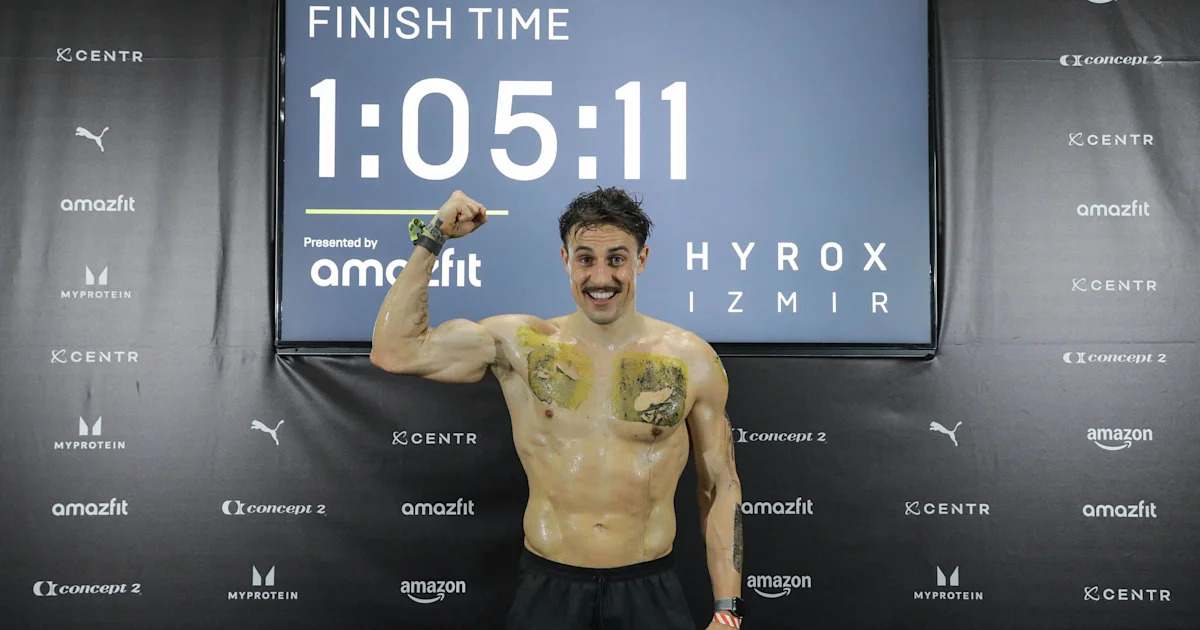
Lou did not treat it as a bit. He says he trained for nearly a year, splitting time roughly evenly between running and strength work and drilling the race specific movements. He finished in 1:05:11, first in his age group and fifth in the men’s field. He had set a sub-60 goal and missed it, but the result was legitimate. The tattoo and QR code rode along the whole way, and Lou filmed himself dancing with the logo on his backside to push the story further.
Advertisement
That contrast is the story. The marketing was a meme. The race was not. You cannot fake your way through 100 wall balls because a software company paid for the real estate on your legs.
Did the stunt work?
For Stan, it depends on what you were buying. “The goal here was not driving conversions or social reach,” a Stan representative said. “This stunt was all about creating something people would talk about and being in the Zeitgeist.” Leo Yu, the company’s creator partnerships manager, put it more bluntly: “Most ads get skipped, but nobody looks away from this asset. It’s going to work its butt off for us.”
By Stan’s account, the play generated more than 1.5 million impressions across Lou’s channels and the organic pickup around it. Harder numbers, QR scans, clicks, actual conversions for the six sponsors, were not tracked or shared, which the campaign’s organizers acknowledged. Impressions are the easiest metric to claim and the softest to bank. Whether $20,000 in attention became $20,000 in customers is, for now, unknowable, which is a fair verdict on most stunt marketing.
Advertisement
What it says about the attention economy
Lou has reportedly built a roughly $3 million solo business almost entirely on his willingness to do things worth talking about, and he is candid that the stunt was as much content as sponsorship. It worked because it was unexpected, physical, and slightly absurd, three things the feed rewards.
It also raises the uncomfortable version of the question. When attention is directly monetizable, there is a pull toward doing increasingly outrageous things to capture it, and the line between building a business and performing for the algorithm gets thin. Lou is on the right side of that line for now, pairing the stunt with a real athletic effort rather than a manufactured moment. The tell will be what the next one has to be to top it.
The takeaway is less about the glutes than the model underneath: a solo founder turned a Saturday morning fitness race into a $112,000 media event, and the price of entry was doing the hard thing. The marketing traveled because the effort was real. Everything else was a logo on it.
Advertisement
This article is for informational purposes only and is not medical, legal, or financial advice. Consult a qualified professional before changing your training, diet, or supplement routine. The authors and publisher accept no liability for any loss or injury arising from use of this information.
This story was originally published by Men’s Fitness on Oct 1, 2026, where it first appeared in the News section. Add Men’s Fitness as a Preferred Source by clicking here.