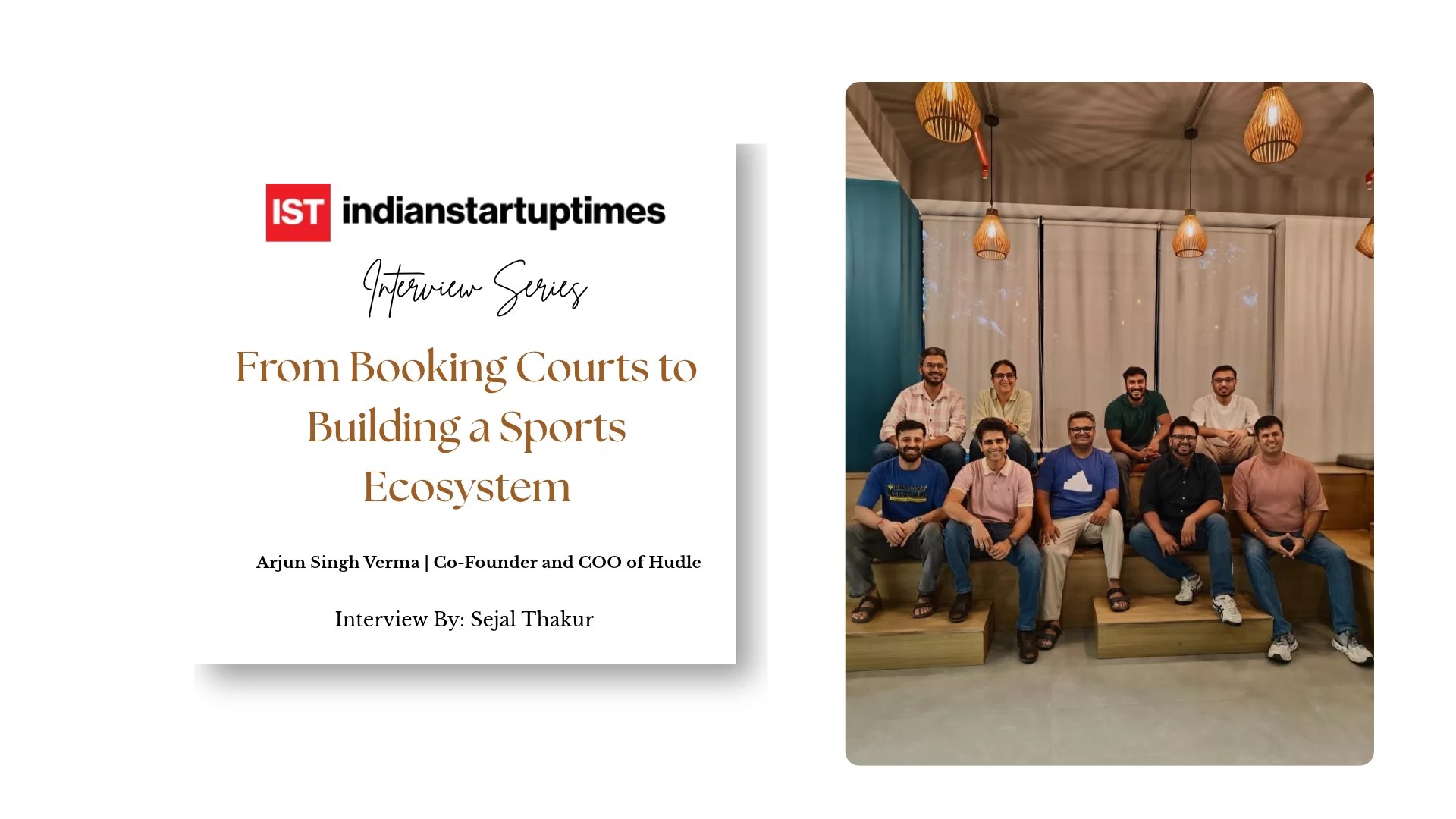
Hudle began with a simple problem: finding and booking a place to play was harder than playing itself. Today, the sports-tech platform connects players with more than 4,000 venues across 110-plus cities and supports over 40 sports, positioning itself as a broader ecosystem for recreational sport in urban India.
In an exclusive interview with Indian Startup Times, Arjun Singh Verma, Co-Founder and COO of Hudle, explains how the company moved from venue discovery to venue operations, community building, player ratings and AI-powered match analysis.
From a booking platform to a sports ecosystem
Hudle’s starting point was accessibility. When the company began, sports venues were limited, and many were not easily accessible to everyday players. “We started with a simple problem statement: finding and booking a place to play was harder than playing itself,” Arjun says. The platform now works with 4,000-plus venue partners across 110-plus cities. According to Arjun, the fact that demand remains underserved despite this expanded supply indicates the size of the opportunity. Hudle has evolved from a booking platform into a system that addresses what a recreational player needs to play regularly at venues, players, games, coaching and equipment.
Growth drivers: Venues, communities and new sports
Hudle’s growth has followed a clear sequence. In the early stages, the company focused on supply: onboarding venues and making them easier to book. As the platform scaled, the focus shifted to the recreational player and to building community around play. Venues, new sports, technology and city expansion all feed into that goal. “We believe sports will become the number one social and going-out activity for urban India,” Arjun says. “People go out with friends and family, and fitness is a byproduct of that.”
Padel and pickleball: A shift in how India plays
Newer racket sports have become a major growth driver for Hudle. The platform now lists more than 40 sports, and padel and pickleball have entered the top three most-booked sports alongside badminton within two years. According to Hudle, 90% of padel games and 75% of pickleball games in India are booked through its platform. The company attributes the rapid adoption of these sports to three factors:
- They are social.
- They have a low learning curve.
- They require fewer people to organise a game.
This points to a changing sports consumer: people increasingly want sport to be easy to start and easy to plan, not only competitive.
Technology beyond bookings
Booking gave Hudle a foundation: data on who plays, where, how often and with whom. The company has since built additional layers on top of that.
Venue operations
More than 4,000 venues now use Hudle’s software for daily operations, including slot management, memberships and analytics. According to Arjun, many venues did not have digital systems before Hudle. The platform enables venue owners to see occupancy by hour, identify underpriced slots and manage memberships from a phone.
Player experience
On the player side, Hudle has introduced features designed to address common reasons people stop playing:
- Community games: Players can host a game and allow others to join, addressing the problem of not having people to play with.
- GRIP: The Game Rating Index for Players provides an objective rating for racket-sport players, helping match players at similar levels.
- Hudle Vision: An AI-based analysis layer that records games and generates highlights and match statistics. It is live on padel courts in Delhi NCR, Mumbai, Goa and Vadodara, with further expansion planned.
- Coaching, equipment and merchandise: The platform aims to help players find coaches and gear within the same ecosystem.
Overcoming early challenges
Hudle’s early challenges reflected the fragmented nature of India’s sports infrastructure. Many venues lacked digital systems, and sports venues were not widely viewed as serious businesses. Hudle worked closely with venue owners and built tools to solve their day-to-day problems first. Arjun says several venue partners have since grown their businesses, with some becoming entrepreneurs in the process.
On the player’s side, hesitation was another barrier. Many people avoided playing because they felt they were not good enough or found the environment intimidating. Hudle addressed this through community games designed to be inclusive and judgement-free. “This has also helped women’s participation grow from almost nothing to around 20% today,” Arjun says. “That growth has compounded from newer sports like padel and pickleball.”
How do the verticals fit together?
Hudle’s business spans venues, games, communities, tournaments and coaching. Arjun says these verticals are not separate businesses; they work together to create a one-stop solution for recreational players.
- Venues provide places to play.
- Games and communities bring people together and encourage repeat participation.
- Communities and coaching help newcomers enter the ecosystem.
- Tournaments and events keep more experienced players engaged.
The company believes that every player who keeps playing makes the model stronger: Hudle scales on retention as much as on acquisition.
The next phase: 10 million active players
Over the next three to five years, Hudle plans to deepen its presence in existing cities, enter new ones, and continue building technology for both players and venues. The company’s stated goal is to reach 10 million active players on Hudle within the next two years. “Our larger aim is to make sports the go-to social activity for urban India,” Arjun says. “We want to be the platform where India finds, plays, and improves at sport.”
Hudle raised $2.5 million in a Series A round in 2025, led by Sky Impact Capital and Physis Capital, with participation from investors including Mahesh Bhupathi and Gaurav Kapur. The company said the funding would support product innovation and expansion of its venue network across Tier 1, 2 and 3 cities.
Interview By: Sejal Thakur