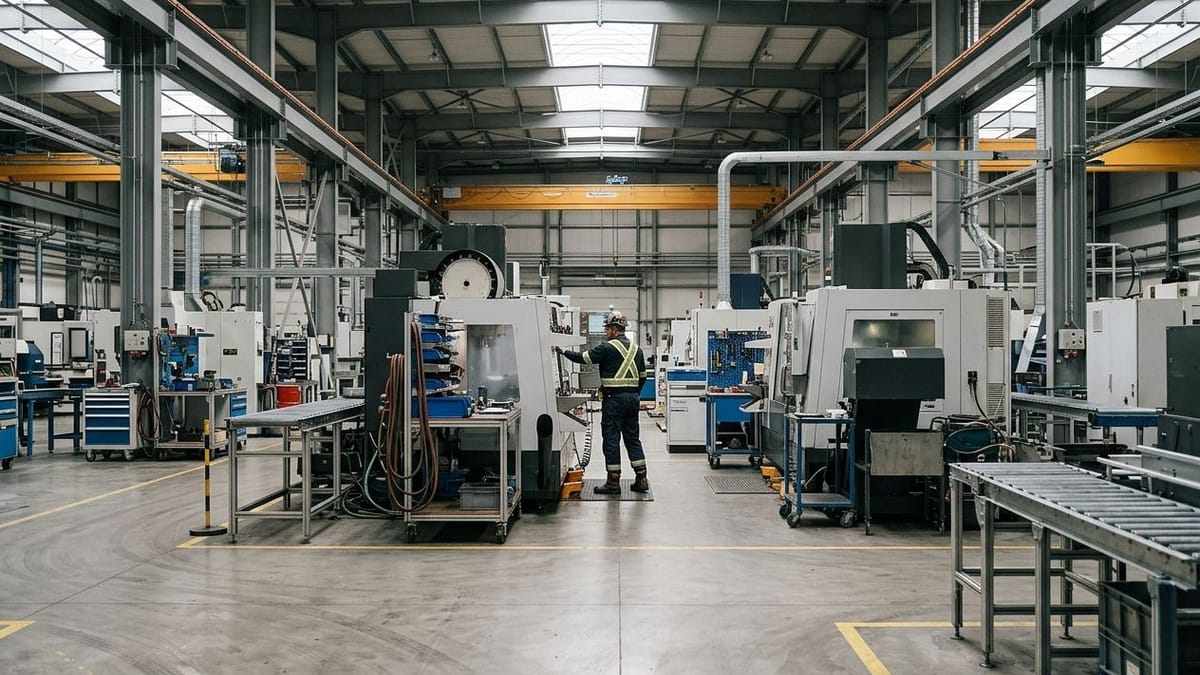
Bob McGrew, former research executive at OpenAI, has emerged from stealth with Arda, an AI manufacturing startup launching at a $1.5 billion valuation. The move signals a major bet that artificial intelligence can revitalize American manufacturing, as one of OpenAI’s key technical leaders pivots from building foundation models to applying AI in industrial settings. McGrew’s departure from OpenAI and immediate launch at unicorn status marks one of the highest-profile exits from the ChatGPT maker this year.
Arda just became the latest unicorn to emerge from OpenAI’s executive ranks, and it’s betting big on a sector AI hasn’t fully cracked yet: American manufacturing. Bob McGrew, who spent years as a senior research leader at the ChatGPT maker, has quietly assembled a $1.5 billion startup aimed at bringing cutting-edge AI capabilities to factory floors across the United States.
The launch comes as the AI industry faces mounting pressure to prove its value beyond chatbots and code generation. While OpenAI and its rivals have dominated headlines with increasingly powerful language models, the real test for artificial intelligence may be whether it can solve complex physical-world problems like manufacturing optimization, supply chain management, and industrial automation.
McGrew’s pedigree gives Arda instant credibility in a crowded field. As a research executive at OpenAI, he worked on some of the foundational technology that powers GPT models. His departure adds to a growing list of high-profile exits from the company, following infrastructure VP Sachin Katti’s recent move to build his own venture. The exodus reflects both the maturation of AI technology and the growing opportunities for specialized applications beyond general-purpose models.
The $1.5 billion valuation at launch puts Arda in rarefied company. Most startups spend years grinding toward unicorn status, but McGrew’s track record and the white-hot AI investment climate have enabled him to build at scale from day one. The valuation sits between recent funding rounds for AI infrastructure plays – Tenstorrent just raised $1.5 billion at a $6.2 billion valuation to challenge Nvidia in AI chips, while robotics startup Eka hit $1.45 billion developing physical AI breakthroughs.
What sets Arda apart is its focus on reviving U.S. manufacturing through AI, a mission that aligns with growing political and economic pressure to rebuild domestic industrial capacity. American manufacturing has hemorrhaged jobs and facilities for decades as production shifted overseas. AI advocates argue that intelligent automation could make U.S. factories competitive again by dramatically improving efficiency, quality control, and adaptability without simply replacing human workers.
The technical challenge is formidable. Manufacturing environments are messy, unpredictable, and require AI systems that can handle physical constraints that don’t exist in purely digital domains. Unlike training a language model on text scraped from the internet, building AI for factories means dealing with sensor data, robotic systems, supply chain variables, and the physics of materials and production processes. It’s the kind of complex, multimodal problem that has historically been difficult for AI to solve.
But the timing may finally be right. The same advances in foundation models that power ChatGPT – better reasoning, multimodal understanding, and the ability to learn from limited examples – could translate to industrial settings. If Arda can build AI systems that understand both the digital and physical aspects of manufacturing, it could unlock massive efficiency gains.
The startup landscape around industrial AI has been heating up rapidly. Companies are racing to apply large language models and computer vision to everything from predictive maintenance to supply chain optimization. Security startup Blackwall recently hit a $2.2 billion valuation dealing with AI-related infrastructure challenges, while defense tech player Anduril reached a staggering $90 billion valuation building AI-powered military systems.
McGrew’s ability to attract funding at this level suggests investors believe the manufacturing opportunity is massive and that OpenAI alumni have unique insights into how to build effective AI systems. The company hasn’t disclosed its investor lineup or specific details about its technology approach, but the unicorn valuation indicates serious institutional backing.
The launch also highlights the ongoing talent migration from big AI labs to specialized startups. As foundation models become more commoditized and accessible, the real value creation may shift to companies that can apply AI effectively in specific domains. Manufacturing represents one of the largest potential markets, with trillions of dollars in economic activity that could be transformed by intelligent automation.
For OpenAI, the departure of another senior executive continues a pattern of key leaders spinning out to build their own ventures. The company has positioned itself as a talent factory for the AI industry, though the steady stream of exits also raises questions about retention and internal dynamics. Recent controversies, including an FBI arrest of a Saudi employee over a recording device, have added to scrutiny of the company’s operations.
Arda’s success will ultimately depend on whether it can deliver real results in actual manufacturing environments. The industry is littered with AI startups that promised transformation but struggled to move from pilots to production deployments. Factory operators want proven solutions, not experimental technology, and the bar for reliability in industrial settings is extremely high.
McGrew’s Arda represents a crucial test for AI’s real-world impact beyond digital products. If the startup can prove that modern AI techniques can genuinely revitalize American manufacturing, it could unlock one of the technology’s most important applications and justify the massive valuation. But the company will need to move quickly from stealth to demonstrable results as competitors rush into the same space and investors demand returns on their unicorn bets. The next 12 months will reveal whether Arda’s manufacturing vision can match its billion-dollar ambitions.