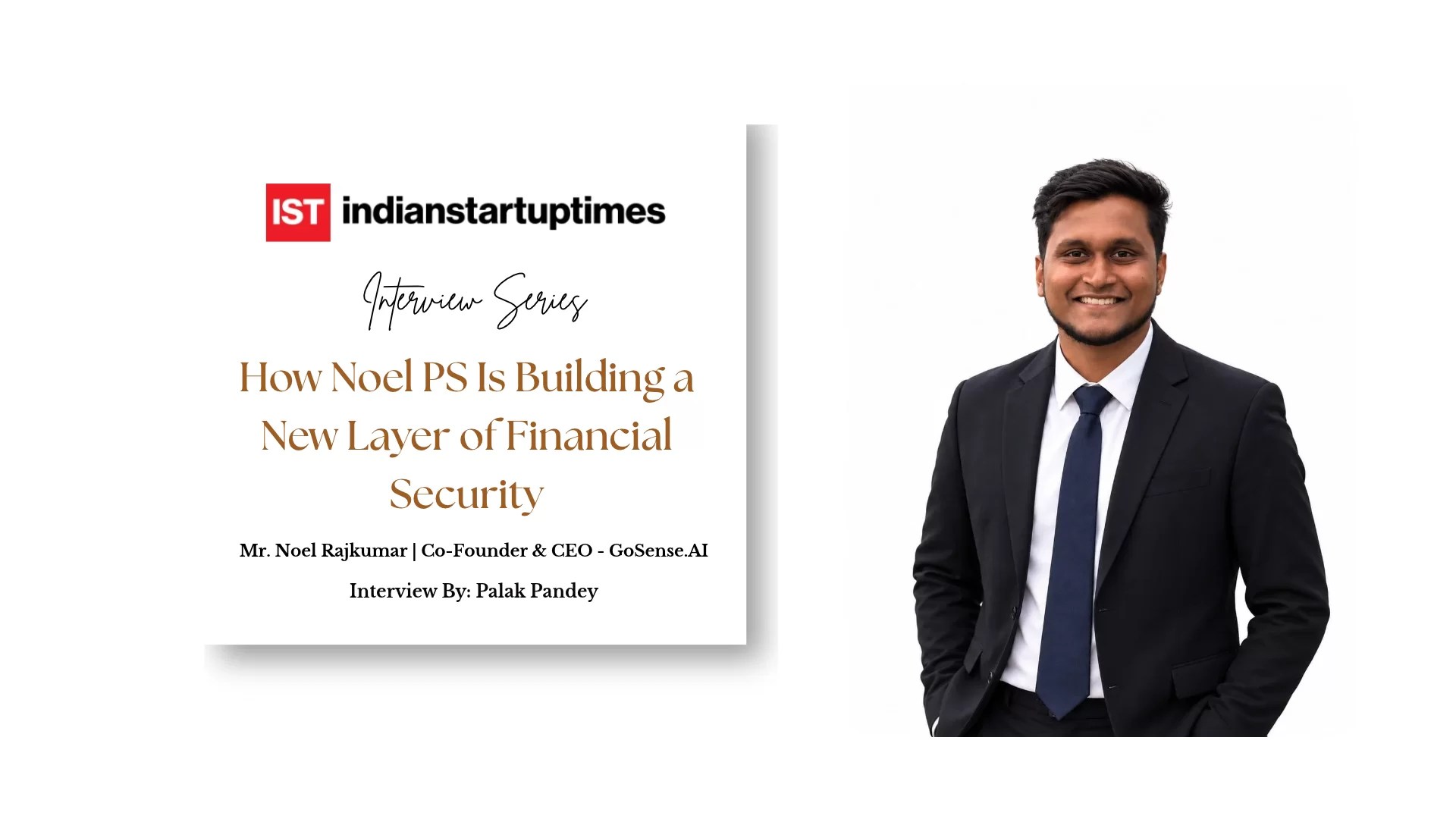
Digital payments have made life easier for millions of Indians. People can now transfer money, pay bills, and shop online within seconds. But as digital payments grow, so do the risks of online fraud. Fraudsters are finding new ways to trick people through fake apps, remote-access tools, and AI-powered scams.
For Noel PS, Co-founder and CEO of GoSense.AI, preventing fraud is not just about identifying suspicious transactions. It is also about understanding what is happening on a user’s device before a payment takes place.
GoSense.AI is building a device-based fraud prevention platform for banks, fintech companies, UPI applications, and other financial institutions. After around 18 months of product development, the company was established as a separate entity. Its technology aims to identify suspicious device activity and user behaviour that could indicate a potential fraud attempt.
According to Noel, the company currently works with two banks and three payment companies. Its platform combines device security checks, behavioural analysis, and protection for AI-powered applications.
In a conversation with Indian Startup Times, Noel spoke about his journey into entrepreneurship, the personal experience that strengthened his interest in fraud prevention, how GoSense.AI works, and why he believes digital security needs to evolve alongside financial technology.
From Different Industries to Building a Fraud Prevention Startup
Noel’s career has taken him through several industries, from automotive engineering and digital entertainment to artificial intelligence and financial technology. Each experience helped him understand different aspects of building products and solving customer problems.
He began his professional journey in 2019 with Anand Automotive, where he worked with the research and development team on piston-ring engineering. He later moved into the digital entertainment industry, working in digital marketing and customer support for an OTT platform.
After that, he gained experience in product evangelism and community building at an AI company. These roles helped him understand how products are developed, how customers interact with them, and how companies communicate the value of their solutions.
His move into payment fraud prevention became a turning point.
While working with transaction monitoring and anti-money laundering systems, Noel noticed a problem. Sometimes, genuine transactions were flagged as suspicious, while fraudulent transactions managed to pass through the system.
This made him think about whether financial institutions could look beyond transaction data and understand more about the device being used to make a payment.
A transaction might appear normal on the surface, but the device could show signs of suspicious activity. For example, it might be running a malicious application or being controlled through a remote-access tool.
Noel began exploring whether this additional information could help financial institutions identify risks earlier.
That idea eventually became the foundation for GoSense.AI. The goal was to add another layer of security to existing fraud detection systems, helping banks and fintech companies understand potential risks before they lead to financial losses.
A Personal Experience That Made Digital Fraud More Real
Noel’s decision to work on fraud prevention was influenced not only by his professional experience but also by something that happened to him personally.
Around three to four years ago, he was looking for a house to rent. He found a broker through a property-listing platform and received a link asking him to pay an advance amount to view the property.
The next morning, he noticed several notifications showing that money had been withdrawn from his bank account.
The loss was close to ₹3 lakh, which Noel described as his entire life savings at that time.
The incident made him realise how easily someone could become a victim of digital fraud. It also made him think about people who may not be familiar with online scams and the risks associated with sharing information or clicking on unknown links.
He began considering how such incidents could affect his parents, friends, and other people who use digital payments every day.
During the interview, Noel explained that he wanted to build something meaningful that could help people understand what was happening on their devices.
The experience gave his professional interest in fraud prevention a more personal purpose. It strengthened his desire to develop technology that could help identify suspicious activity before it resulted in financial loss.
Although GoSense.AI primarily provides its solutions to financial institutions, the larger objective is to make digital financial services safer for the people who use them.
Why Transaction Monitoring Alone May Not Be Enough?
Traditional fraud prevention systems often examine transaction details to identify unusual activity. These systems remain important, but Noel believes that looking only at the transaction may not always provide the complete picture.
Consider a situation where a fraudster convinces someone to install a remote-access application or share control of their phone. The victim may then make a payment that appears genuine to the bank, even though they have been manipulated.
Similarly, a malicious application or compromised device may create risks that are difficult to identify through transaction data alone.
This is the gap GoSense.AI aims to address.
Its technology looks at device-level information and behavioural signals that may help financial institutions understand whether a payment session carries additional risk.
The company sees potential applications across different parts of the financial sector, including smaller banks, cooperative banks, non-banking financial companies (NBFCs), digital lenders, UPI applications, and capital-markets platforms.
Noel is particularly interested in institutions that face increasingly sophisticated fraud risks but may not have the resources to build advanced security systems entirely on their own.
For these organisations, an additional security layer could strengthen their existing systems without requiring them to develop every capability internally.
The aim is not to replace existing fraud detection tools but to provide more information that can help financial institutions make better-informed decisions.
How GoSense.AI’s Technology Works?
GoSense.AI integrates its technology into a bank’s or fintech company’s mobile application through a software development kit, commonly known as an SDK.
In simple terms, an SDK allows the company to add its security features to an existing application without rebuilding the entire app.
According to Noel, the platform has two main components: an AI-native Runtime Application Self-Protection (RASP) system and a runtime AI protection layer.
The first component focuses on the security of the device and the activity taking place while an application is running.
It can check for potential warning signs, including rooted or jailbroken devices, emulators, debugging tools, and other suspicious conditions. These checks can help identify environments that may be more vulnerable to fraud or manipulation.
The platform also looks at how users interact with an application. This may include signals related to typing, swiping, and navigation.
Rather than depending on a single warning sign, the system uses different signals to assess the risk associated with a session. This can give financial institutions additional context when deciding whether an activity requires closer attention.
The second component, runtime AI protection, focuses on security risks that may emerge as financial institutions introduce AI assistants and agents into their applications.
AI-powered systems can create new challenges, such as prompt injection, accidental exposure of sensitive information, and automated activity that behaves in unexpected or potentially harmful ways.
GoSense.AI’s runtime protection is designed to identify potential threats arising from these interactions while the application is running.
Noel also highlighted the company’s zero-trust approach. Under this approach, a user is not automatically considered safe simply because they have used an application many times before. Each session can be assessed again for potential risks.
This is important because a familiar device or a previously trusted user account may still become compromised.
By combining device checks, behavioural signals, and runtime protection, GoSense.AI aims to help financial institutions identify suspicious activity earlier and understand the risks more clearly.
Making Security Practical for Banks and Fintech Companies
Building security technology is only part of the challenge. The solution must also work smoothly within existing applications without slowing them down or frustrating genuine customers.
Noel said that GoSense.AI’s SDK is approximately 8 KB in size, with response times below 200 milliseconds, according to the company’s stated product specifications.
The company aims to provide additional security checks while keeping the impact on app performance and the user experience to a minimum.
It also takes a gradual approach when introducing its technology to customers.
Instead of immediately blocking transactions that the system considers suspicious, GoSense.AI typically starts with a process known as a shadow-mode pilot.
During this phase, the system evaluates activity and generates risk scores, but it does not automatically block transactions based on those scores. This allows the bank or payment company to observe how the technology performs without immediately changing the customer experience.
After several weeks, GoSense.AI works with the client’s product and fraud teams to compare its assessments with confirmed fraud cases and other available evidence.
The teams can then evaluate whether the system is identifying meaningful risks and whether its signals are useful in real-world situations.
This approach is important because a fraud prevention system must do more than detect suspicious activity. It must also avoid incorrectly flagging genuine customers.
Too many false alerts can create unnecessary friction for users, while missed warnings can leave customers and financial institutions exposed to risk.
According to Noel, the company currently works with two banks and three payment companies. These relationships provide an opportunity to test the platform in practical settings and continue improving its capabilities.
The Growing Challenge of AI-Enabled Fraud
As financial services become more digital, fraudsters are also finding new ways to carry out attacks.
One development Noel highlighted is malware-as-a-service. In this model, malicious software and tools may be made available to people who do not have advanced technical skills of their own. This can make certain types of cyberattacks easier to carry out.
Artificial intelligence is adding another layer of complexity.
Fraudsters can use AI tools to create convincing messages, imitate people, and make social engineering attempts harder to recognise. Messages that once contained obvious language mistakes may now appear much more natural.
This means users can no longer rely on spelling errors or poor grammar alone to identify a suspicious message.
Noel also discussed coercion-based scams, in which victims are pressured or manipulated into authorising payments themselves.
In such cases, a payment may pass normal authentication checks even though the person making it has been deceived or is acting under pressure.
Identifying these situations is difficult. Behavioural signals and other available information may provide additional context, but such signals must be handled carefully to avoid wrongly flagging legitimate users.
Another emerging concern is the use of automated agents to interact with financial applications.
As banks and fintech companies introduce AI-powered assistants, they will need ways to distinguish legitimate automated activity from malicious bots or compromised AI systems.
For GoSense.AI, these developments reinforce the need to look beyond conventional transaction monitoring and consider what is happening on the device and within the application itself.
A Focused Plan for the Next Three to Five Years
Looking ahead, Noel wants GoSense.AI to strengthen its presence in India, expand its customer base, and continue developing its fraud prevention technology.
Rather than rushing into international markets, the company plans to focus on understanding and serving the Indian financial ecosystem first.
India has a wide range of digital payment users, devices, languages, and levels of digital awareness. Building solutions that work across these different conditions presents both a challenge and an opportunity.
The company also wants to reach more cooperative and smaller banks, NBFCs, digital lenders, and payment applications.
On the product side, its priorities include improving the detection of scams and coercion-based fraud, identifying cloned or fake applications, and strengthening security for AI-powered financial services.
Another area of interest is the possibility of sharing fraud intelligence across financial institutions without exchanging raw customer data.
If implemented with appropriate privacy safeguards, this could help institutions recognise broader patterns of suspicious activity while protecting sensitive customer information.
These plans reflect the company’s intention to expand gradually, strengthen its technology, and respond to the changing needs of financial institutions.
What It Takes to Build a Startup for the Financial Sector?
As Co-founder and CEO, Noel’s role extends beyond developing technology. He also works closely with financial institutions to understand their problems and turn their feedback into product improvements.
Banks and other financial organisations operate under strict regulatory and operational requirements. A new technology must fit into existing systems, meet security expectations, and demonstrate that it can work reliably.
This makes customer feedback especially important.
Noel believes that listening to fraud teams and understanding their day-to-day challenges helps a startup build a product that addresses real problems rather than relying only on assumptions.
He also highlighted the importance of building repeatable processes as a company grows. Startups cannot depend entirely on individual effort. They need clear systems that help teams solve problems, deliver consistently, and maintain product quality.
For founders entering the financial services sector, patience is equally important. Sales cycles can be long, and financial institutions need time and evidence before adopting a new security solution.
Trust, compliance, and product performance all play a role in that decision.
GoSense.AI’s use of shadow-mode pilots reflects this understanding. By allowing customers to evaluate the technology before relying on it for security decisions, the company can demonstrate its capabilities in a more measured way.
Building Towards Safer Digital Payments
For Noel, the larger goal is to make digital financial services safer without making them harder to use.
Security systems need to strike a balance. If they interrupt genuine customers too often, they can make everyday payments frustrating. If they fail to identify suspicious activity, customers and financial institutions may face financial losses.
GoSense.AI is working towards a model in which potential risks can be identified earlier, device activity can be understood in greater detail, and financial institutions can make more informed decisions before a payment is completed.
The company’s approach also reflects a wider change in digital security. As fraud methods become more sophisticated, transaction data alone may not always tell the full story. Device security, user behaviour, and the risks associated with AI-powered interactions are becoming important parts of the conversation.
Noel’s journey from product and customer-facing roles to building a financial security startup has been shaped by his interest in solving problems that existing systems may not fully address.
His personal experience with fraud gave that mission a deeper meaning. It showed him how quickly a digital interaction can turn into a financial loss and why stronger protection matters.
For GoSense.AI, the opportunity ahead lies in helping financial institutions recognise risks earlier, protect genuine users, and reduce the chances of digital fraud resulting in financial loss.
Interview By: Palak Pandey