
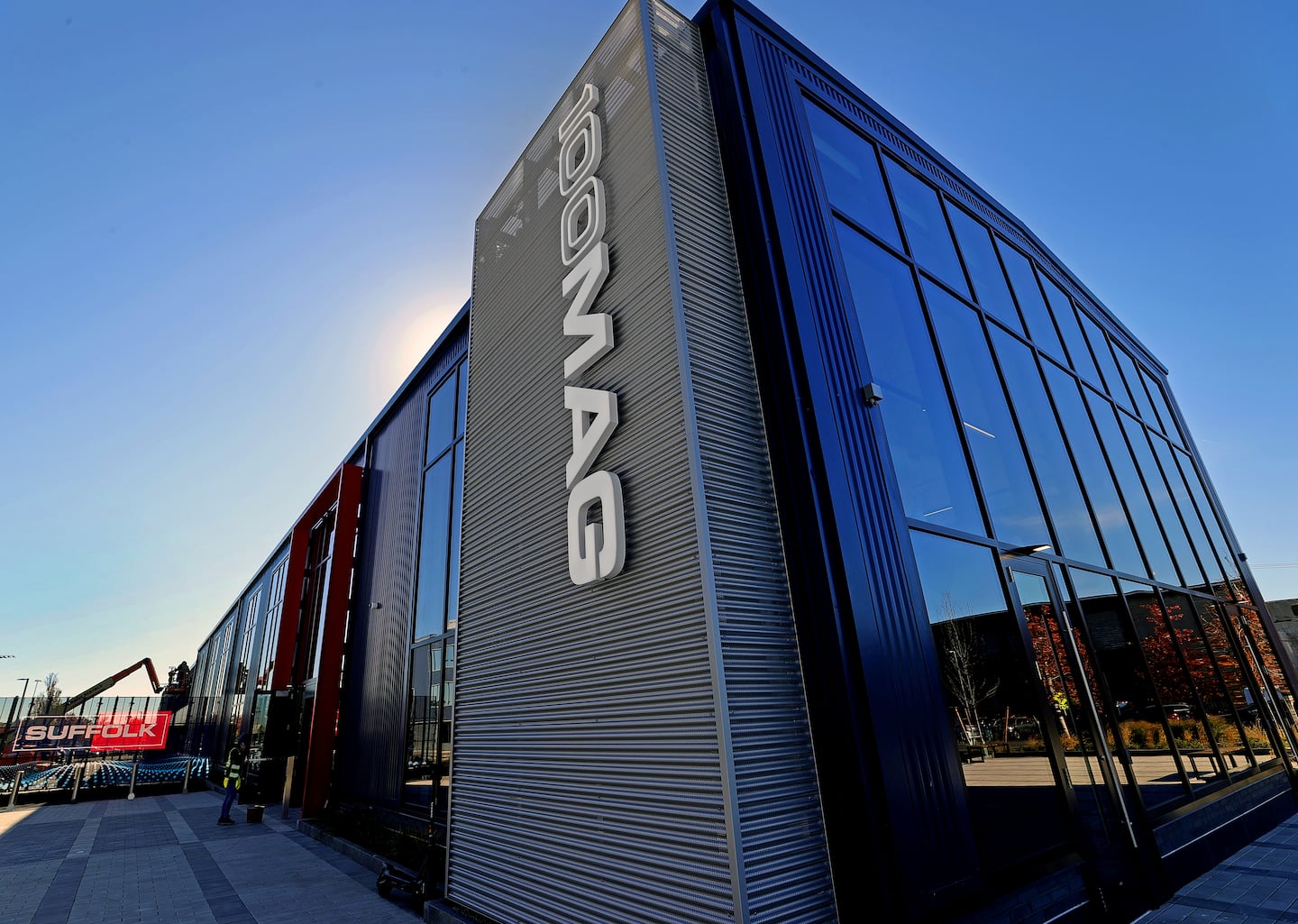

Suffolk Construction has around 150 projects underway across the country. But the project that Suffolk chief executive and owner John Fish most wants to talk about right now is the one he just finished behind his headquarters.
Suffolk invested $50 million in massive renovations to two old industrial buildings at the site, combining them to create a new 40,000-square-foot structure that it calls “100MAG,” a reference to its address on Magazine Street in Roxbury. The revamped building behind Suffolk’s corporate office on Allerton Street opened Oct. 26 amid the blocks of warehouses, meat processors, and auto body shops that make up the Newmarket area.
The main goal: to have a new facility where Suffolk’s design, artificial intelligence, and data work can happen under one roof. It will also house the company’s startup accelerator, known as Boost, and its venture capital firm, Suffolk Technologies. The renovations also included new control rooms in the main headquarters in which updates of Suffolk’s various projects can be observed in real time, on big screens.
“We have an ecosystem we’ve created here,” Fish told visitors during a tour.
For Fish, it’s about making every stage of the construction project, from the initial design to the final punch-list items, safer and more efficient. That means using new software and other tech, dreamed up by the startups supported by Boost and Suffolk’s VC firm, on Suffolk job sites. Fish’s company is also employing AI to gauge each project’s progress and where it might be hitting snags. And AI engineers are being assigned to big projects, like the new hospital that Suffolk is building for Dana-Farber Cancer Institute, to work with construction teams to improve their workflows. Even the seemingly simple task of speeding up supply orders can save weeks of time and millions of dollars.
For a low-profit-margin business like construction, he said, this kind of efficiency can make the difference between turning a profit, or losing money on a particular job.
“AI is going to change the way we build going forward,” Fish said.
One example is the technology developed by Openspace.ai, a sort of “Google Street View” to remotely monitor and document conditions at construction sites. Jeevan Kalanithi, the San Francisco startup’s chief executive, said Suffolk has been an invaluable supporter, as an investor and a user of its software.
Kalanthi said he has seen some companies use technology as a marketing gimmick, but Suffolk is using it to gain a competitive advantage.
“John and Suffolk, they walk the walk,” Kalanthi said. “They truly believe technology has a part to play in solving very big, complex problems in construction.”
Fish has been a believer in harnessing high-tech in construction for years, even going so far as trying to rebrand his company as a tech firm in the late 2010s. Fish now defines Suffolk as a “construction company that uses technology,” including tools that differentiate Suffolk from its rivals.
Suffolk has continued to grow amid Boston’s construction slowdown by seeking new markets, focusing on everything from data centers to casinos to airports. Fish expects $13 billion or more in revenue in this fiscal year. Fifteen years ago, 75 percent of Suffolk’s business came from Massachusetts projects. Now that number is under 20 percent.
Still, this latest project represents an important investment in an often-overlooked section of the city, one that usually ends up in the news because of issues with encampments, not headquarters expansions. Of Suffolk’s 4,000 employees across its various subsidiaries, about 500 work at the Roxbury campus.
Sue Sullivan, executive director of the Newmarket Business Improvement District, says the Newmarket industrial zone is experiencing a rebound, with minimal vacancies and fewer issues with homelessness and crime. Plus, she points to investments in the new Roxbury Prep charter high school and nearby Clifford Park — and, of course, Suffolk Construction.
“The difference in the narrative for Newmarket is now spurred in large part by Suffolk’s investment,” Sullivan said. “We talk about [being] a ‘tough tech’ industrial innovation district. Suffolk’s investment just leans right into it.”
Jon Chesto can be reached at [email protected]. Follow him @jonchesto.
Source link