Amid public concerns about the impact of AI, the Singaporean government is actively exploring various ways to ensure that AI can be more beneficial for industries, companies, and workers.
The development of artificial intelligence (AI) has indeed raised a number of concerns, ranging from potential job losses, threats to personal data security, cybercrime, negative impacts on education, ethical issues, the spread of hoaxes, to misinformation.
Without dismissing the aforementioned issues, Singapore is attempting to adopt a perspective focused on the benefits of AI. The country is developing various initiatives to leverage AI in addressing significant challenges within the industry.
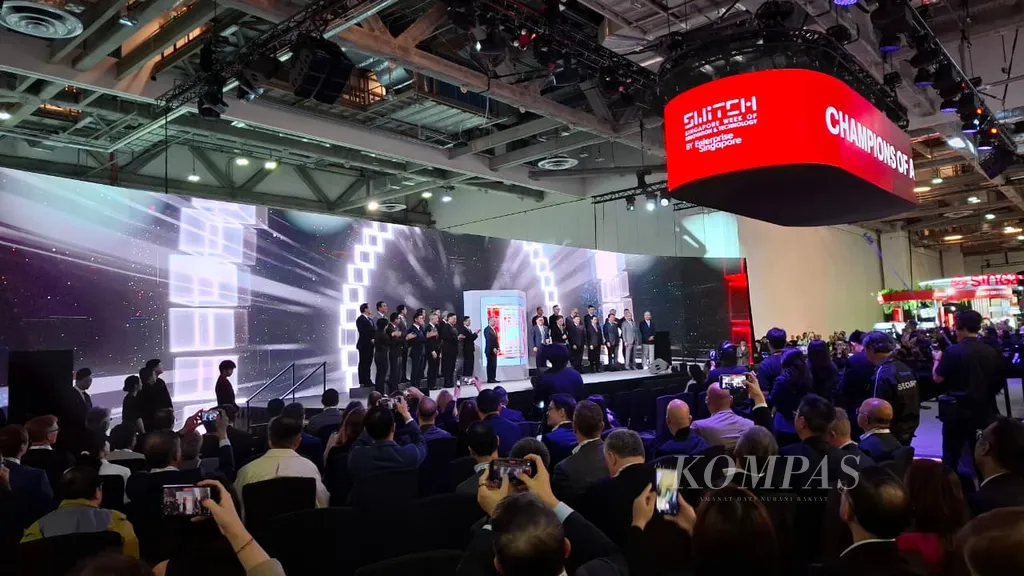
AI will be a central focus at the Singapore Week of Innovation and Technology (SWITCH) 2026, scheduled for October 27-29, 2026, at the Sands Expo and Convention Center Marina Bay Sands in Singapore. The innovation festival is expected to attract 25,000 participants from 100 countries.
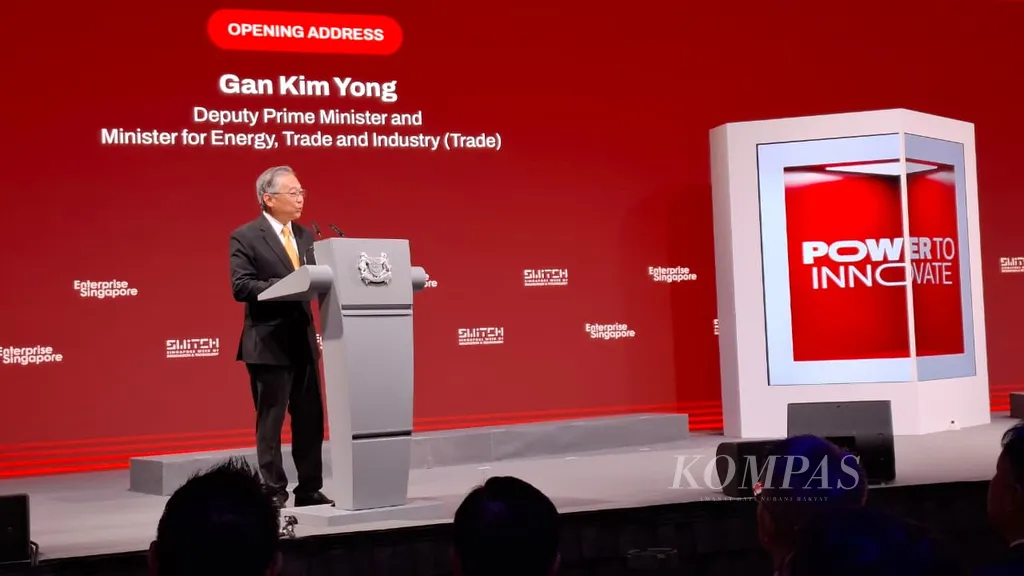
“We hope to explore various ways for AI to work better for our industries, companies, and workers, in order to build a more innovative, competitive, and inclusive economy,” said Singapore’s Deputy Prime Minister and Minister for Trade and Industry, Gan Kim Yong, on Tuesday (27/10/2026) during the opening of SWITCH 2026 at Marina Bay Sands, Singapore.
According to Gan Kim Yong, Google’s Project Genome and Microsoft’s MatterGen have demonstrated the potential of AI in accelerating the discovery of innovative materials. However, these materials must be synthesized, validated, and produced on a large scale before they can be utilized by the industry.
Transforming scientific breakthroughs into commercially useful products remains a significant challenge. To address this, the Singapore government launched the Materials Accelerator for Research and Venture Enterprise Launchpad, or Marvel-AI. This Rp 2.1 trillion (S$170 million) government-funded initiative will establish an integrated platform combining advanced AI models with self-driving laboratories.
“We hope to explore various ways for AI to work better for our industries, companies, and workers,” said Gan Kim Yong.

Advanced AI models will identify promising materials and design experiments. Subsequently, laboratories will rapidly synthesize and test these materials. To facilitate the transition of these developments into industrial applications, Marvel AI will connect researchers with companies.
Startups and small and medium enterprises (SMEs) will have access to the research expertise, infrastructure, and validation capabilities they need. This will create opportunities for industry partnerships, company growth, and new ventures.
These efforts undoubtedly require commitment and support. Over the past six months, Enterprise Singapore has engaged various companies and industry experts to identify business players who demonstrate commitment and have concrete plans to embark on this transformation journey.
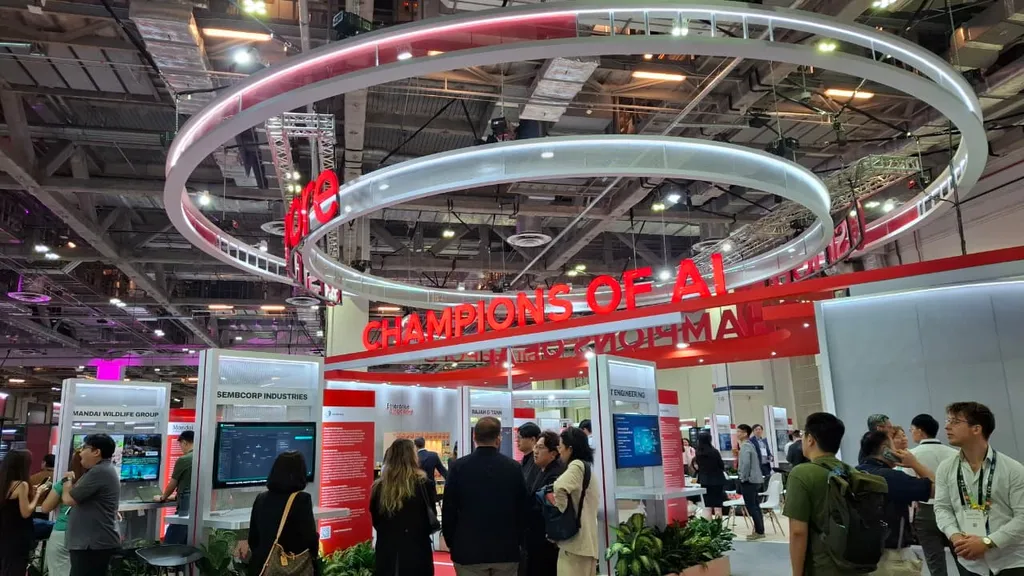
“Today, I am pleased to announce the first cohort, which consists of 24 companies from various sectors under the Champions of AI initiative,” said Gan Kim Yong.
These champions are committed to developing their workforce, creating new job opportunities, redesigning job roles, and building AI capabilities across their organizations. Their investment in human resources will be crucial for effectively leveraging technology.
Ultimately, the emergence of AI should not be viewed merely as a threat to job loss, but rather as an opportunity to foster a new awareness. With AI’s presence, employers must consider how jobs will evolve and equip workers with the skills and confidence needed to meet these changing demands.
“Redesigning work and training must begin in tandem with changes in business processes, not at the end of the process. We want AI to help people reduce the time spent on routine tasks and provide more time for work that leverages their judgment, creativity, and expertise,” he added.
Helping humans
One such effort is being undertaken by The Robot Company. This U.S.-based firm designs AI-powered robots to perform specific tasks that are best left to machines rather than humans.
“Currently, there is a significant need for tasks involving moving, retrieving, placing items, or reorganizing stock over considerable distances. To carry out these very routine tasks, we are deploying robots,” said Daniel NG, founder and Chief Operating Officer of The Robot Company.
The use of robots is crucial when humans face significant safety risks and dangers, such as in mining companies. By employing robots, companies can prevent hazards that could threaten workers while still maintaining jobs by utilizing remotely operated machines.
Daniel envisions a future where investments in robot development become more affordable, easier to adopt, and more widely utilized in environments that truly require them, such as hazardous locations, search and rescue operations, and disaster relief efforts.
“I believe robots will replace certain specific jobs, while humans will take on other types of work. It’s not that we are incapable of doing it, but because this world is vast and there are so many businesses and industries where we need to implement robots,” he said.
A similar sentiment was expressed by Huy (Yuuki) Bui, a developer and engineer at Menlo. He stated that, so far, the companies partnering with Menlo are very confident that no AI-based robot can fully replace human workers. “And we agree with that,” he said.
Yuuki does not believe that AI will take over the world. However, he is convinced that we will eventually transition to a scenario where humans and AI coexist. “Besides, this robot has a big red button on its back. If they try to take over the world, just press that button!” Yuuki said with a laugh while controlling the Asimov 1 robot.
Menlo designed an agentic robot, a robot that, when given a task, will complete it autonomously. Once someone gives it a prompt, the robot will attempt to complete it. Even if it makes a mistake, someone can correct it, and the robot will figure out how to do it correctly and continue to improve.
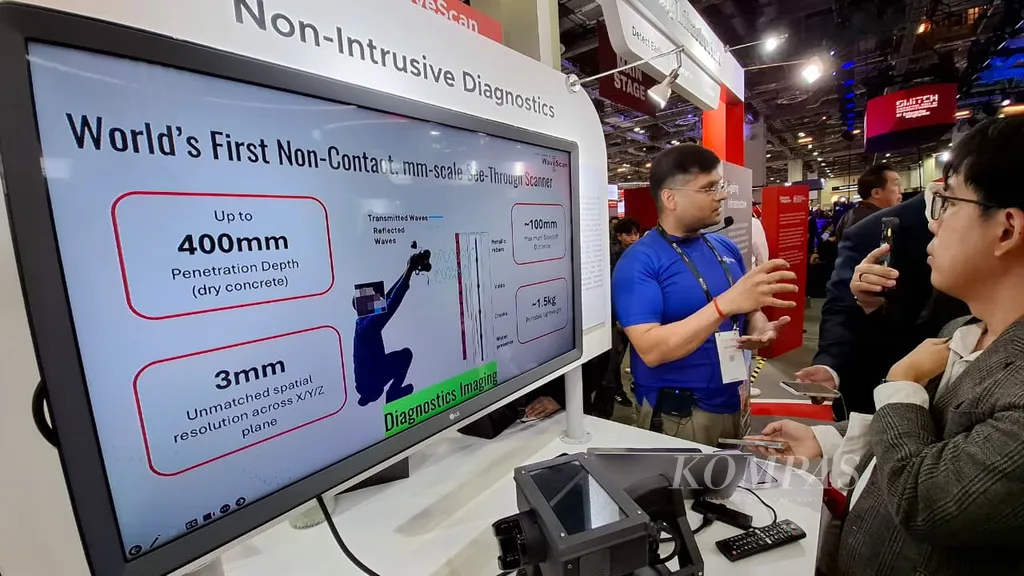
AI-based innovations are also being developed by WaveScan, a company focused on electromagnetic imaging technology for non-destructive testing and inspection of building structures. “This tool can see the building structure, rebar, cavities, and even cracks. With this information, civil engineers and engineering professionals can make decisions about how to make repairs or whether the building complies with building safety guidelines,” said Kush Agarwal, CEO and founder of WaveScan.
This device is akin to a body scan using X-rays or a CT scan. With its high resolution and image accuracy, it allows users to detect very small defects or objects within a structure.
“In Singapore, we have been developing this over the past eight years and have implemented it in various countries. This technology has undergone a series of safety regulations, is certified, completely safe to use, and has been applied in residential buildings, commercial structures, civil infrastructure, and manufacturing plants,” he explained.
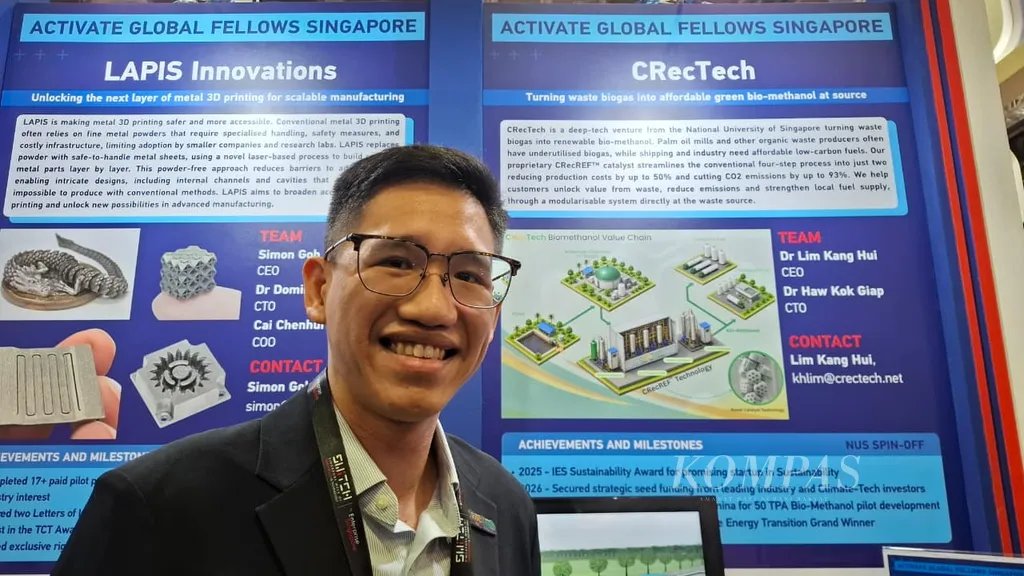
SWITCH 2026 also featured CRecTech, a startup from the National University of Singapore that is developing technology to convert biogas waste into renewable bio-methanol. “We are partnering with Pertamina to develop this technology, which efficiently and affordably transforms biogas into biomethanol,” said CRecTech CEO Lim Kang Hui.
According to Lim, palm oil mills and other organic waste producers often have biogas that is underutilized. On the other hand, shipping companies and the industrial sector require affordable low-carbon fuel. This is why CRecTech has developed a catalyst that simplifies the conventional four-stage process into just two stages.
“This process reduces production costs by up to 50 percent and cuts CO₂ emissions by as much as 93 percent. We add value to waste, reduce emissions, and strengthen local fuel supply through a modular system directly at the waste source,” he added.
The Singaporean government has fostered a wide array of innovations, and the examples mentioned above represent just a small fraction of them. This is why SWITCH aims to bring together numerous partners who can transform various innovations and technologies into tangible outcomes.
At the SWITCH 2026 event, SLINGSHOT was held, a deep tech startup pitching competition that has been held since 2017. The number of registrants continues to increase from around 1,000 in 2017 to more than 5,000 in 2026.
This year, Miraqules, an Indian startup, was selected as the grand winner with its patented StopBleed® biomaterial innovation. This product is designed to stop bleeding within 60 seconds. Miraqules also won the Health and Biomedical category award.
For the past decade, SLINGSHOT has served as a springboard for startups aiming to tackle pressing challenges around the globe, including sustainability, healthcare, manufacturing, food security, and AI.
Speaking before global innovation ecosystem players gathered at Marina Bay Sands, Gan Kim Yong emphasized the need to transform AI capabilities into new business opportunities and create better job prospects for the community. “This is how we build a more innovative, competitive, and inclusive economy,” he concluded.
Source link