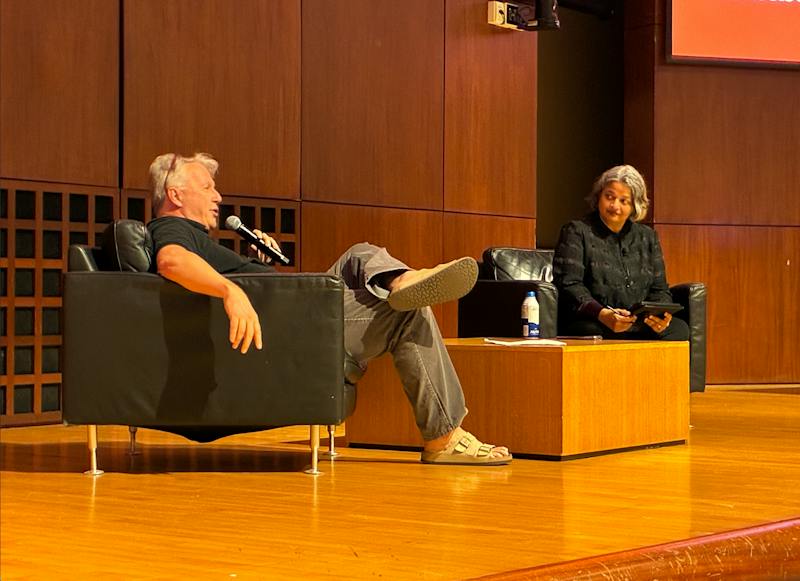
Paul Graham ’86, co-founder of Y Combinator, the start-up accelerator and venture capital firm that has launched industry giants including OpenAI, Kalshi, Airbnb and DoorDash, spoke to a packed 600-person auditorium in Kennedy Hall. He discussed entrepreneurship, the value of a liberal arts education and why dropping out of college isn’t the only path to success for aspiring startup founders.
Graham co-founded YC in 2005, which invests in early-stage startups in exchange for equity, runs them through a 3-month program and ends with founders pitching to investors. YC has since launched over 5,000 companies with a combined valuation exceeding $1.3 trillion. Among YC’s earliest success stories was OpenAI CEO Sam Altman, who participated in the inaugural 2005 batch.
Graham began his Wednesday talk by joking that he was “the first graduate” in artificial intelligence as a student who designed his own major at Cornell.
“I was a philosophy major most of the time here,” he said. “But a lot of people thought I was a [computer science] major because I took so many CS classes.”
A multi-millionaire, Graham made his first millions by co-founding Viaweb, an early e-commerce company. Graham is one of Silicon Valley’s most widely-read thinkers, especially for his blog’s personal essays.
Reflecting on the value of a college degree today, he noted that the “latest trend” his company has noticed is college students dropping out to found startups.
“You do learn more in a startup, but … you don’t get to choose what it is, ” Graham said. “What you can’t do in a startup is learn about things just out of curiosity.”
Graham pushed back on the idea that students must launch a startup as soon as possible. While the opportunity to launch a startup “will always be there,” he said that “school has an expiration date like fresh fish.”
“Whatever startup idea you have now, you’ll have a better one in two years anyway,” Graham said. He dismissed the fear of waiting as “nonsense.”
Provost Kavita Bala opened and moderated the event, titled “How To Turn Yourself Into a Startup Founder,” with remarks on Cornell’s ongoing efforts to provide students with entrepreneurial opportunities.
“When we launched Cornell Tech, Cornell’s aspiration was to create a Y Combinator kind of atmosphere in New York City to fuel the startup economy in New York,” Bala said during the event.
Bala also highlighted the Cornell Committee on the Future of the American University’s findings in a report last month, which highlighted the education of the “whole person.”
“This commitment now with the kinds of changes in technology we are seeing is more important than ever before, and I believe this aligns with how [Graham] thinks of education,” she said.
During his talk, Graham said that ideas for startups should be rooted in genuine interest and argued that money alone is a poor incentive for successful startups. In the best case, he said, founding a startup should sit at the “intersection” of “loving” the work and “making money.”
“The only way to discover the very best ideas is to let yourself be drawn along by pure curiosity,” Graham added. “Your curiosity is not random. It’s doing a lot of selection.”
During a rapid-fire Q&A session moderated by Bala, Graham addressed pre-submitted questions from the audience on entrepreneurship.
Responding to a question from Jay Patel ’26, who founded VigilantAI, on when startup founders should keep working on ideas that have previously failed, Graham emphasized the importance of understanding “why” ideas failed, and noting what others “were overlooking.” He pointed to Dropbox as an example of a YC-backed company that succeeded in syncing user data while other companies failed.
“It was a really good answer,” Patel told The Sun, who interviewed with YC in August and plans to reapply.
Prof. Matt Marx, the newly-appointed vice provost for entrepreneurship, innovation and external management, was also in attendance. He noted Graham’s long-standing influence as a “thought leader” in the tech ecosystem.
“I’ve been a fan for literally three decades,” Marx said in an interview with The Sun. “He’s the G.O.A.T.”
In his new role, Marx developed Foundercentral.org, an AI-powered tool to help Cornell students, alumni, faculty and staff with their startup endeavors. The tool is part of the University’s Entrepreneurship at Cornell program, which runs conferences and hackathons for the entrepreneurship community.
“This is the kind of culture we’re trying to build,” Marx said, referring to the website. “It’s connecting people. I’m all about telling people what’s happening here…. We’re … re-embracing those alumni who love this campus, but maybe feel a little disconnected.”
Students in attendance voiced varying perspectives on Graham’s advice regarding higher education.
“I think people should be open to dropping out of college,” said Bilal Munawar M.Eng. ’27, who traveled from Cornell Tech’s campus in New York City for the talk. “There’s nothing apart from experience that teaches you how to do things.”
After the talk, Graham led a small group, invitation-only discussion, which students were invited to in an email from Director of Alumni Engagement Kristie Blake.
Orion Hoch ’28, a team lead for Cornell GeoData, a project team focused on engineering in earth and atmospheric sciences was among around 30 attendees, alongside members of various Cornell project teams and the entrepreneurial club Armada. Hoch noted that while he expected a “tech-focused” discussion, the event was more about entrepreneurship.
While Hoch described Graham as “a very nice” and “welcoming guy,” Hoch walked away from the event “more on the skeptical side.”
“In my opinion… as an engineer, you’re young, and you look up to these people, [so] you just have to be careful,” he said. “You have to be more cognizant [and ask] why does somebody want me to invest in these high-risk, volatile startups?’”
Wyatt Sell M.Eng. ’27, told The Sun the talk was “inspiring” and gave “a very pleasant picture” of creating a startup that was against “anti-intellectualism” in startup culture.
“I really like that he’s very much like, no, writing and reading is important and being broadly curious is good,” Sell said.
Concluding his lecture, Graham linked the journey of becoming a founder of a major company back to what he saw as the core principles of an undergraduate education.
“The recipe for turning yourself into a startup founder, the advertised purpose of this talk, is pretty much identical with the traditional ideal of liberal education,” Graham said. “And that is pretty cool when you think about it.”
Yuhan Huang is a member of the Class of 2028 in the College of Arts and Sciences. Yuhan is a staff writer for the News department and can be reached at [email protected].
Read More
