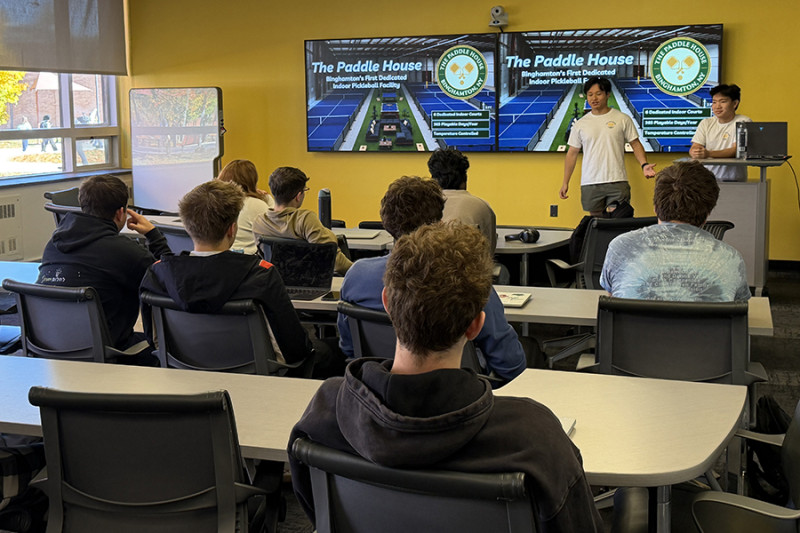
In the Glenn G. Bartle Library’s Innovation Lab, around two dozen students gathered in anticipation for a guest talk. The day’s speaker was Shark Tank survivor-slash-veteran Tomo Delaney-Lethbridge. He detailed his life journey and experiences that led him down the pathway of starting his company Noshi For Kids, which won “shark” Mark Cuban’s investment and stamp of approval, and continues to thrive.
Delaney-Lethbridge is an old friend and former mentee of Eric Krohn, director of business incubation programming in the Office of Entrepreneurship and Innovation Partnerships (EIP). And this is just one possibility of what a day might look like in Krohn’s Intro to Entrepreneurship course, the only class of its type at Binghamton available outside the School of Management.
“Entrepreneurs are found everywhere — and I would be willing to bet that there are more entrepreneurs outside the School of Management than inside,” Krohn said. “To me, it’s incredibly important that we continue to offer this class, because it’s open to everyone.”
Krohn’s class guides students through the methods, applications, and practice of entrepreneurship — a curriculum he has created and termed as MAP. From the first day of the semester, students jump into the deep end of startup ideation, before learning foundational skills like customer discovery and interviews, business planning, and pitching.
Developing a startup is actually a rather scientific process, Krohn said, likening processes such as customer discovery to a blind study. His students trek and trawl campus over the course of a month, collecting 20 interviews per week, gathering data and feedback, and testing their hypotheses of what ideas might or might not work.
By the time they amass around 80 interviews, students are ready to put their skills into practice: learning to turn their data into a proper pitch. After wading through the typical gripes and groans of working in groups, then conquering any lingering fears of public speaking, Krohn’s students come away from the course adept in entrepreneurial theater and science.
What is all this work for? A potential venture at Binghamton University.
“Every semester, I tell my students you have two options for the topic of your business, so to speak,” Krohn said. “You can either work on making students on campus happier, or you can start a business that makes students on campus less sad.”
Binghamton’s entrepreneurship bug
Intro to Entrepreneurship has been funded by EIP for a decade. Since Krohn took over the course, he said, he has seen students start their own spinouts, bloom into avid public speakers, and even pursue further business education.
“I always try to feel the class out every semester at the beginning and ask how many people here are interested in entrepreneurship. Maybe 10 to 15% say, ‘Yes, I’m interested in it,’” he said. “By the end of the class, that number is usually closer to 70%.”
The curriculum is unusual: Few college-level classes dispatch students to interview people on the street in the name of data collection and startup ideation. Moreover, the class provides rare opportunities to learn about tools like the business model canvas and simulated investor pitches.
“These students are coming out with so much more of a well-rounded education and understanding about entrepreneurship, and that should be the goal of any intro class: to truly understand the topic that you’re talking about,” he said.
Krohn’s maxim for students is to make their peers either happier or less sad. In the past, his students have done so in a number of ways, from starting culturally diverse and healthy food trucks to tackling homesickness and fitness, to relaxation spas and gaming businesses to battle stress and boredom. Students have pitched ideas to address parking complaints or improve community safety by offering safe late-night rides.
Several of these ideas have even become woven into the fabric of the University, Krohn added, visible in the international food trucks stationed around campus or mental health boosting activities like massages during finals week.
And the creativity doesn’t stop when the semester ends. Many of Krohn’s students return to his office or inbox for consultations on new business ideas.
“That entrepreneurship bug may not become overt just during the course of the semester. But the greatest gift that EIP gives is that we can put this bug into people’s minds through education,” he said. “Maybe it will come to them five years later. But as long as it does, I really think we’re doing justice to the students, by offering this class.”
For Binghamton senior Jason Moeller, the bug bit him in full. He is one of three co-founders who won the BLDC Business Plan Competition’s grand prize for an indoor pickleball facility. The Paddle House is slated to open this winter.
Student business winners
The Paddle House is the project of three friends: Moeller ’27, Brian Ng ’26, and Kai Chen ’27, but it isn’t Moeller’s very first venture.
Moeller is an economics major at Binghamton, while his other two co-founders are School of Management students. The first time he pitched anything was through Harpur Edge during his junior year, and he won third place in the competition.
“I definitely felt acknowledged to be a non-business student doing these business competitions. That was pretty awesome,” he said.
The idea at the time concerned a potential meal prep business with Chen, though the company didn’t end up managing to scale after the competition. In a classic entrepreneurial story of pitching and pivoting, Moeller and Chen, alongside Ng, ended up with The Paddle House by the next year.
While pickleball is gaining popularity in Greater Binghamton, there are no dedicated indoor spaces for the sport, particularly during winters, when conditions outside are less than favorable. The Paddle House aims to be the first year-round facility fully designed for pickleball and pickleball only.
“People can come and play and buy memberships and stuff like that, but it’s not just about that,” Moeller said. “We want it to be a place where people come and hang out and make new friends. Families can enjoy time together. It’s just a community-building spot for the area, and I think it’s needed.”
Submitting the idea to the Binghamton Local Development Corporation’s Business Plan Competition, Moeller, Ng, and Chen were among the eight businesses chosen as competition finalists to pitch before judges. BLDC’s competition is not a college contest — The Paddle House’s team was competing with founders from around the city.
“It’s a sign that we are educating these students to the point that they are able to not only apply for these things, but win,” Krohn said. “That is an amazing signal that we’re doing things correctly and with the right groups of people.”
Winning the BLDC competition’s grand prize was a major boost in allowing Moeller and his co-founders to pursue The Paddle House full throttle. Moeller sees The Paddle House as his future after graduation, with plans to stay in Binghamton to get the business off the ground.
The prospect of pursuing what he believed in and what he enjoyed had always drawn Moeller toward entrepreneurship. What fully lit the spark, however, was taking Krohn’s Intro to Entrepreneurship class during his freshman year.
“I had some interest in starting a business. I never knew what. I never knew how,” Moeller said. “His class is what gave me the initial guidance in the beginning, the small steps on how to fundamentally go about starting an actual business.”
Moeller named Krohn’s customer discovery unit as one of the lessons and techniques he still uses to this day. It’s easy for business owners to fall into bias regarding their ideas; the act of actually going out and deliberately seeking pushback, he said, is integral to the eventual success of the startup.
As for where The Paddle House falls in Krohn’s spectrum of happier to less sad, Moeller said it’s both.
“If you look at Long Island, which is where I’m from, there are pickleball facilities in every 30-minute radius you can think of. There are a couple in Syracuse. Binghamton just has not adopted this yet,” he said. “The goal of us coming here is to have people try something new, develop a new hobby, meet new people in the process — which brings happiness in itself. I think that’s really what we’re trying to do.”
From freshmen to founders
Even among high school students, interest in entrepreneurship is growing. Among faculty, spinning out companies is one way to demonstrate the impact of their research and innovations. As the business landscape changes and grows, Krohn said, fostering applicable skills early is imperative.
“It’s almost like fishing for oysters. You never know which oyster shell is going to have that pearl in it, but there are ones that do,” he said. “I think we need to start lending the opportunity for entrepreneurial growth and education and experience from day one with students.”
Beyond coursework, Binghamton offers an Entrepreneur Connect club for students.
“They will connect you to these competitions so that if you have an idea, you can pitch to a panel of judges,” said Moeller, a former member. “Who knows? You could be like me and actually end up winning money for it.”
At the moment, Moeller is parsing through the legalities of starting business operations. After all the paperwork comes the actual setup: Moeller and his co-founders will be spending the rest of fall designing the courts and bringing in equipment. Along the way, he has grown well-acquainted with Binghamton’s mayor, and he has even been recognized by strangers at places like Sam’s Club.
“I was just shopping, and somebody came up to me and asked, ‘Are you the pickleball guy?’” he said. “And I was like, ‘Yes, that’s me!’ It’s a great feeling.”
As the director of business incubation programming at EIP and the Koffman Southern Tier Incubator, Krohn has spent eight years mentoring founders and startups. He said there is something special about working with students.
“To affect someone’s life, that they walk away with something that you’re passionate about — that’s an egg,” he said. “That’s giving something to someone that they’re going to carry with them forever.”
It can be hard to tell if students are truly grasping the material. Seeing his students’ final projects — and what they pursue beyond the classroom — is what convinces Krohn he has succeeded.
“That’s nurturing the future,” he said. “I think any teacher probably cherishes that same sort of feeling. We’re not doing it for money at this point. You’re affecting the rest of life on this planet, in essence, and hopefully you’re teaching people awesome things so that you’re influencing life in an awesome way.”
For students like himself who might have an inkling of interest in pursuing business, Moeller encourages them to take Krohn’s class.
“If you have any interest going into it, he’ll only spark it more,” he said.
Perhaps the most important lesson Moeller has learned is to embrace the trials and tribulations along the way — like a true entrepreneur.
“Just try. I’ve obviously failed. The first thing I tried lasted a couple months. It was mainly just making food for friends,” he said. “It never actually got to be what the idea in my head was. But I’m glad I tried, because failure is not a bad thing.”
Even if his students choose not to go down Moeller’s path, Krohn said, the skills of entrepreneurship, from the confidence to lead projects to the ability to speak in public, extend beyond business ventures.
“These are the lessons that make us successful in life, no matter what you do, whether you’re a chef or mechanic or surgeon. I truly believe that taking this class — and the fact that it’s open to everyone — is one of the best things that you can do,” Krohn said. “Just be prepared to make people happier or less sad.”