


Wilmington startup Predicate is developing technology that could change how doctors identify life-threatening medical conditions before symptoms become severe.
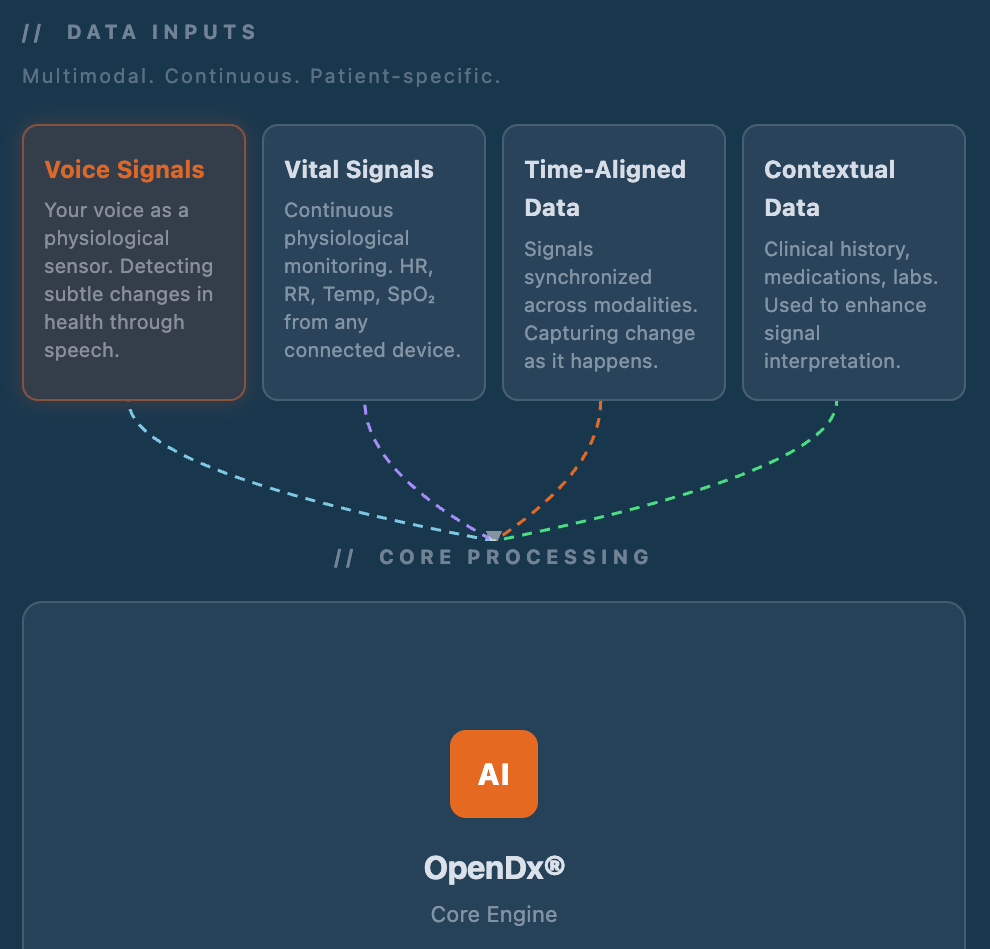
The startup’s initial product, OpenDx, combines voice data with traditional vital signs to identify patterns associated with sepsis, a potentially fatal condition caused by a particularly extreme bodily response to infection. Predicate claims to be the first company in the world to combine these two sources of data to predict sepsis, using its proprietary fusion algorithm.
The idea originated with Predicate founder Morris Nguyen, an intensive care physician who recognized an opportunity to make better use of the growing amount of health data being collected by wearable devices.
While treating critically ill patients, Nguyen saw the potential for technology that could give physicians a more complete picture of a patient’s health, allowing them to recognize signs of deterioration earlier and potentially intervene before conditions became life-threatening.
That realization led Nguyen to develop OpenDx, an AI-powered platform designed to analyze subtle changes in a person’s voice alongside physiological measurements, ultimately aiming to identify patterns of decline that may otherwise go unnoticed.
“What we’re doing is first transcribing everything they say and categorizing it into clinical entities, which gives us context,” Nguyen said. “Then, on top of that, we look at specific biomarkers within the voice. So now, voice becomes a vital sign.”
But Predicate’s ambitions extend beyond developing another healthcare software platform. The company is also working to bring its technology directly into medical devices and wearables through specialized semiconductor architectures.
“We are an intelligence stack that is first validated in software and then deployed on silicon,” Nguyen said.
Clinical trial updates
Sepsis is notoriously difficult to identify in its early stages, often presenting symptoms that resemble more common illnesses like the flu or pneumonia. That challenge made it a natural starting point for Predicate.
“I chose to build a model on sepsis detection first because it’s the hardest condition to detect,” Nguyen said. He added that it’s because it is so difficult to identify early warning signs that sepsis is responsible for approximately one in five deaths globally.
Of course, with a product addressing a problem like this within the healthcare industry, serious clinical trials are a must.
One of Predicate’s most significant findings came from a completed study involving 270 patients at Hospital Escuela in Tegucigalpa, Honduras.
Researchers initially planned to combine voice recordings with physiological data collected through WHOOP wearables. However, patient encounters averaged just 10 minutes, leaving insufficient time to establish reliable baselines.
“We had to throw out 270 wearable records. We couldn’t use it, so we were left just with voice data,” Nguyen said.
Patients were asked standardized questions, and their responses were recorded, transcribed, translated and analyzed by OpenDx’s AI model. The model focused only on the content of patients’ responses, identifying patterns in how they described their symptoms.
Nguyen said the model successfully identified 98% of patients with sepsis, highlighting the potential diagnostic value of analyzing patients’ descriptions of their symptoms. He also contrasted the study’s findings with the difficulty clinicians face in identifying sepsis early, describing conventional detection as “the flip of a coin.”
While studies report varying detection rates, sepsis is frequently missed during initial assessments—particularly by emergency medical personnel. When overlooked, it can go undetected until the patient’s condition significantly deteriorates, delaying critical treatment.
Predicate is also conducting studies in Ireland, Chile, and North Carolina in collaboration with Duke and Novant Health.
Health Hubs
Nguyen was particularly excited about the company’s emerging work in Africa, where Predicate is exploring how its technology could support last-mile healthcare delivery and maternal health using through something called a Health Hub.
The solar-powered hubs would use cameras, microphones and sensors to collect vital signs and analyze patients’ voices. Patients would follow on-screen instructions and answer questions through an AI agent or telemedicine connection, enabling the system to assess their health without requiring a medical professional to be physically present.
The initial focus is maternal and neonatal health, with a study scheduled to begin in mid-November across five maternity hospitals in Kenya. Nguyen said the company is working with organizations including UNICEF and has participated in discussions with the World Health Organization.
Nguyen said the initiative is being driven in part by foundation funding for healthcare access technologies, particularly in communities where traditional medical infrastructure is limited.
“We’re solving for the problem of lack of access to care, and in a very vulnerable, highly susceptible population,” Nguyen said.
He hopes to deploy 20 health hubs across Africa over the next year, potentially reaching tens of thousands of mothers and babies. Eventually, Nguyen envisions bringing the same technology to rural communities in North Carolina and elsewhere in the United States.
“These hubs are designed to create access points to healthcare anywhere in the world,” Nguyen said.
Five-year plan
Over the next year, Nguyen hopes to advance OpenDx toward regulatory approval, with plans to submit the company’s sepsis prediction technology to the FDA by October 2027.
Looking five years ahead, Nguyen envisions OpenDx moving beyond a cloud-based software platform and becoming embedded directly into medical devices and wearables through chips using Predicate’s proprietary semiconductor designs, which are in development.
“Where we want to end up is that OpenDx is on a chip, and that chip is inside an OEM partner’s device, close to the source of the signal,” Nguyen said. “We do that through white-label licensing. You know those ‘Intel Inside’ stickers? I’d love to be able to stick ‘OpenDx Inside’ on a bunch of devices.”
QUICK BITS
Startup: Predicate AI Labs
Founder: Dr. Morris Nguyen
Founded: 2024
Team size: 6
Location: Wilmington
Website: predicatelabs.ai
Funding: Pre-seed closed, raising seed
The platform is designed to work across wearable devices, collecting physiological data over time to establish a baseline of a person’s health. When a patient begins experiencing symptoms, OpenDx can compare new measurements against that historical data, combining them with voice analysis to identify potential signs of deterioration.
For Predicate, the goal is to give patients a better understanding of what is happening in their bodies while providing doctors with more context to make informed decisions.
“So that’s what we’re offering, is that peace of mind,” Nguyen said. “Like, look, someone is checking, or at least something is checking all the time, and is trying to make sense for you.”
Source link