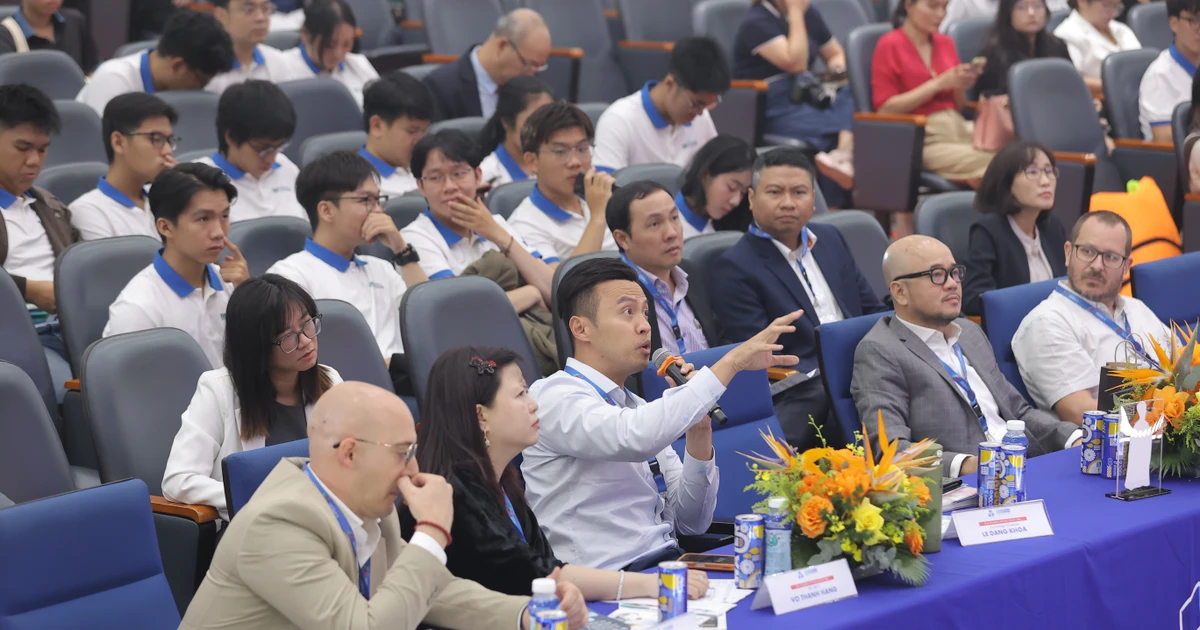
The 2026 final round took place at the University of Technology (Vietnam National University Ho Chi Minh City), bringing together 57 projects, including teams from 8 countries. This year’s competition saw 408 projects registered from Vietnam and more than 20 countries worldwide , demonstrating the competition’s growing appeal.
Over nine seasons, Bach Khoa Innovation (BKI) has gradually expanded its scale and international networking opportunities, becoming a platform that fosters entrepreneurship and innovation among students.
The Education and Times newspaper interviewed Associate Professor Pham Dinh Anh Khoi, Director of the Innovation Center, Ho Chi Minh City University of Technology (Vietnam National University Ho Chi Minh City), to clarify the appeal of the competition and the support solutions available for students in developing their startup ideas.

– Looking back at the competition’s development over the past 9 years, how would you assess the remarkable changes in BKI, from its scale and project quality to its appeal to domestic and international students?

– In my opinion, the most notable change after 9 seasons is that BKI has expanded from a platform for ideas into an environment for developing scientific and technological solutions and innovations linked to business practices.
Starting with 50 projects registered in the first season in 2018, the competition, originally for students of the University of Technology (Vietnam National University Ho Chi Minh City), has continuously expanded in scale. By its 9th season, the competition had 408 registered projects, including 38 international projects; 57 projects reached the final round, with 9 international teams from 8 countries.
From a single university-level competition in its first season, the contest has evolved into two groups: Creative Entrepreneurship (comprising three categories: High School, University, and Startup) and University-Business. The University-Business categories are organized in collaboration with businesses, creating an environment for developing innovative solutions to address practical problems posed by businesses.
In terms of project quality, the solutions increasingly demonstrate the ability to address the problems of modern society, linked to digital transformation. Notably, in this year’s University category, there’s the VieGrand AI Plus project, combining AI cameras, the VieBot robot, wearable devices, and a mobile application, aimed at supporting health monitoring, fall detection, and stroke risk warning in the elderly. In the University-Enterprise category with Dow Vietnam, the ECOVAL project develops non-fired ventilated bricks from multi-layer plastic packaging and rice husks, combined with a digital platform using AI.
Through this, the competition creates an initial technological and market foundation for projects to move towards commercialization by refining the product based on customer feedback and usage effectiveness.

– What factors have helped the competition gradually build its current position?
Domestic teams gained an expanded international experience right here in Vietnam, while international teams had the opportunity to learn about real-world problems and connect with the local innovation ecosystem. The FloodGuard Technologies team from Universiti Malaya ( Malaysia ), which won first prize in the University category with their AI-integrated UAV solution for flood rescue, is a prime example of the quality of professional exchange.
For students, the appeal of the competition also lies in the process of perfecting the product, honing project development and presentation skills, and building connections that can continue after the final round.
The network of partners also contributes to creating additional resources and ensuring the credibility of the competition. Sponsoring organizations include the National Innovation Center, the Innovation Department, and the Ho Chi Minh City Department of Science and Technology. The French Embassy is both a strategic partner and a diamond sponsor, along with a system of domestic and international sponsors, notably VNPT Group and TISI Company from Japan .
Regarding the factors that build the competition’s standing, in my opinion, the first foundation is the capacity, reputation, brand, strengths in science and technology, innovation, and the network of businesses and partners of the University of Technology. Along with that is the effort to maintain, develop, and elevate the competition’s international standing in line with the university’s strategic direction on innovation and internationalization in each season.
Next, the approach involves linking idea development with critical feedback and business collaboration. In the University-Business group of BKI 2026, Dow Vietnam, Schneider Electric, and Indefol GmbH directly presented challenges related to plastic circularity, energy management, and sustainable development.
– The internationalization process of BKI opens up opportunities for exchange, learning, and interaction with teams from many countries. In your opinion, what specific values does this process bring to Vietnamese students?
– The most important value of internationalizing the competition is that it helps Vietnamese students broaden their perspectives on issues and evaluate solutions within the context of borderless innovative thinking, linked to the global socio-economic environment.
With the same need, teams from different countries may choose different technologies, target customers, or business models. Through the project development process throughout the competition, students understand that a good solution needs to be suitable for the usage conditions, affordability, and cultural context of each market.
The second value is the training and development of skills for working in an international environment. Through the competition, Vietnamese students have the opportunity to practice expressing ideas fluently in English, presenting evidence, answering challenging questions, and respecting different approaches.
Next, connections will be formed that can develop into professional exchanges, co-development of products, or exploration of local markets between Vietnamese and international teams; and between the teams and the network of experts and businesses at the University of Technology, both domestically and internationally.
This is a crucial opportunity for teams to expand their project development capabilities, aiming to conquer the global market in the future.
By competing with international teams, Vietnamese students can better identify their strengths and weaknesses, enabling them to further enhance their creative abilities and their capacity to bring ideas to market.
In my opinion, teams can self-assess themselves based on four key aspects from a global market perspective: how well-validated the problem and customer are; whether the technology has the potential to be registered for intellectual property rights and what proof-of-concept prototypes exist; whether the business model convincingly explains costs, revenues, and market approach; and whether the team has the necessary implementation and collaboration capabilities.
Self-assessment based on these aspects is not only useful for the solution development process but also helps teams improve the innovative entrepreneurial capabilities of individuals and the team as a whole.

For Vietnamese students, their professional background and understanding of local needs can be an advantage if translated into a product with clear evidence. I think each team, whether domestic or international, has its own strengths and weaknesses. The important thing is that teams need to rely on specific feedback to identify their gaps. When Vietnamese students learn from evidence and flexibly adapt their solutions to market needs, international experience will help them develop their creative abilities and gradually access the international market.
– In the context of innovation playing an increasingly important role in economic development, how do you view the significance of entrepreneurship in the training of university students?
– Entrepreneurial activities linked to innovation are becoming increasingly significant for society in general, and especially for university students.
Being trained and experiencing innovative entrepreneurship during their studies is a method that helps students develop the ability to create and verify value for the market from the knowledge and skills acquired in the classroom. Through the learning and experience process, students gradually improve their capabilities such as identifying problems from a market perspective, coordinating interdisciplinary knowledge, mobilizing resources, collaborating, learning from experience, and taking responsibility for the results.
These skills will be useful for students after graduation, whether they choose to work in a corporate environment to gain experience and life skills or decide to start their own business.
– Based on your experience in implementing entrepreneurship and innovation activities for students, what do you think universities, innovation centers, and incubators need to do to support students in developing ideas, perfecting products, and gradually bringing them to market?
– I think the school and the aforementioned units have four main tasks.
Firstly, the school needs to continue refining the framework and roadmap for creative entrepreneurship training according to international standards in the curriculum of all majors and specializations, especially in the engineering field.
In the course syllabi, including projects, the school should collaborate with partner businesses to incorporate practical problems related to business and market needs. This helps equip students with the necessary foundational knowledge to develop innovative entrepreneurial thinking during their studies.
Secondly, it is necessary to inspire and motivate students to participate in innovative entrepreneurial activities. Accordingly, innovation centers and incubators should organize events such as workshops, seminars, and exhibitions, sharing experiences, success stories, and the values that teams can create in the future. Through these events, students gain more awareness and motivation to invest appropriately in their ideas.

At the University of Technology, the four-stage roadmap of training – inspiring – experiencing – incubation has been implemented and perfected since 2018. Prior to that, the university established the Technology Business Incubation Center (now the Innovation Center) in 2010, the Innovation FabLab for Prototype Manufacturing to Support Startups in 2022, and organized the first season of the annual Bach Khoa Innovation startup competition in 2018.
Currently, the university is continuing to refine its ecosystem to support innovative startups, aiming to assist in the commercialization process not only for students but also for alumni, faculty, and startups in the community. Through this, knowledge can be transformed into valuable assets, contributing to the development of the university, Ho Chi Minh City, and the country.
Thirdly, schools need to create conditions and opportunities for students to experience innovative entrepreneurial activities, typically applied scientific research projects, business-linked projects, and innovative entrepreneurship competitions like BKI.
Innovation centers and incubators need to strengthen and expand cooperation with businesses, incorporating specific business problems and needs into project content or competitions, while leveraging the support of partner networks during implementation. Research activities and startup competitions for students also need investment from universities to ensure effective organization, providing practical support and value to all participants.
Finally, promising innovative student startup projects, after demonstrating initial value to businesses or the market through business collaborations or competitions, need to be further nurtured to better meet real-world needs.
To be effective, innovation centers and incubators need well-structured incubation programs, support resources, and collaboration from supporting organizations, investment funds, and receiving businesses.
Thank you very much, sir.