Factors influencing young people’s entrepreneurial intentions
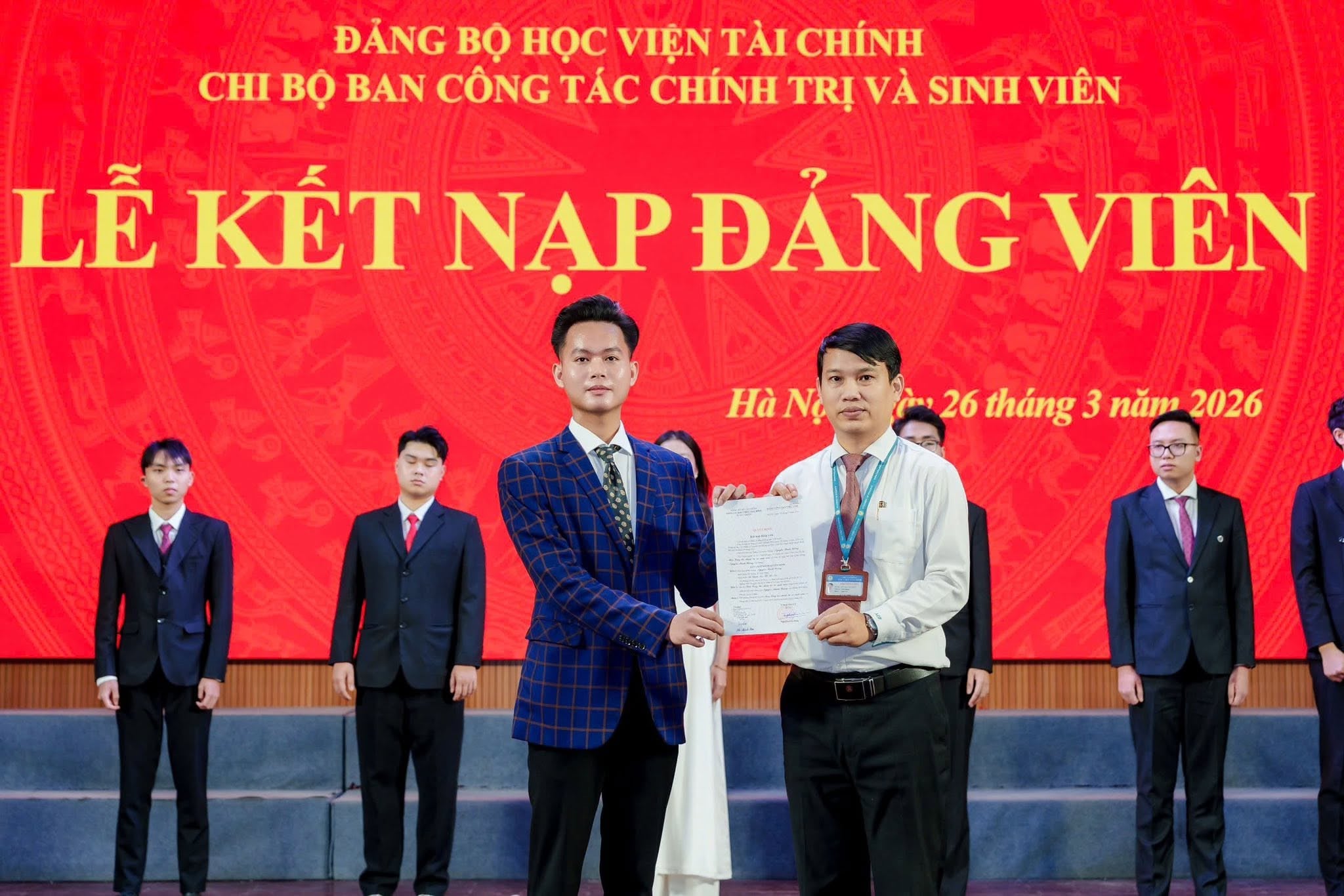
Nguyen Manh Hoang is currently a fourth-year student majoring in Public Financial Management at the Faculty of Public Finance, Academy of Finance. Besides his studies and research, Hoang also serves as the Deputy Secretary of the Youth Union of the Faculty of Public Finance.
Hoang is particularly interested in the government’s approach to finance. His knowledge of public finance management helps him view resources not only through revenue and expenditure figures, but also through the question: How are policies designed and allocated to create a real impact on people’s lives?
From that interest to competitions and programs promoting entrepreneurship among students, the young man began to think more about the gap between an idea and the ability to turn that idea into reality.
“Young people may have knowledge, ambition, and an innovative spirit, but not everyone is ready to start. Lack of capital, limited connections, and difficulty building trust with potential investors are obstacles I’ve encountered on my entrepreneurial journey. From that, I posed a question from the perspective of someone studying public finance: Does the government ‘s financial support policy only help young people overcome difficulties in accessing capital, or can it also influence their mindset and strengthen their confidence to boldly start businesses?” Hoang shared.
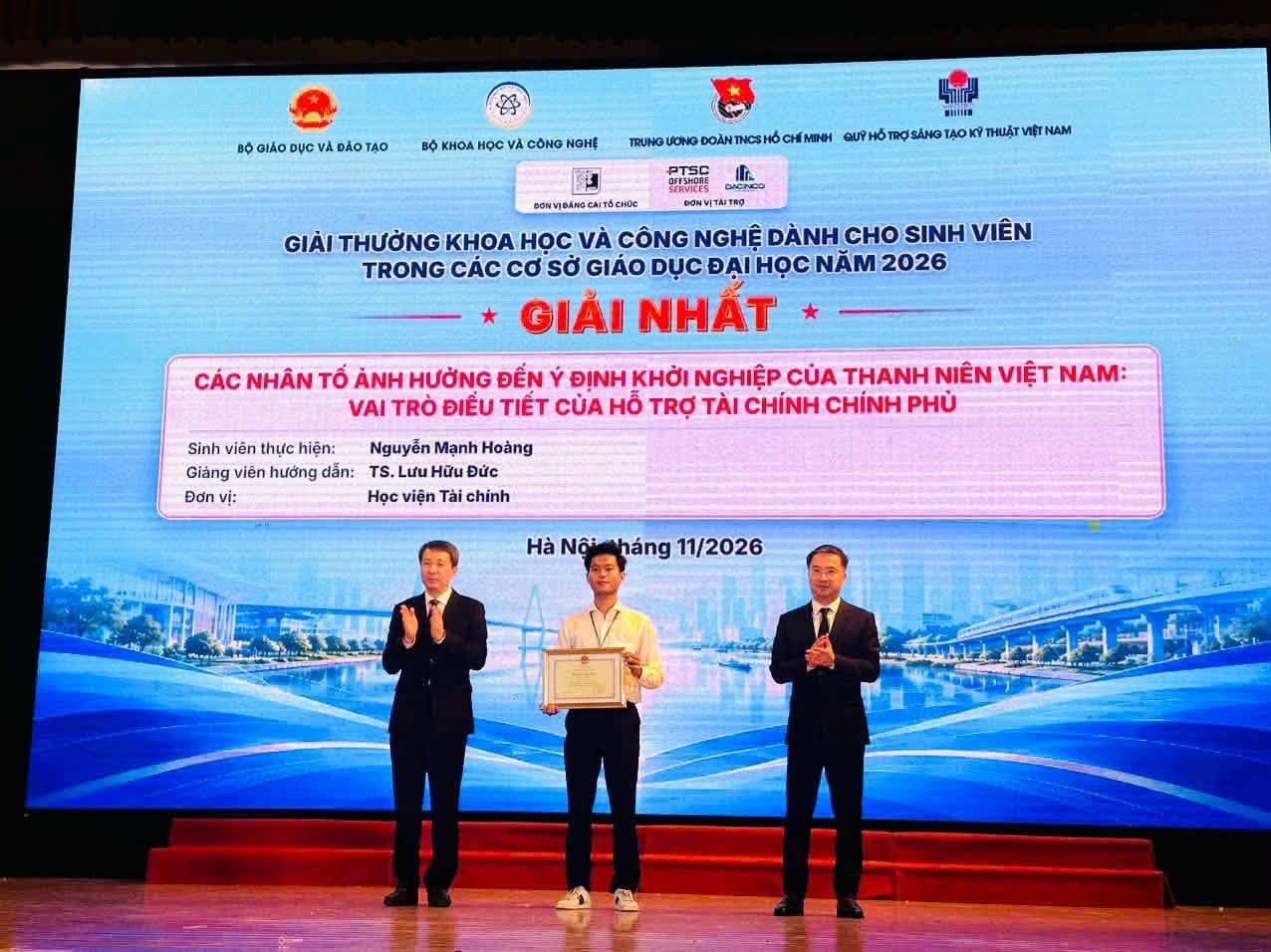
That question became the guiding principle for the research topic “Factors Influencing the Entrepreneurial Intentions of Vietnamese Youth: The Regulatory Role of Government Financial Support”. The study addresses two key issues: identifying the psychological factors influencing entrepreneurial intentions and clarifying the role of government financial support in relation to these factors and the decisions of young people.
To find the answer, Hoang and his research team surveyed 1,681 young people aged 16 to 30 in the North, Central, and South regions of Vietnam, from various professions and fields. The large survey scale placed significant demands on the questionnaire design process, as entrepreneurial intentions are influenced by many psychological factors that are difficult to observe and measure directly. The differing economic circumstances, living conditions, and perceptions among participants also necessitated careful consideration in designing the survey tools.
Another challenge lies in the very focus of the research. If only factors directly impacting entrepreneurial intentions are considered, the study will fail to answer the research team’s most pressing question: How might government financial support alter the impact of psychological factors?
To solve the problem, Hoang proactively searched for, compiled, and compared scientific documents from both domestic and international sources; consulted with his supervising lecturers, and gradually refined the model, measurement scales, and data analysis methods. This process required the researcher not only to have a firm grasp of specialized knowledge but also to persistently verify each hypothesis, ensuring that the results were well-founded.
From the survey data, a notable finding pointed out by Hoang and his research team is that the approval and support of family, relatives, and society have the greatest impact on the entrepreneurial intentions of young people in the study sample. When family and community support is available, young people have more motivation to pursue their ideas.
Survey data also shows that government financial support does not directly impact entrepreneurial intentions. The role of policy lies in its ability to regulate and enhance the impact of positive psychological factors. Specifically, government support can help strengthen family and societal support for entrepreneurial choices; and at the same time, help individuals better understand their own capabilities and the external resources they can access.
“This finding has given me a broader perspective on startup support policies. Financial resources are not only significant in terms of their material value but can also build confidence, helping young people feel that their entrepreneurial path is grounded and recognized by society. In other words, for a policy to be effective, in addition to allocating capital, attention must be paid to accessibility and the impact of the policy on the awareness of the beneficiaries,” Hoang emphasized.
Based on the research findings, Hoang believes that one of the immediate requirements is to improve access to existing support programs. In reality, many students are not fully aware of or do not know how to access these resources. Therefore, strengthening communication to help young people clearly identify the programs, conditions, and methods of access is necessary.
In addition, it is necessary to continue improving the startup ecosystem, simplifying administrative procedures, increasing market transparency, and designing financial support that is appropriate for each stage of startup idea development. According to Hoang, the effectiveness of policies should not only be judged by the scale of capital or the number of beneficiaries supported, but also by assessing their ability to impact the awareness, behavior, and decisions of the recipients.
Hoang hopes that the research will contribute to a more scientific basis for improving policies to support youth entrepreneurship, especially in enhancing access to information, capital, and the effective use of state financial support tools.
“The process of scientific research has helped me grow.”
When Hoàng learned that his project had been named the winner of the top prize at the 2026 Science and Technology Award for students in higher education institutions, he couldn’t hide his surprise, emotion, and happiness.
“This result is a recognition of the efforts throughout the research process, and it reminds me of the support of my teachers, family, and friends. In particular, I would like to thank Dr. Luu Huu Duc – my supervising lecturer – who accompanied me throughout the project. He not only provided professional feedback, helping the group refine the model and research methods, but also encouraged students to think independently, boldly ask questions, and persistently defend their arguments,” Hoang shared.
Looking back on his journey, Hoang believes that what he has gained is more than just an award. Scientific research has helped him change his approach to problems: from passively receiving knowledge in the classroom to proactively asking questions, seeking evidence, analyzing from multiple perspectives, and being more cautious when making judgments . His knowledge of public financial management has also become more relevant as it is applied to explain a practical problem in real life.
Regarding future plans, Hoang hopes to continue improving his research capabilities, especially in quantitative analysis methods and evaluating the impact of public policies. Along with that, he plans to develop his research topic further by delving deeper into the effectiveness of financial support tools for young entrepreneurs, and seeking opportunities to publish his findings in reputable scientific journals.
Hoang himself has always harbored the desire to start his own business in the future. But for now, he wants to accumulate more knowledge, experience, and research skills to apply to his work, especially in the fields of public finance, policy planning, and implementation.
Addressing students who are hesitant about scientific research, Hoang advised: “Don’t wait until you’re good enough to start scientific research, because the research process itself will help us grow and become better. The greatest value of research lies not only in awards or achievements, but also in what each person learns and the growth they experience after persistently pursuing a problem.”
Source link