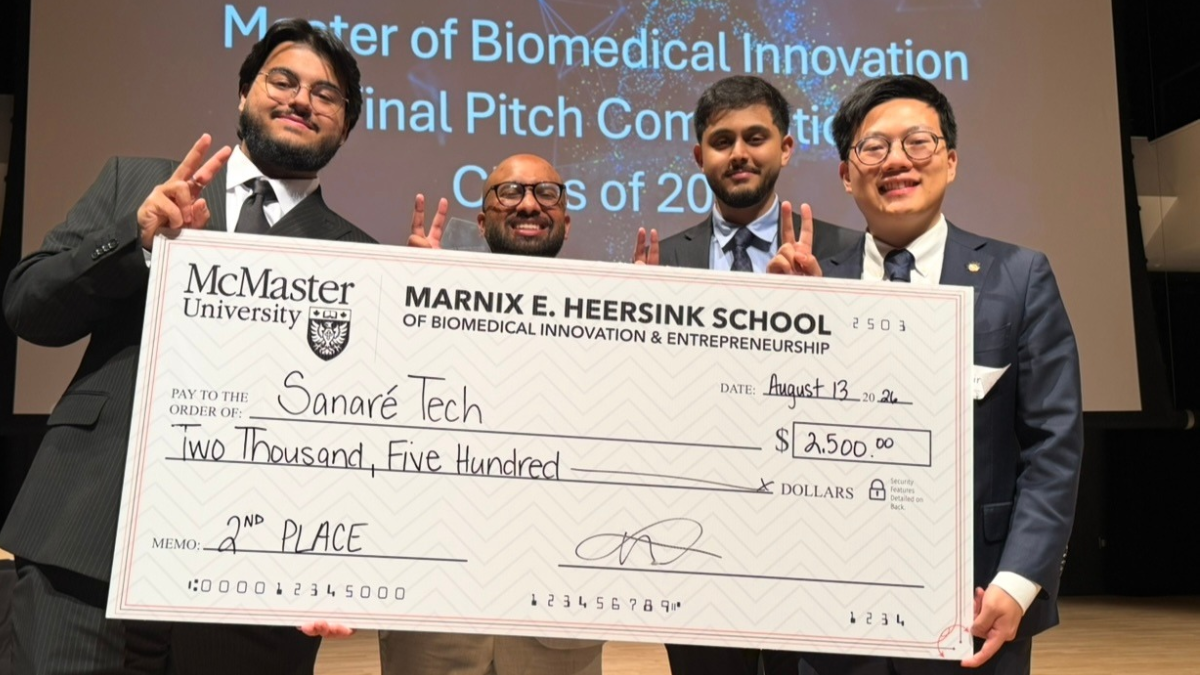
A team of McMaster graduates have together founded a start-up meant to transform post-knee-surgery rehabilitation.
What began as a clinical immersion project in McMaster University’s Master of Biomedical Innovation (MBI) program has led to a lasting friendship and an award-winning venture aiming to transform post-knee-surgery rehabilitation.
Manupa Dissanayake, Jialiang (Kevin) Hu, Sarim Shiraz and Dhrutaaksh (DJ) Jhaveri had never met before they were grouped together on the first day of the MBI program. They were placed in a rehabilitation and pain medicine setting, spending time observing physicians, clinicians, and patients.
“The objective was to identify problems that doctors are facing and determine which ones are worth solving,” says Hu. “We weren’t there to start a company right away. We were there to observe, listen and understand the challenges clinicians face every day.”
Through careful listening and observation, the team quickly identified a problem: People recovering from knee surgery do most of their rehabilitation at home, leaving clinicians with limited insight into what happens between appointments.
“Through hundreds of patient and physician interviews, we discovered that the root problem is that doctors don’t have access to quantitative objective data that can reliably support clinical decisions,” Hu says.
The solution
Identifying that gap in recovery data became the foundation for the team’s solution. With that in hand, and in consultation with advisors from within MBI, the team designed the Sanaré Sleeve, a sensor-integrated compression knee sleeve that provides objective data throughout the rehabilitation process.
“Our sensor integrated system measures muscle activation, range of motion and joint strength using flexible sensors that move with the knee,” Shiraz says. “By providing greater visibility into recovery between appointments, Sanaré supports more personalized rehabilitation, more informed return-to-activity decisions and improved patient outcomes.”
The team used the creation of the sleeve to catapult into the start-up space, founding Sanaré Technologies. Their mission is to make recovery visible.
“Our vision is a future where every patient can recover with confidence, supported by accessible technology that connects home rehabilitation with clinical care,” says Shiraz.
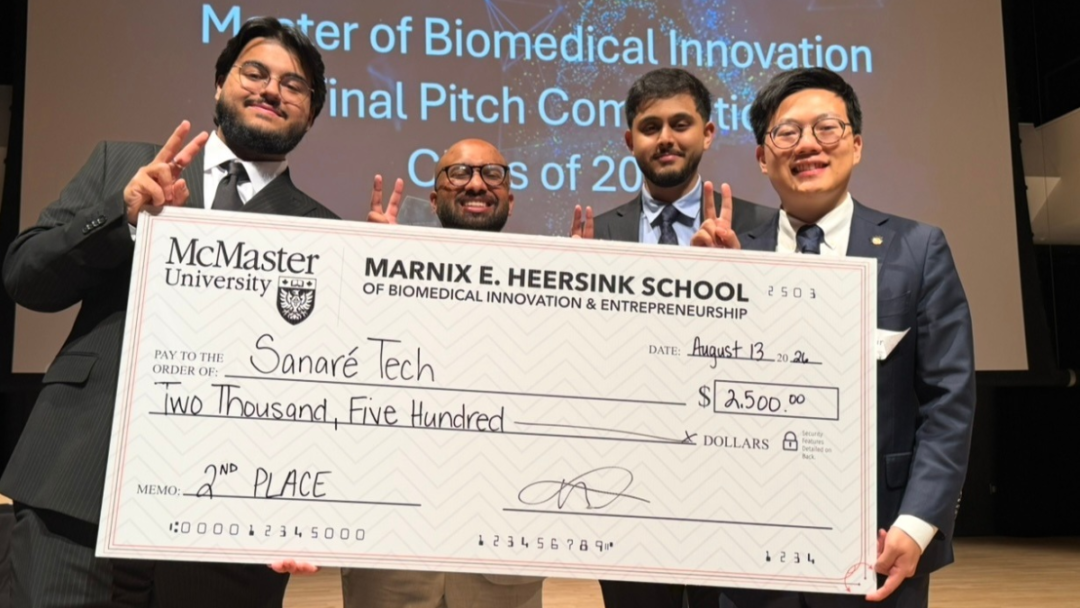
The team’s work has already earned recognition within McMaster’s innovation ecosystem. Sanaré Technologies placed second at the 2026 MBI Final Pitch Competition, while co-founder Dissanayake received the inaugural Dr. Alan Neville Legacy Award for Innovation Leadership and Impact. The startup was also selected as a top-five finalist in The Forge’s Startup Survivor Pitch Competition.
Keys to success
With the many accolades under the belt of Sanaré, the team says its success stemmed from their experiences within the MBI program.
They specifically highlight how the program allowed them to test ideas, make mistakes, and learn before entering the market.
“The year we spent together at McMaster was probably one of the most impactful of our careers. The Master of Biomedical Innovation program gave us the tools and the environment we need to really take that leap of faith to start a company, while the connections and network were extremely important,” Dissanayake says.
Dave Mammoliti, program director of the MBI program, says the success of the team validates the approaches and the learnings they try to instill in students.
“What makes this team’s success so compelling is that it followed the exact process we try to teach in MBI. They started by listening, observing and understanding a real clinical challenge before ever thinking about a solution. Their willingness to validate the problem, work through uncertainty and learn from failure is what ultimately transformed a classroom project into an award-winning venture,” Mammoliti says.
With convocation happening this month, the founders of Sanaré will cross the stage and complete their journey through the MBI program. They’re eager for the company’s next chapter, with plans to expand Sanaré through seed funding and validation studies in both Canada and the United States.
“We see these experiences as opportunities to build our skills, deepen our understanding of the industry, and bring what we learn back to Sanaré as we work to turn our vision into reality,” Dissanayake says.
“We’re excited for what comes next.”
Education