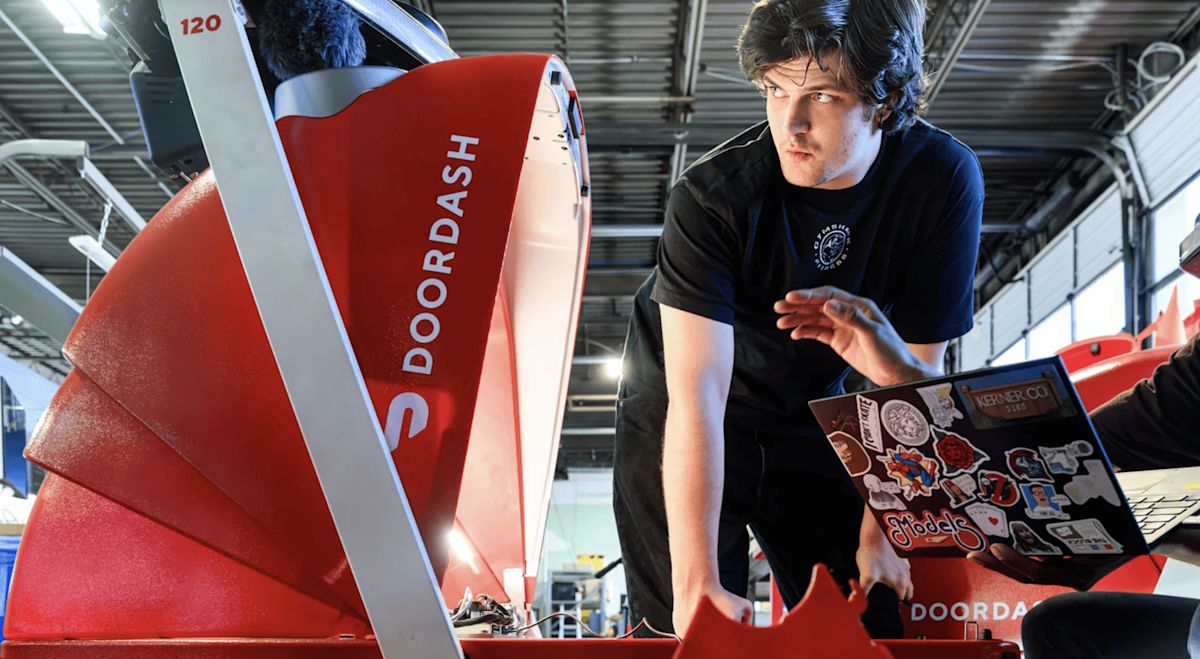
Operational efficiency across the retail supply chain—from product to point of sale all the way to the customer’s door—is getting a significant tech boost. This week, DoorDash is doubling down on AWS to scale its autonomous delivery fleet.
Futuriza in Brazil is using generative AI to create its high-end fashion photography presets. And we learn that Nedap is introducing real-time RFID visibility to a new retail concept in Germany.
More from WWD
Advertisement
Advertisement
DoorDash expands partnership with AWS
DoorDash named Amazon Web Services (AWS) as its preferred cloud provider in a multi-year deal designed to scale its autonomous delivery technology. The deal extends the existing partnership, which has been in place since 2013, with DoorDash Labs engineers using the AWS cloud and AI to put the capabilities of an autonomous vehicle into Dot, the cooler-sized delivery robot that is designed to operate in bike lanes and on the street at speeds of up to 20 to 25 mph.
Beyond training Dot to navigate the real world and “learn the rules of the road,” AWS Compute (the cloud services) is the engine that powers DoorDash’s entire Autonomous Delivery Platform. The AI-powered dispatching system looks at a whole range of real-time variables such as distance, order size, traffic, local Dasher availability, etc., and then determines the best way to fulfill that order, which could be a human Dasher, a drone or a Dot robot.
DoorDash is relying on AWS to process massive volumes of fleet and routing data at scale in order to rapidly identify and resolve navigation bottlenecks and keep its AVs moving at speed and reliability as the markets grow. The multi-modal approach will see the robots taking on the shorter, more routine neighborhood trips in the high-volume areas and the human couriers will be freed up to take on the longer, more complex deliveries.
Advertisement
Advertisement
The “Canva” of fashion?
Futuriza, a Brazilian fashion-tech startup, said it has officially launched Futuriza Studio, which is a generative AI photography platform dubbed the “Canva of Fashion.” The company said he announcement arrives alongside a $1.5 million investment from global VC Antler (Singapore), with the company already preparing a $10 million series A round for global expansion.
“Unlike complex AI imagery tools that require intricate prompt engineering, Futuriza Studio is entirely preset-based,” the company said. “Users simply select from a robust library of models, poses, backgrounds and preset campaigns.”
The company said the turnkey system was developed by industry experts who used AI workflows that were “already battle-tested over 1 million times by iconic brands like Calvin Klein and Farm Rio.”
Advertisement
Advertisement
“We are bridging the gap between scale and premium aesthetics,” said Felipe Silva, CEO and founder of Futuriza. “Futuriza Studio gives brands the power to showcase products digitally without the staggering costs of traditional photoshoots.”
Nedap opens at S. Fashion
Nedap, the item level inventory visibility provider, is showcasing its RFID retail technology at S.Fashion.
S.Fashion is a new fashion innovation store, which opened at SAP’s HQ in Walldorf, Germany, on Nov. 11. It’s based on VF Corporation’s O11 multi-brand retail concept and functions as both a working store and a live testbed that connects the in-store shopping experience with the back end of retail operations. The company said the deployment is part of its wider partnership with VF Corporation, who are rolling out the Nedap Inventory Engine across their entire brand portfolio and over 1,500 stores to eliminate stock discrepancies and improve product availability across all sales channels.
Advertisement
Advertisement
Inside the new S.Fashion space, the Nedap Inventory Engine is the central RFID truth engine, providing real-time product data to the three key store functions. There are overhead RFID readers, which allow the customer to find the product themselves. The iD POS Pro and Self Checkout solutions incorporate the inventory tracking into the checkout process and the iD Gate PRO is used to monitor store exits and trigger an alarm if unsold product is leaving the floor.
Best of WWD