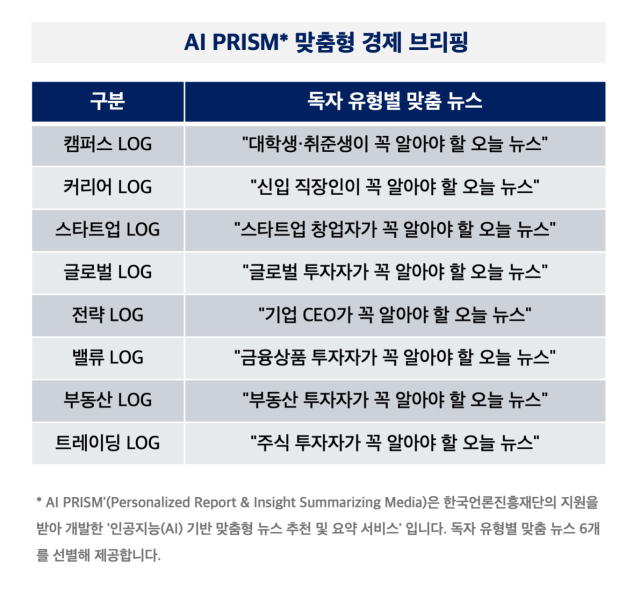
▲ AI PRISM* Personalized Economic Briefing
* Editor’s note: AI PRISM (Personalized Report & Insight Summarizing Media) is an artificial intelligence-based personalized news recommendation and summary service developed with support from the Korea Press Foundation. It selects and provides six news items tailored to each reader type.
■ Toss global super app: Viva Republica has set up a local unit in Canada, extending its overseas footholds across Oceania, Europe, South America, Asia and North America. Cumulative revenue for the first three quarters of this year came to 2.92 trillion won, with net profit of 238 billion won. Drawing on its experience of attracting customers in Korea through simple money transfers and then broadening its services, Toss plans to start with frequently used features in each market before widening its business scope. Market watchers say Toss is successfully carrying out an overseas expansion experiment that even established financial firms have not managed.
■ Global fast-food industry: KFC India has rolled out menu items using gochujang sauce at more than 1,400 outlets, while McDonald’s Korea’s gochujang butter sauce campaign has spread to 13 markets across Asia. With global fast-food chains launching one Korean-sauce menu item after another, food-tech and consumer goods startups may find it worth examining whether large restaurant operators can serve as a distribution channel.
■ Defense tech startups: Forge, a U.S. platform for trading private company shares, estimated Saronic’s valuation at about $12 billion. That is up roughly 30% in about six months from $9.25 billion at the time of its Series D round in June. IMM Investment was the only Korean asset manager to join the Series D. The increase has been attributed to the company’s combat performance with the U.S. Navy, and expectations for overseas expansion are also growing as the Greek navy moves to adopt the vessels. Startups in physical AI and autonomous systems may want to note that combat results and government orders can translate into higher valuations.
[News of Interest to Startup Founders]
– Key points: Toss has set up a local unit in Canada, expanding its overseas business footholds to five regions. According to McKinsey and QED Investors, the North American fintech industry generated $310 billion in revenue last year, close to half of the global total. Canada is moving to introduce open banking, which could play to Toss’s strength in consolidating financial services scattered across multiple providers into a single app. In Australia, its first overseas market, the company combined a financial dashboard with everyday benefits, and in Canada it is expected to look for opportunities to extend into transfers and payments on the basis of services built around financial information. Cumulative net profit for the first three quarters of this year was 238 billion won, up 47.3% from a year earlier. Delivering results overseas as well is expected to strengthen assessments of its growth potential in any future initial public offering. For founders, the approach of leading with frequently used features and then expanding services offers a reference case for cutting the cost of overseas expansion while testing the market at the same time.
2. KFC and McDonald’s Have Fallen for Gochujang: Korean Sauces Spread Worldwide
– Key points: KFC India launched “Korean Dunked,” made with gochujang and sesame sauces, at more than 1,400 outlets, and McDonald’s Australia introduced a Korean-style barbecue sauce menu item at all of its local stores in April this year. The gochujang butter sauce campaign developed by McDonald’s Korea has been running in 13 markets across Asia since September, with menu line-ups varied to suit consumer tastes in each country. No Brand Burger released its “Real Bibimbap Burger” on the 30th of last month. Average daily sales at outlets with heavy foreign traffic, such as the Seongsu Lab, Yeoksam and COEX stores, were five to six times the nationwide average. Korean-style chicken accounts for more than 40% of chicken sales at Lotteria in Vietnam. The trend of global restaurant operators adding Korean-sauce menu items gives startups without their own distribution networks a reason to consider whether large restaurant chains can serve as a sales channel.
– Key points: Saronic, a maker of autonomous unmanned surface vessels (USVs) built on physical AI, is valued at about $12 billion based on figures from Forge, a U.S. platform for trading private company shares. That is up roughly 30% in about six months from $9.25 billion at the time of its Series D round in June. In July, the U.S. Navy used three Corsair vessels to strike Iran’s Bandar Abbas naval base, among other combat deployments, and in September the company was selected as a producer for the U.S. Navy’s medium unmanned surface vessel program. The Greek navy is moving to acquire more than 30 vessels following tests in October and has submitted a purchase request to the United States, though this has not yet led to a contract. IMM Investment was the only Korean asset manager on the Series D investor list, and Saronic is preparing for an IPO targeted for 2030. As a case showing how government orders and combat performance can translate into a higher valuation, it is worth noting for startups focused on business-to-government deals.
[Reference News for Startup Founders]
– Key points: The Brookings Institution estimates that U.S. AI infrastructure investment will reach $10.3 trillion, or about 13,870 trillion won, between 2025 and 2032. The U.S. consumer price inflation rate rose again to 3.7% in September. As data center construction increases, costs for semiconductors, electricity and construction labor are rising, and some analysts say AI investment is offsetting the effect of rate increases, meaning structural cost inflation could persist for three to four years or more. Whether 3% inflation becomes entrenched, however, remains uncertain. ABN AMRO Bank calculated that if annual AI investment reaches 3% of gross domestic product, the U.S. real neutral rate would rise by about 0.2 percentage points between 2026 and 2030. That could lead to a repricing of assets including stocks, bonds and real estate. Because a higher baseline for interest rates can raise funding costs, startups also need to reassess how long their cash will last.
5. MBK Focuses Investment on AI, K-Aesthetics and Governance
– Key points: MBK Partners Chairman Michael Byungju Kim identified AI, K-aesthetics, corporate governance and demographic change as promising investment themes in Northeast Asia at the firm’s annual general meeting. Kim projected that investment in Korean semiconductor manufacturing equipment will reach $86 billion from this year through 2028. Korean cosmetics exports grew from $6.5 billion in 2019 to $11.4 billion last year, while the combined share of the United States, Europe and Japan rose from 21.3% to 45.7% over the same period. Kim pointed to K-aesthetics as another investment area in Korea. MBK has invested about $1 billion in AI-related companies and $1.1 billion in three firms: Osstem Implant, Skin Idea and AXIS-Y. Osstem Implant generates about 70% of its revenue overseas. Kim said that alongside selecting growth industries, the firm would treat how companies manage their capital and the checks in place on management as key investment criteria. The remarks offer a reference point for gauging the investment standards of large private equity firms.
– Key points: Daewoong Pharmaceutical (069620) has registered a U.S. patent for using enavogliflozin, the main ingredient in its Envlo drug, to treat diabetes in canines. Inventage Lab received a decision to register a U.S. patent for its technology for a 12-month sustained-release neutering injection for pets. GNT Pharma is building a production system compliant with U.S. Food and Drug Administration and European Medicines Agency standards, aiming for U.S. and European approval of its canine dementia treatment Zedacure in 2028. To that end, it is working with Ireland’s Chanelle Pharma and in July this year signed a regulatory support contract with Knoell Animal Health. Korea’s exports of veterinary medicines last year rose 9.8% from the previous year to $330 million, and preliminary exports for the first half of this year came to $197 million. The strategy is to differentiate in overseas markets by extending ingredients from human drugs to animal use or by applying drug delivery technologies.
Source link