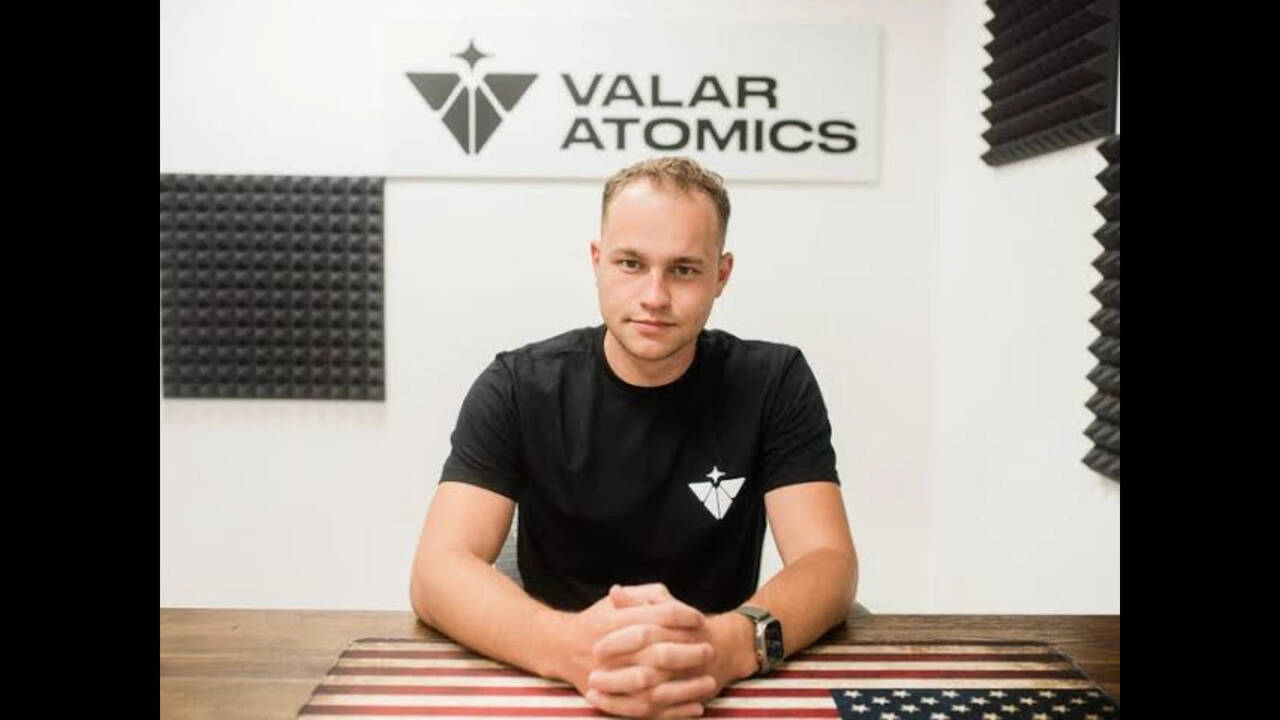
What does it take to build a billion-dollar company before turning 30? For American entrepreneur Isaiah Taylor, the journey began with an unconventional decision of leaving high school at just 16.
Today, at 27 years, Taylor is the founder and CEO of Valar Atomics which is a nuclear energy startup developing small modular reactors (SMRs) to meet the growing demand for electricity. The company has attracted significant investor interest and made headlines after demonstrating how electricity generated by one of its nuclear reactors could power an Nvidia AI system.
Taylor’s journey, from a teenage school dropout to the head of a high-profile nuclear energy startup, is an unusual success story, combining self-learning, entrepreneurship and an ambitious bet on the future of artificial intelligence.
Isaiah Taylor did not follow the traditional route to entrepreneurship. Instead of completing high school and pursuing a college degree, he decided to leave school at 16 and explore his interests in business, software and nuclear energy.
His interest in nuclear technology also had a family connection. His great-grandfather, Ward Schaap, was a nuclear physicist who worked on the Manhattan Project, the US-led research programme that developed the first atomic bombs during World War II.
Taylor developed an interest in software engineering at an early age. He taught himself programming and began working on software projects through contractual assignments. This experience helped him understand technology and business from a practical perspective.
Before launching Valar Atomics, Taylor had already experimented with entrepreneurship and founded two other startups. These early ventures gave him experience in building businesses and identifying opportunities in emerging technology sectors.
Taylor founded Valar Atomics in 2023 with an ambitious goal of developing advanced nuclear reactors that could provide reliable electricity to industries and businesses.
The company is working on Small Modular Reactors (SMRs), a category of nuclear reactors designed to be smaller and potentially easier to manufacture and deploy than conventional nuclear power plants.
Unlike traditional nuclear facilities, SMRs are designed with the possibility of factory-based manufacturing and installation at locations where electricity is needed.
They could potentially serve energy-intensive industries, manufacturing facilities and data centres.
The timing of Taylor’s venture is particularly significant. The rapid growth of artificial intelligence has increased the demand for electricity, especially from large data centres that require continuous power to operate advanced computing systems.
As technology companies expand their AI infrastructure, finding reliable and consistent energy sources has become a major challenge.
Nuclear energy is increasingly being considered as one possible solution because it can generate electricity around the clock.
Valar Atomics is positioning its technology to address this emerging energy requirement.
One of the biggest milestones in Valar Atomics’ journey came in 2026, when the company demonstrated the potential of its nuclear technology to support AI computing.
On June 18, 2026, the company’s Ward 250 reactor achieved nuclear criticality.
This means that the reactor reached a state in which a sustained nuclear chain reaction could take place.
In July 2026, Valar Atomics demonstrated electricity generation using its reactor and used the power to operate an Nvidia Blackwell-based AI system.
The demonstration attracted attention because it brought together two important areas of technological development: advanced nuclear energy and artificial intelligence.
However, it is important to understand the scale of this achievement. The demonstration involved a limited amount of electricity and should not be confused with a fully operational nuclear power facility supplying a large commercial data centre.
Valar Atomics and Nvidia also announced that they were exploring plans for a 30-megawatt AI data centre in Utah, US. The proposed project aims to use the company’s nuclear energy technology to support the facility’s electricity requirements.
Valar Atomics reached another major milestone on August 4, 2026, when it announced a $1 billion Series B funding round led by Sequoia Capital.
The company also secured a $200 million credit facility, providing additional financial support for its expansion plans.
According to Bloomberg, the funding round valued Valar Atomics at approximately $6 billion. The investment reflects growing interest in technologies that could address the energy challenges created by artificial intelligence, cloud computing and large-scale data infrastructure.
For a company founded in 2023, raising such a significant amount of capital marks a major development in its journey.
Taylor’s journey stands out because he entered a highly specialised industry without following the conventional academic route.
Nuclear energy is a complex field that requires expertise in engineering, physics, safety systems and regulatory compliance. Building a company in this sector involves much more than having a promising business idea.
His experience in software development, earlier entrepreneurial ventures and interest in nuclear technology helped shape his approach to business.
His story also highlights an important shift in the global technology landscape. As AI becomes more powerful, the demand for electricity is creating opportunities in industries that may seem far removed from conventional software and technology businesses.
Taylor’s rise is therefore not just a story about dropping out of school.
It is also about recognising an emerging problem, identifying a potential solution and building a company around a technology that could become increasingly important.
His journey is a reminder that career paths do not always look the same. However, it should not be interpreted as a reason for students to leave their education. Taylor’s achievements have been shaped by years of self-learning, technical experience, business experimentation and work in a challenging industry.
At just 27, he has placed himself at the intersection of two rapidly evolving sectors: nuclear energy and artificial intelligence. Whether Valar Atomics can turn its ambitious reactor technology into large-scale commercial infrastructure remains to be seen, but its rapid rise has already made Isaiah Taylor an entrepreneur to watch.