

June/July co-founders Tessa Commers (left) and Katie Beck Sutler. (Images courtesy June/July)
Three years after landing in Richmond with several startup launches under her belt, Katie Beck Sutler is at it again.
The former CEO of emergency contraception brand Julie has just co-launched June/July, a new telehealth startup geared toward Gen Z women.
Billed as a “health home base” targeted mainly at young women ages 18 to around 30, June/July (styled june/july) is a web-based service where users can have virtual visits with a healthcare provider, refill prescriptions, track their menstrual cycle and explore health concerns related to things like sexual health, contraception, acne and metabolic care.
With an accompanying iPhone app set to launch in the coming months, Beck Sutler told BizSense she’s hoping to take her past experience building “culturally resonant” brands like Julie to June/July, and make the oft-dizzying healthcare world more accessible and inviting to young women.
“(I) led that for the last two years, and then really over the last year, I was just, through my role at Julie, having so many conversations with young women about the morning after pill, but really, more generally, their healthcare journeys, and realizing that there was a real gap in, not just reproductive healthcare, but healthcare in general for women, from like 18 to 30-ish (years old),” said Beck Sutler.
The 40-year-old spent around a decade in the nonprofit sector, before pivoting around five years ago into the consumer startup world, when she joined friend Brian Bordainick and his co-founder Julie Schott at Starface, a skincare brand known for its hydrocolloid pimple patches.
Beck Sutler then helped Bordainick and Schott launch several other similarly “Gen Z-focused” companies, including former nicotine replacement therapy brand Blip, and, in 2022, Julie, an emergency contraceptive pill brand that currently sells at major retailers like CVS and Target.
After playing a few different roles around that portfolio of companies, Beck Sutler took over as the president of Julie in late 2024, and was named CEO in early 2025. Though previously based in New York City, she moved to Richmond in 2023.
During her tenure at Julie, Beck Sutler said she often heard young women say they struggled to find providers they felt were available and listening to their concerns.
“When you’re in middle school, high school, you have a pediatrician that you’re going to, and then all of a sudden, you turn eighteen, you get kind of shoved into the world, whether college or not, and have to, from that moment, really figure out how to navigate your healthcare,” she added. “You’re often moving so much, you might go to college (in) one place and move somewhere else for a job and every single time have to restart, have to find a new provider … that felt like a real pain point.”
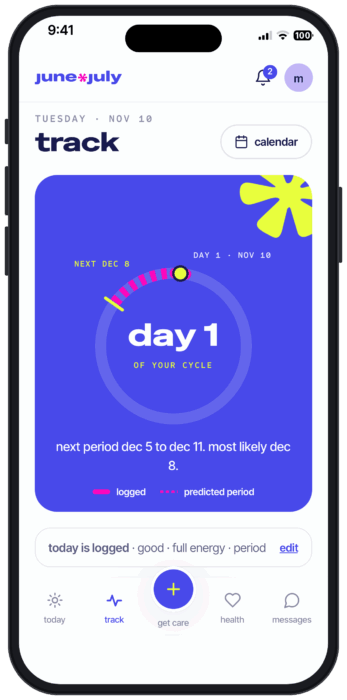
The app features menstrual cycle and symptom tracking.
Beck Sutler, since exiting Julie last July, has been working on getting June/July up and running, building out the team and the platform. Her co-founder is Seattle-based Tessa Commers, a board-certified pediatrician.
Commers also specializes in working with young women aging out of pediatric care, and has a large following on TikTok sharing sexual health information online. Beck Sutler previously worked alongside Commers at Julie.
Beck Sutler described June/July as a service where patients can receive any care that does not require being in-person. It also offer tools like symptom tracking and a preventive care list for users to keep track when they’re due for appointments like a pap smear or an STI test.
The platform features splashy bright colors and all-lowercase typography, with a young feel Beck Sutler said is meant to speak the language of the Gen Z woman. The brand name is meant to evoke a life transition, an experience Beck Sutler said many of their users will likely be facing while using June/July.
To Beck Sutler, the system is meant to have “the convenience of being able to message your provider in a way that feels like a text message,” but with the security of a healthcare message with a provider. Having that approachable identity is something she feels she’s learned from her past work.
“I think all of the brands I got to work on for the last five years, Starface, Blip and Julie, particularly, are just masterclasses in culturally resonant connection with consumers. Brands that make people feel something and feel like they’re a part of something, and I learned so much from that,” she said.
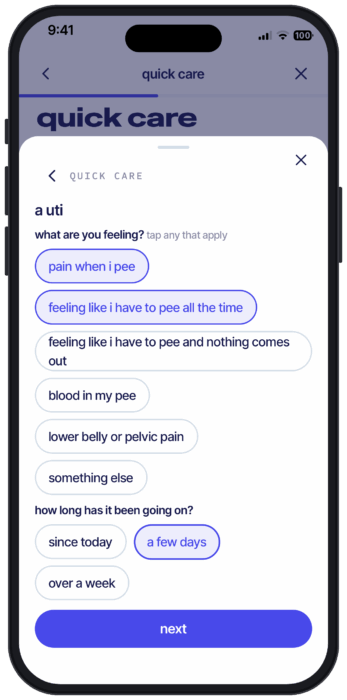
June/July currently has a few different price options. Users can become a member for $39 per month, which includes a yearly, 45-minute video telehealth visit, unlimited messaging with a healthcare provider, two “quick care” consultations per month to discuss any more routine issues like an acne flare-up or a urinary tract infection and input on menstrual cycle and symptom tracking from a provider.
Additional quick care consultations or 25-minute video visits are also available at an additional cost under the $39 per month membership.
Users can also sign up for free to track their period cycle and symptoms through the app and access the preventive care list.
Users who sign up for free can pay as they go for appointments, which include a $49 one-time fee “care episode” where they can receive immediate care through the app or a 15-minute video call with a provider, get prescriptions sent to their pharmacy and receive follow-up messages about their visit for three months.
Users can leave notes ahead of video visits so their medical providers know what they want to discuss ahead of time.
“For $49, with a care episode, they can deal with the UTI, the vaginal symptoms, the acne flare, the migraine, the prescription, emergency contraception, those types of things, but if someone really wants to have a deeper, ongoing care relationship … they should become a member,” Beck Sutler said.
Per Beck Sutler, the platform was built out on top of an existing electronic health record system that June/July customized. The medical provider portal shows pop-ups from users when they put in health requests detailing what the issue is.
June/July is currently just a web-based platform, with an iPhone app set to launch broadly in the next few months. Due to healthcare regulations, the app is currently only available to users in Virginia and New York. Beck Sutler said there are a few other states the app is already licensed in, but that they are waiting to turn on access in those states until they can get things more off the ground.
Users can share their symptoms with their provider ahead of video calls or throughout the month.
The app saves data and, after a few months of a pattern like a mood spike during a certain time of a user’s menstrual cycle, will alert the user and ask them if they would like to speak to a medical provider about it. The app also alerts users to data like how long their menstrual cycle typically is.
Beck Sutler said in the product’s next iteration, the team behind June/July hopes to add more data visualization points, like how a user’s mood and sleep are interacting. The team also plans to add the ability to order labs through the app in the next few weeks.
Care through the app is FSA/HSA eligible. Beck Sutler said that the team is currently starting the process of working to be in-network with medical insurers, hoping to have coverage available for June/July in the next year or so.
She noted the platform is HIPAA-compliant when it comes to data storage and protection, adding that, to her knowledge, this is not the case with many menstrual cycle and symptom trackers on the market.
“The reason we are offering cycle and symptom tracking data is so it can be used in concert with your overall healthcare with your provider, and so I think that really elevates the expectation and approach around privacy,” she said.
The company is starting out backed by $700,000 in angel funding, around half of which has come from Richmond-area angel investors.
While her co-founder remains based in Seattle, Beck Sutler has been doing much of her work out of Shockoe Bottom startup incubator Startup Virginia; she collaborated with the incubator’s team on finding angel investors.
Beck Sutler said June/July will go out to raise its first institutional round of capital in the spring.
June/July’s inaugural team includes Beck Sutler and Commers, as well as some fractional engineers, a creative director and two nurse practitioners who are providing the care alongside Commers.
Beck Sutler said June/July will grow its team of healthcare providers as the company continues to scale.
Source link