

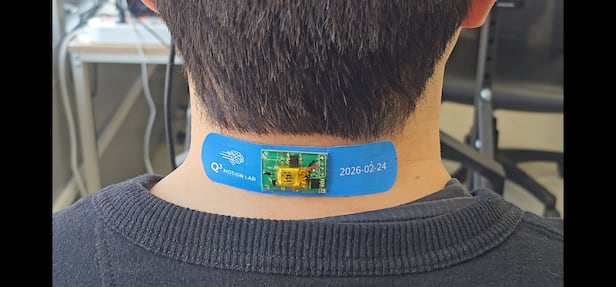
As virtual reality (VR), Extended Reality (XR) and Autonomous Driving technologies advance, new forms of motion sickness are drawing attention. People wearing XR devices or riding in self-driving cars can experience motion sickness when visual information conflicts with the movement their bodies feel. One startup is seeking to address the problem with electrical stimulation rather than medication.
“For XR devices to be used every day like smartphones, they need to be comfortable even when worn for long periods,” said Park Han-kyu, CEO of Q3 Motion Lab. “We decided to start by developing a motion sickness relief product so people could easily understand and experience noninvasive electrical stimulation technology.”
Founded in August last year, Q3 Motion Lab is a deep-tech startup developing a wearable device to relieve motion sickness using artificial intelligence (AI)-based neural stimulation technology. CEO Park is also an associate professor in the Department of Global Biomedical Engineering at Sungkyunkwan University, balancing research with running the company.
Park, who has researched noninvasive electrical stimulation, saw potential applications for the technology. But commercialization faced a hurdle: The concept of electroceuticals was unfamiliar to consumers, and their understanding and acceptance of the technology were low. Park therefore chose a product addressing motion sickness in XR and future mobility settings as the company’s first business model.
Q3 Motion Lab’s core product is an ultralight AI wearable device weighing 7g. It uses real-time brainwave analysis and a closed-loop AI control algorithm to deliver neural stimulation tailored to the user’s condition. It aims to relieve motion sickness symptoms caused by conflicting sensory information.
Unlike conventional motion sickness medicines, the device does not use chemical drugs. The company is developing a product that uses noninvasive electrical stimulation to reduce the burden of medication-related effects such as drowsiness and impaired cognitive function. It plans to expand its applications beyond XR content users to include passengers in Autonomous Driving vehicles.
“Overseas, invasive neural stimulation technologies are being developed for serious conditions such as Parkinson’s disease, while some companies in Korea are focusing on sleep-related fields,” Park said. “We want to use noninvasive technology to develop a range of products for everyday use.”
Starting with its motion sickness relief product, Q3 Motion Lab plans to expand the applications of its technology for regulating the autonomic nervous system. In the long term, it is also considering developing technology to address a range of nervous system-related issues, including sleep, concentration and anxiety.
The company has also made business progress since its founding. Q3 Motion Lab has been selected for government support programs three times and recently secured 200 million won in seed investment. The company plans to use that support to accelerate development of products consumers can experience firsthand.
Initially, the company will target both the business-to-business (B2B) and business-to-consumer (B2C) markets. Its strategy is to gauge consumer response with a general wellness product, then commercialize products claiming medical benefits after obtaining the relevant approvals from the Ministery of Food and Drug Safety.
“Because it’s a new technology, many people were not easily convinced even when we explained its potential,” Park said. “But some people understood its value, and securing investment confirmed its potential. I want to show that a new market can be opened.”
Park also said the company aims to grow by pioneering a new market rather than following existing electroceutical companies. The plan is to broaden the applications of electroceuticals by incorporating neural stimulation technology into products for everyday use.
“It’s not that drugs are bad. I think there are areas where medication is needed and others where electrical stimulation technology may be better suited,” Park said. “I want to find ways electroceuticals can help improve people’s lives and build a new market.”
Source link