Hong’s company has employed 17 people, many of whom previously worked at Meta’s Fundamental Artificial Intelligence Research (FAIR) lab, as well as Meta’s GenAI team and Google Brain, which merged into DeepMind in 2023.
Founded in March, Axiom drew widespread attention after announcing it had solved two long-standing Erdos math problems that had resisted solutions for decades. In September, the company revealed it had raised $64 million in seed funding.
Hong says Axiom’s ambition, tackling the hardest problems in mathematics, has been key to attracting top talent. “One thing I heard from some of the top researchers and mathematicians I’ve recruited to Axiom is that solving for mathematical superintelligence will be their legacy,” Hong told Business Insider. “When the problem is hard enough, talent density gets very high, and that makes you a magnet for other great thinkers.”
 |
|
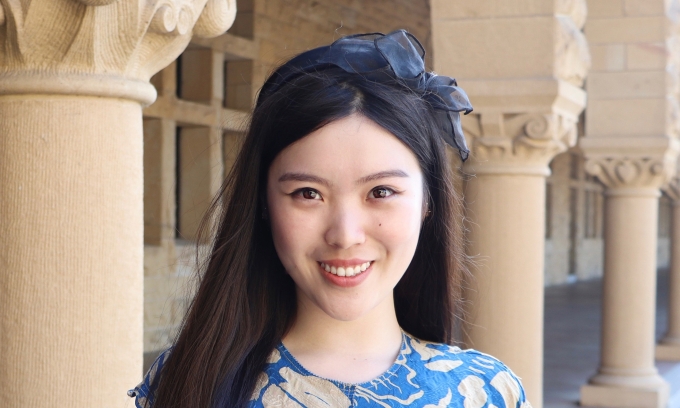
Carina Hong, founder of AI startup Axiom Math. Photo from Hong’s LinkedIn |
Among Axiom’s most notable recruits is Ken Ono, a 57-year-old professor at the University of Virginia and one of the world’s leading mathematicians, as well as Hong’s former mentor. “Ken Ono is the idol of many math students,” said Hong.
Ono has followed an unconventional path from the outset. Crushed by parental pressure as a child, he left high school without graduating, yet went on to attend college, discover his passion for mathematics, and spend decades teaching at the University of Wisconsin and Emory before joining the University of Virginia in 2019.
Along the way, he led one of the country’s premier research programs for elite undergraduates and mentored 10 Morgan Prize winners, including his current boss. In mathematics, Ono is best known for his contributions to number theory, spanning topics from Ramanujan’s congruences to the umbral moonshine conjecture.
“He’s a larger-than-life figure in mathematics,” said Ken Ribet, a former president of the American Mathematical Society.
Ono said that curiosity and intellectual discovery, not financial gain, drove his decision to join Axiom. “I’m not doing this for the money,” Ono said, explaining that he turned down more lucrative offers from larger AI companies.
At the startup, his task is to stretch Axiom’s AI systems to their limits by designing problems that demand deep mathematical insight and by developing benchmarks to assess their performance.
Hong’s company is named after the mathematical term for a basic truth that can be the starting point of an entire theory. She aims to create an “AI mathematician” capable of reasoning through established problems, generating new ones, and rigorously validating its conclusions through formal proofs. If successful, Axiom could help solve mathematical challenges that have baffled human thinkers for generations.
“One thing I heard from some of the top researchers and mathematicians I’ve recruited to Axiom is that solving for mathematical superintelligence will be their legacy,” Hong said. “When the problem is hard enough, talent density gets very high, and that makes you a magnet for other great thinkers.”
She said that she focused some of her early recruiting efforts on FAIR because “they consistently deliver amazing research work.”
Hong grew up in Guangzhou, China, where she developed a love for mathematics, according to Forbes. She taught herself English as a child to read advanced math textbooks and competed in math Olympiad programs under intense time pressure.
“I was always very interested in mathematical discoveries,” Hong told The Wall Street Journal.
After earning bachelor’s degrees in mathematics and physics from MIT, Hong won the prestigious Frank and Brennie Morgan Prize, awarded to the top undergraduate math researcher in America.
As a Rhodes Scholar at Oxford University, she earned a master’s in computational neuroscience. She then enrolled at Stanford University to pursue a joint law degree and Ph.D. in mathematics.
While at Stanford, Hong met Shubho Sengupta, an AI scientist at Meta, by chance in a coffee shop. As they chatted, they realized they could combine their expertise and collaborate on groundbreaking ideas.
After closing Axiom’s seed funding round in September, Hong dropped out of Stanford and made Sengupta the company’s first hire. He now serves as Axiom’s chief technology officer.