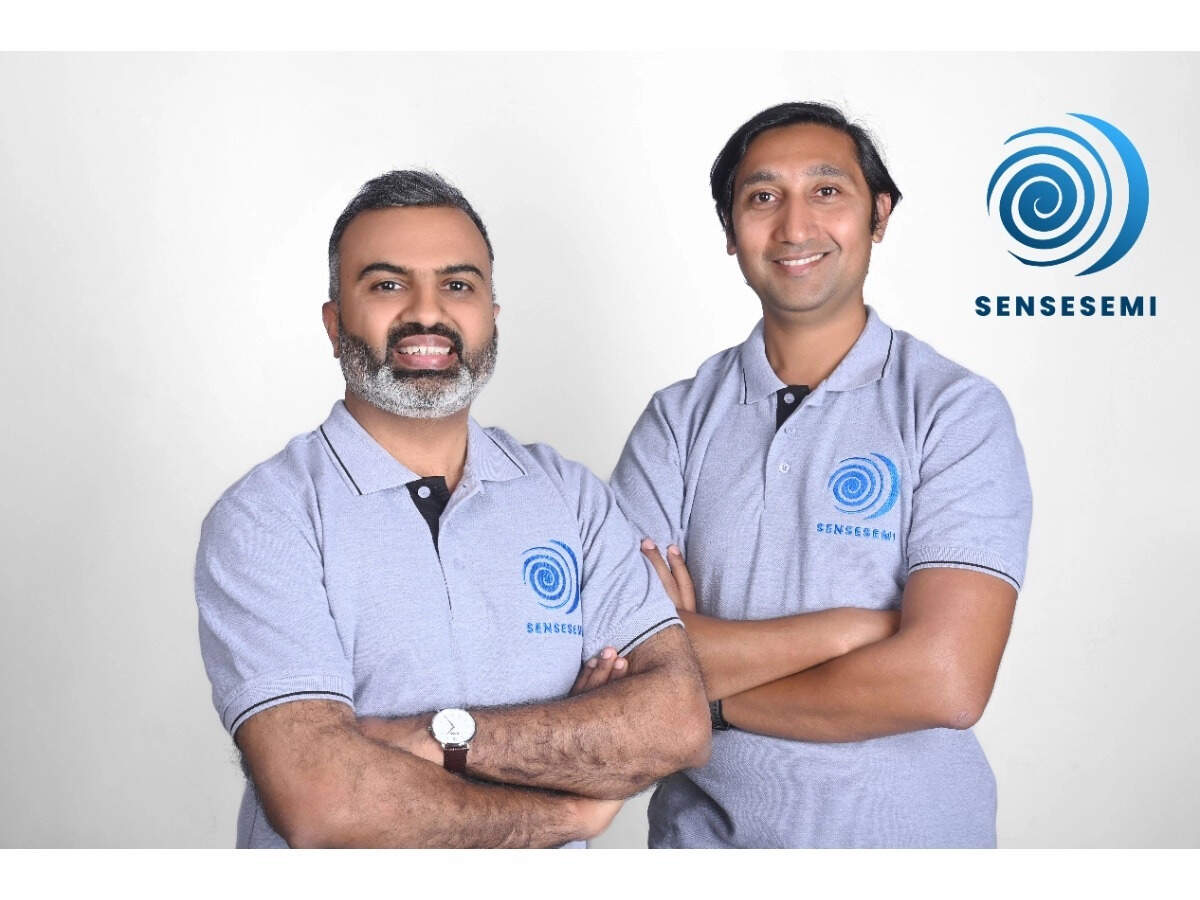
Sensesemi is building integrated edge-AI system-on-chips (SoCs) that combine AI inferencing, wireless mesh connectivity, and precision analogue signal processing on a single chip.
“As the name suggests, we work on sensing semiconductors. There are a lot of sensors in the world today, but there is no intelligence at the sensor node itself. That is where we come in, bringing intelligence directly to the sensor node,” Vijay Muktamath, founder and CEO of Sensesemi, told ET.
Muktamath said the company’s focus is on integrating AI and wireless capabilities at ultra-low power. In sectors such as healthcare, automotive, robotics, and industrial IoT, power consumption is a key constraint as most devices are battery-operated, he said.
The startup is planning its first chip tape-out this quarter, a process where the final chip design is sent to a fabrication plant for physical manufacturing. Commercial production is targeted for the first quarter of next year, and a second test chip is planned for the third quarter of this year.
Looking at the market opportunity, Muktamath said the company expects close to 30 billion connected devices globally by 2030, including sensors and other endpoints. “Of these, only about 8-10 billion currently have intelligence built in, leaving significant headroom for edge AI adoption,” he said.
On the manufacturing side, the founder said it plans to work with TSMC as its fab partner for the first generation of chips, while outsourcing testing and packaging to domestic OSAT players. Sensesemi is also exploring partnerships with Kaynes technologies for testing and packaging in India.
Sensesemi is Muktamath’s second attempt at building a fabless startup in India. When he tried to build a wifi chipset startup over a decade ago, it faced severe infrastructure constraints.
“There were no OSAT facilities in India, no commercial testing infrastructure, and even basic probe stations were unavailable. Packaging had to be done in Japan, and the logistics completely consumed us,” he said.
He added that many of these challenges have since been addressed. “Today, I can call an OSAT (facility) and say the chip will arrive in 15 days, and they are ready. That gives me confidence that many more semiconductor startups will emerge, even from tier-II cities,” Muktamath said.