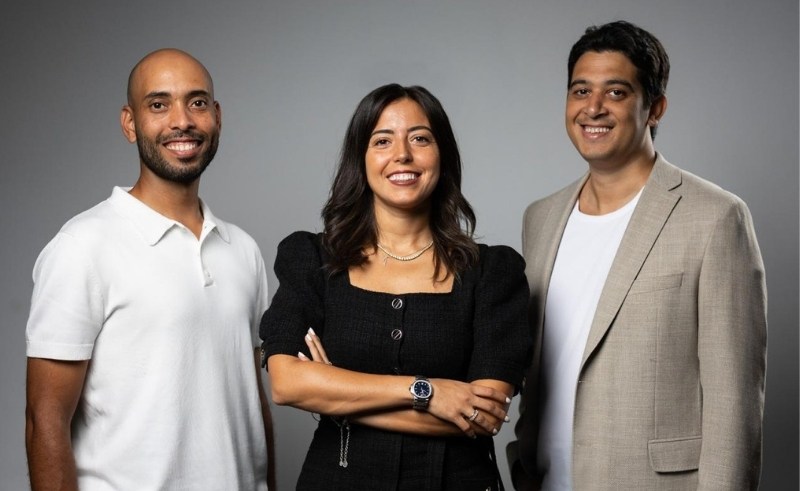


As the first company approved under Egypt’s Startup Charter, Flend leverages a tech-driven platform to unlock financing for SMEs.
In a market where small and medium enterprises (SMEs) represent the majority of economic activity but remain structurally underserved, fintech startup Flend made a straightforward bet – if access to finance and capital can move at the speed of business, growth will follow rapidly.
Flend began in mid-2022, when four founders from very different corners of Egypt’s financial and tech sectors came together with a shared goal in mind. Nehal Helmy, co-founder and Chief Strategy Officer, remembers the moment clearly.
“We started Flend with the idea that we want to do something for SMEs,” she told StartupScene. “They have a lot of challenges when it comes to financing.”
Joining her were CEO Ahmed Zaki, COO Saif Bendari, and CTO Mohammed ElBeltagy. Together, they brought experience across venture capital, banking, technology, and development finance. That combination, they realised, was exactly what was needed to tackle a problem that had long held back a majority of Egypt’s SMEs.
The problem they set out to solve is vast. According to Egypt’s Micro, Small & Medium Enterprises Development Agency (MSMEDA), SMEs/MSMEs account for an estimated 90% of the private sector, 43% of the GDP and 75% of the workforce. Despite this, accessing financing is slow, rigid, and often hard to come by. Traditional banks rely heavily on outdated financial statements, field visits, and scoring processes that can take months, or even a years, to complete. Non-bank financial institutions, meanwhile, are equally bureaucratic, leaving businesses stranded when they need cash to grow.
“That’s if they get approved, and rejection rates are very high,” Helmy says. “They need working capital. They need something fast and reliable. Without it, growth stalls, and promising ventures never get off the ground.”
Flend’s premise is not that SME financing does not exist, rather that it is inefficient and fragmented. Instead of relying solely on historical financial statements, Flend uses real-time, verifiable transaction data to assess creditworthiness.
The company integrates directly with platforms where SMEs actually operate, such as payment service providers like Paymob and Cashier, logistics platforms such as Bosta and Khazenly, and ERP or e-commerce systems like Foodics and Shopify.
“We’re not really reinventing the wheel here,” Helmy says. “We look at real transactions and verifiable data that enables us to do accurate credit scoring and decrease the risk,” Helmy says. In doing so, Flend aims to make SMEs “bankable using data that’s already there.”
The solution was simple conceptually but challenging to execute. The founders set out to create a fully digital, tech-enabled financing platform built exclusively for SMEs. From onboarding to disbursement, the entire process is handled online, saving business owners from branch visits, piles of paperwork, and the months-long wait typical of traditional financing.
But technology alone wasn’t enough. The team built Flend with regulation in mind from day one. It is the first company in the country operating under Egypt’s digital non-bank financial institution (NBFI) licence for SME finance, Helmy explains that regulation isn’t just a compliance step, it’s a structural advantage.
“Being regulated actually helps with different things. First is it enables you to lend to SMEs in a correct way, because if you’re lending without a licence, you actually have no legal recourse over your borrower. So if someone doesn’t pay back, you can’t do anything about it. Second, it enables you to get financing from banks at low cost back rates,” Helmy explains.
“So you’re able to grow in a sustainable and efficient way. And the fourth thing that we’re focused on is that we just finance small and medium businesses.”
The timing for Flend couldn’t have been better. Egypt recently launched the Startup Charter, a government-led framework designed to formalise and strengthen the startup ecosystem. The Charter introduced the first official definition of startups in Egypt, clarifying the difference between tech-enabled high-growth companies and small businesses with an idea.
Flend became the first company officially recognised under this framework, signaling credibility to investors, access to structured support, and alignment with broader policy initiatives aimed at mobilising $1 billion in guarantees and co-investment. It also underscores a broader shift in Egypt’s entrepreneurial landscape, where regulation and technology are starting to work together rather than in opposition.
“The growth of those businesses is the growth of your country,” Helmy says. “There is so much potential in that space. You can see those small business owners, they put their heart and soul in those businesses.”
Source link