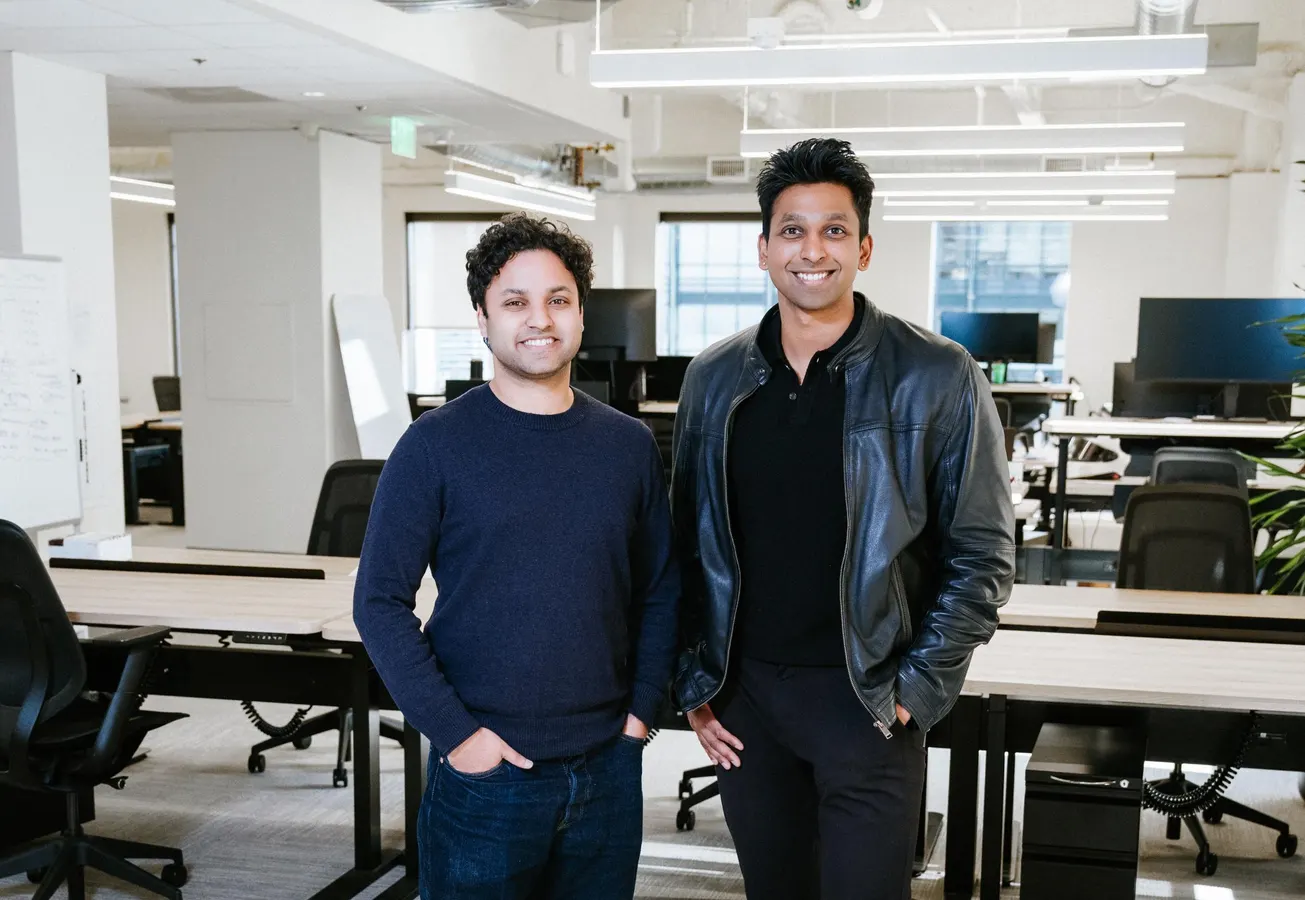
Cofounders Rishabh Jain (left) and Sriram Somasundaram (right) started Latent Health in 2022 with a vision to bridge the gap between diagnosis and treatment with AI agents that can speed up manual processes like prior authorization.
Latent Health
Every week physicians spend 13 hours on average digging through patients’ medical records, answering questions and preparing documentation to prove an expensive drug or treatment is necessary to insurance providers — a gnarly, time consuming process called prior authorization. That can lead to delays in providing critical medication to patients.
Sriram Somasundaram, the 28-year-old co-CEO and cofounder of clinical AI startup Latent Health calls it a “human compute problem,” where humans on both ends (insurance payers and providers) spend hours reviewing the same documents. “It’s a genuine insanity, and this is what happens for essentially every sick patient today,” he says.
Now AI can do much of the data scanning and question answering needed for prior authorization accurately, Somasundaram says. Latent Health is building what it calls a “clinical reasoning engine,” an AI system that ingests data like doctor’s notes, lab results and imaging reports and can answer complex questions about a patient’s medical history. Its AI agents can also compile evidence based on the insurer’s criteria and submit requests after a human reviews them. To avoid having humans wait on hold for hours at end, Latent’s AI can even call insurers on the providers’ behalf to check in on the status of a request.
“Providers love taking care of patients. They’re just so overburdened and there is really only one way out.” Somasundaram says. “We must adopt technology.”
Latent’s software is used by pharmacists, doctors and nurses at more than 45 health systems including large academic medical centers like Yale New Haven Health, UCSF, Mount Sinai and Vanderbilt. Founded in November 2022 by childhood friends Somasundaram and Rishabh Jain, the startup announced Wednesday that it raised $80 million in Series A funding from Spark Capital and Transformation Capital, with participation from Conviction and others and has more than $20 million in annualized revenue. With the fresh capital injection, it’s now valued at about $600 million, according to a person familiar with the deal.
In particular, Latent is targeting the prior authorization process for expensive specialty drugs, prescribed for more complex conditions like cancer. Because of the complex documentation and evidence that insurers require to cover these drugs, they’re a harder problem to solve and end up becoming a massive administrative burden for pharmacists.
“It’s a genuine insanity, and this is what happens for essentially every sick patient today.”
Add to the mix that specialty pharmacies, which provide such medications, are growing quickly. Oschner Health, a health system with 42 hospitals and 370 clinics in the Louisiana area, has seen 30 percent year over year growth for its specialty pharmacy, says Deborah Simonson, its chief pharmacy officer. “I couldn’t hire enough people,” she says. “There was no way for me to continue that growth volume unless I turned to some type of tool to help with the workflows.” AI has filled the gap, especially for major timesucks like scrounging for information that’s often difficult to find. “With Latent, I can find what I’m hunting for in three to four minutes,” she says.
In some cases, physicians and pharmacists must also call insurers to check on the status of a request or provide additional information after a denial. These calls are often long and frustrating. “If I can get AI to do those calls because they’re going to a payer, not to a patient, I know exactly what I want to say to them,” Simonson says. “And actually, the AI person is much nicer because you think if you’ve made me wait 15 minutes twice, I am not a happy camper by the time I talk to you.”
Using AI to make insurance decisions without human oversight can lead to more wrongful denials, especially if insurers lack comprehensive data and or the algorithm is trained on past coverage decisions which could be faulty or biased, a Stanford study found in January. Somasundaram says that’s why Latent is primarily used by healthcare providers — the doctors, hospitals and pharmacies that have a more complete picture of a patient’s health and with a human in the loop to approve the final request. Latent doesn’t currently work with insurers.
The San Francisco-based startup is already facing a string of competitors like Stockholm-based Tandem Technology, reportedly in talks to raise $100 million at a $1 billion valuation, and Mandolin, which is also building AI software to speed up prior authorization for specialty drugs. This drug category is an enormous market: about $225 billion in 2024, and expected to grow to $2.3 trillion by 2034, according to market research firm Global Market Insights. They now make up 50% of U.S. pharmacy drug spending.
Clay Fisher, a partner at multi-stage VC fund Spark Capital, thinks that means there’s room for multiple players. And with AI accelerating drug development and manufacturing, that’s only going to increase specialty drugs in the market. “This is a very strategic place for Latent to actually sit in the nexus of this multi-hundred billion dollar spend brokering between payers, providers, pharma, and the patient,” Fisher says.
A flurry of healthcare AI unicorns have emerged to help doctors save time on tasks like transcribing notes or filtering through medical research. Others, like Yann LeCun’s buzzy’s Advanced Machine Intelligence, aim to apply its cutting edge world models for real world tasks in the healthcare space.
In the future, Latent hopes to also provide services directly to patients. The startup’s agents could remind patients about taking their medication and analyze their charts to identify when they should begin a new therapy, Somasundaram says.
MORE FROM FORBES