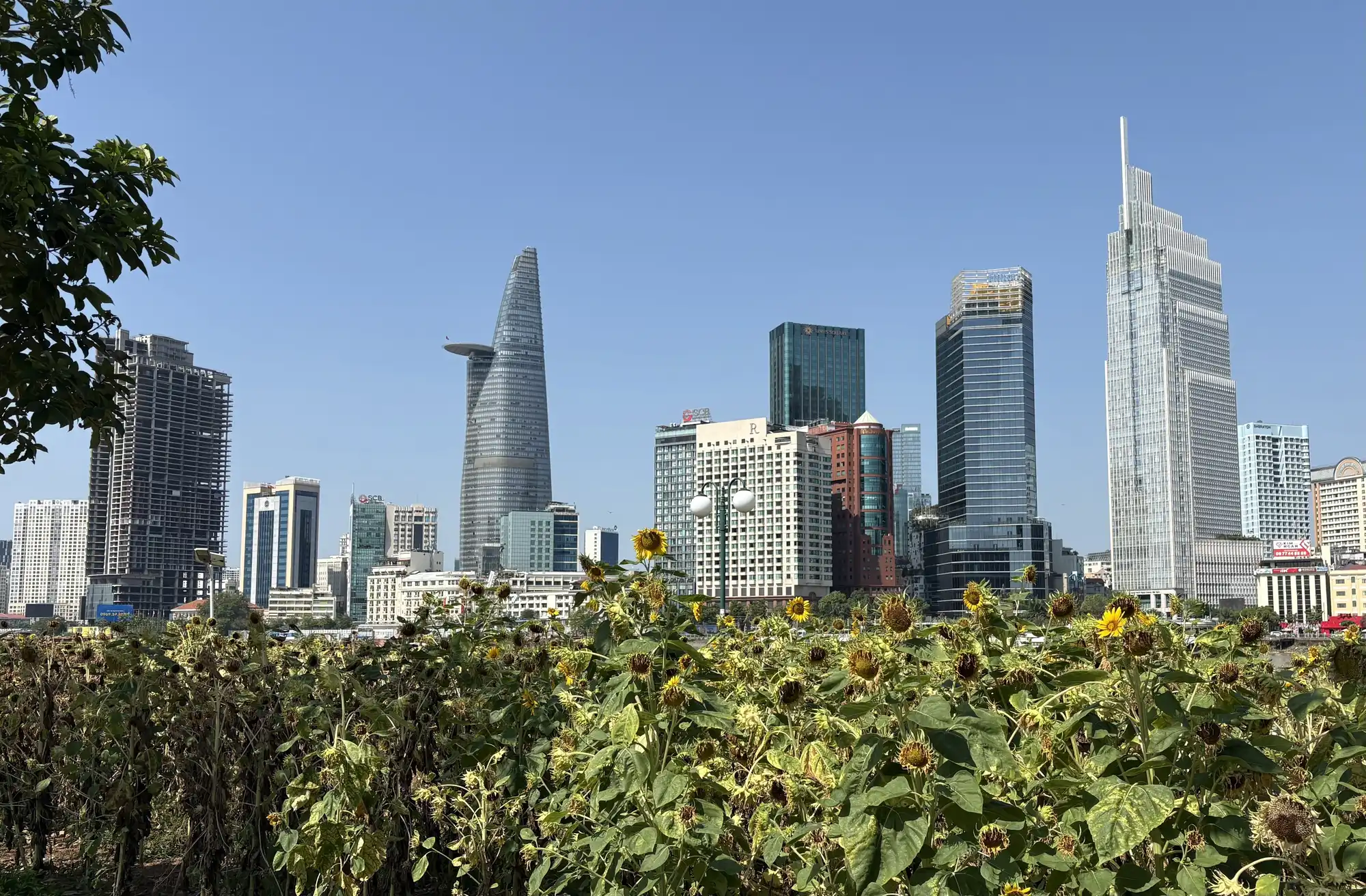
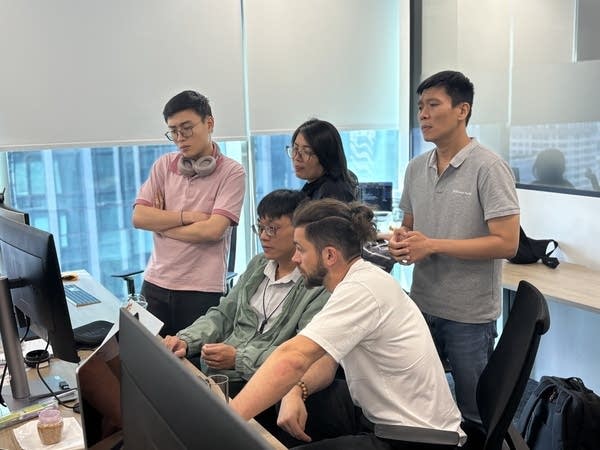


In a gleaming skyscraper in the heart of Ho Chi Minh City, Vietnam, a handful of software engineers huddled over a computer screen, collaborating on a project. They are recent hires of a Silicon Valley-based startup called TinyFish AI, one of thousands competing for highly skilled tech workers as the AI economy expands.
“I really believe that there are smart people everywhere,” said TinyFish co-founder and CEO, Sudheesh Nair. “We just need to bring them in.”
Employees of TinyFish AI at the Silicon Valley startup’s Ho Chi Minh City office.
Marketplace
TinyFish’s first hire in Vietnam was a guy named Huy Vo. He was born and raised in Ho Chi Minh City, but spent 24 years living in the United States, where he got a PhD in computing and worked as a professor in New York City.
“I always wanted to come back home,” he said. “But I was also skeptical about the opportunity here in the city.”
Right now, there are about two working-aged people for every one dependent in Vietnam. In our continuing series, The Age of Work, “Marketplace” host Kai Ryssdal and ADP’s chief economist Nela Richardson have been exploring how that “demographic golden age” is impacting the country’s economy.
When the Vietnamese economy became more market-oriented after a series of reforms in the late 1980s, manufacturing—especially low-cost apparel manufacturing—became an important part of the country’s economy. But over time, Vietnam’s increasingly tech-savvy labor force has drawn new types of investment to the country.
Today, many American technology companies, including Google, Apple, Intel, and Qualcomm, have operations in Vietnam. Nvidia has an agreement with the government to build an R&D facility there, and Ho Chi Minh City has a growing startup ecosystem.
When Vo came to Ho Chi Minh City on sabbatical three years ago, the growth he saw in the city’s technology sector convinced him to leave the United States and move back to his home country permanently.
Huy Vo, country director of TinyFish AI’s Vietnam office speaks with ADP’s Nela Richardson.
Andy An Hai/Marketplace
“A lot of companies come to Vietnam not to outsource the labor, but actually to try to develop the core infrastructure and core technology in AI,” he said.
That hasn’t happened by accident. The Vietnamese government has set a goal of making Vietnam a leader in AI research. There are tax incentives for high-tech enterprises, infrastructure investments, and training programs to nurture young talent.
Yesterday, we looked at Saigon Technology, a home-grown startup that’s part of Vietnam’s growing IT services sector. Their customers are mostly overseas clients, looking to outsource certain software development tasks.
But TinyFish is different—it’s an American company looking to Ho Chi Minh City as a source of elite talent.
Vo has helped the TinyFish build a small team, which the company hopes to expand over time. “We have a relationship with a university here,” said Vo. “In the next few years, I hope to source [more] from the local talent.”
In Thao Dien, an increasingly globalized Vietnam is on display
Vietnam’s economic transformation and rise in foreign investment are evident in Thao Dien, a neighborhood located directly on Ho Chi Minh City’s brand-new metro line that has become popular with expats.
Ryssdal and Richardson in Ho Chi Minh City’s Thao Dien neighborhood, which has become popular with expats.
Andy An Hai/Marketplace
In stark contrast to the motorbike-ruled streets elsewhere, foreign cars line the roads. Ryssdal and Richardson noted chic shops and cafes with a decidedly international flair—a New York Bagel spot, an Argentinian restaurant, and a store selling “Danish luxury children’s clothes,” for example.
“We started this conversation about a workforce that is at its peak,” said Richardson as she and Ryssdal reflected on what they’ve learned in Vietnam. “And yet, it is a city that knows it has to transition quickly from its past—labor-intensive industries— to where the global economy is going.”
To hear more, use the play button at the top of the page.
Source link