Mesa School of Business, a three-year-old institution based in Bengaluru, was built specifically for the startup ecosystem, and its placement report suggests that bet is paying off.
Its 2025–26 Outcomes Report, independently audited by B2K Analytics, makes a compelling case2. Mesa reported an average cost-to-company (CTC) of ₹26 lakh per annum, a highest package of ₹52.5 lakh, and a top-25% average of ₹36.5 lakh. These figures cover Mesa’s first two cohorts of 163 graduates in total. Of these, 131 students (80.4%) were placed in full-time roles, while the remaining 32 (19.6%) chose to build their own ventures. The middle 90% of the placed cohort earned between ₹18 lakh and ₹40.3 lakh, suggesting that the aggregate average is not being pulled by a small number of outlier packages.
“Our outcomes aren’t just measured by salaries,” says Ankit Agarwal, Co-Founder of Mesa and a former BCG consultant and part of the early team at Urban Company. “They’re measured by the responsibility you earn: founder-facing roles, real ownership, and the ability to make decisions that move the business. That’s what we built this institution to produce.”
One of the more notable data points in the report is that approximately 60% of placed graduates landed in what the startup industry calls founder-facing roles. These include positions such as Chief of Staff, Entrepreneur in Residence, and Founder’s Office, roles that report directly to founders and are regularly involved in decisions around P&L ownership, new vertical launches, and company strategy. In the broader startup hiring market, such roles attract thousands of applicants for a single opening.

“In early-stage startups, proximity to the founder is not a nice-to-have. It’s everything,” notes Varun Limaye, Co-Founder of Mesa and an ex-Amazon product leader. “It means you’re in the room where product roadmaps get decided, where capital allocation happens, and where new business lines are greenlit,” he adds.The data also shows that approximately 70% of Mesa graduates pivoted their sector or function during the program, a transition widely considered one of the harder professional moves in the Indian job market, where recruiters historically favour candidates with directly relevant prior experience.Mesa attributes this outcome to a learning model that is deliberately built around doing rather than listening. From day one, students are placed in real situations: generating over ₹5 lakh in sales revenue in their first month through a live D2C business-building challenge, building and launching actual AI products, and working directly on problem statements given by high-growth startups.
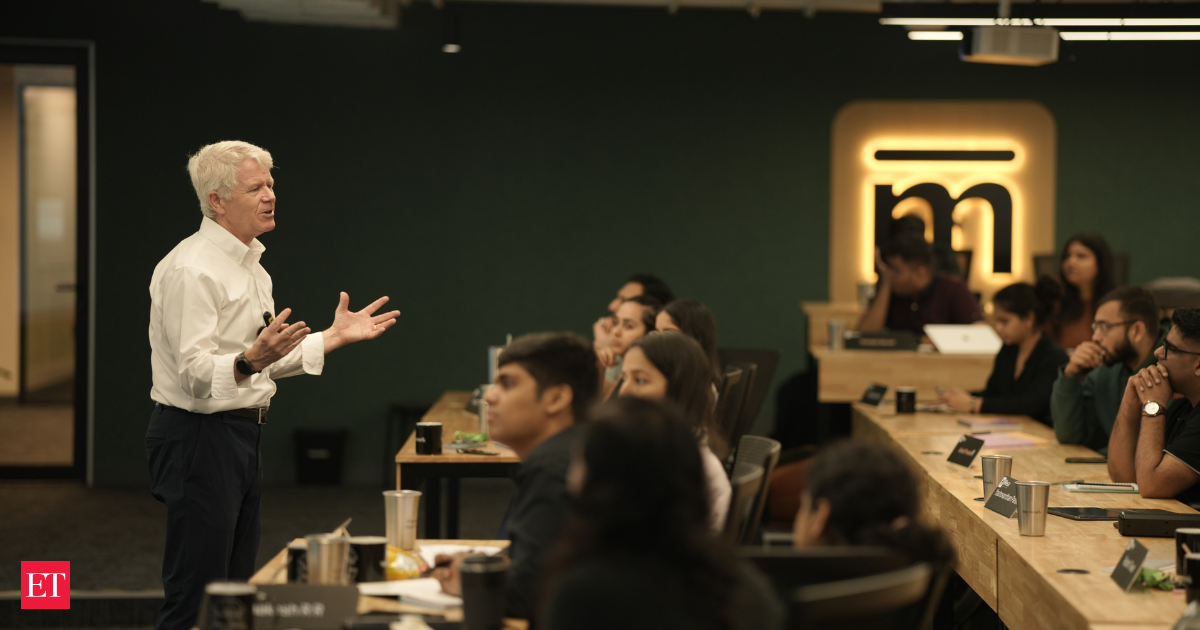
The institution’s Business Strategy Lab (BSL), a six-to-eight-week live capstone, places student teams inside real companies to work on active strategic challenges, not simulated case studies, but actual business problems that founders need solved. The format has generated direct job placements each cohort cycle, with founders converting BSL engagements into offers after seeing students’ work firsthand. Over the course of the programme, Mesa says, students interact with 100+ CXOs and founders who teach on campus, participate in structured problem-solving sessions with operators from companies like Zepto, Razorpay, and Urban Company, and receive 1:1 founder counselling and domain-specific mentorship through a 35-member career preparation team that logs over 250 hours of structured career prep per cohort.
Alongside salaries, 54% of placed graduates secured ESOP grants averaging ₹10.8 lakh, typically vesting over four years, highlighting the growing role of equity in overall compensation. The report adds that 80% of students had job offers before the programme concluded, pointing to strong placement momentum.
The companies that recruited from Mesa’s cohorts include several of India’s most selective startup employers: Zomato, Swiggy, Zepto, Urban Company, Razorpay, Ather Energy, Titan Capital, Epigamia, Snabbit, The Whole Truth, Cult.fit, Grapevine, Scapia, GIVA, and Jumbotail, among others. The top five domains by placement volume were Founder’s Office (Business), Category Management, Product Management, Growth, and Partnerships with 57.5% of students joining early-stage startups.
Mesa was co-founded by Varun Limaye, a Northwestern Kellogg MBA alumnus and ex-Amazon product leader, and Ankit Agarwal, a Harvard Business School MBA alumnus who previously worked at BCG and was part of the early team at Urban Company. The institution says it is backed by Elevation Capital, one of India’s most prominent venture capital firms, and its advisory base includes founders from Flipkart, Paytm, Meesho, Swiggy, Urban Company, and CRED. The program operates as a twelve-month, full-time residential Post Graduate Program in Startup Leadership & Entrepreneurship, structured across seven academic terms and capped at 150 students per cohort.
The curriculum is organised around three stated principles: AI-first, startup-focused, and builder-led. The program includes a Build Your Own Business (BYOB) framework in which students build real businesses and sell to real customers, a Build Your Own Product (BYOP) track in which students ship functional AI products, and an in-house incubator, Mesa Startup Lab, which holds a ₹5 crore fund and provides access to over 50 top Indian venture capital firms. The school offers 150 dedicated hours of AI curriculum, with students building and launching multiple AI-powered products during the program.
The results from Mesa’s in-house incubator have begun to draw attention in their own right. Startups founded by students inside Mesa Startup Lab are collectively doing over ₹20 crore in annual recurring revenue. Everaw, a kid-first healthy snacking brand built by a Mesa student during the programme’s BYOB sprint, was featured on Shark Tank India Season 5. Beyond the in-house incubator, Mesa students have gone on to build with some of the world’s most respected early-stage startup programmes such as Entrepreneur First, The Foundery, and Beyond Seed, reflecting both the quality of founders the programme produces and its integration into the broader startup funding ecosystem.
The faculty includes professors from Kellogg, IIM Ahmedabad, IIM Bangalore, IIT Bombay, IIT Delhi, ISB, and XLRI, along with operators and founders from Zepto, Urban Company, Flipkart, Snabbit, Razorpay, and others.
For observers of India’s business education sector, the placement data Mesa has published invites a broader question about how outcomes should be measured in an economy where startups account for a growing share of high-value employment. Traditional ranking methodologies tend to reward name-brand recruiters and corporate-track placements, metrics that reflect an earlier era of professional aspiration.
The founders believe the shift is structural, not cyclical. India’s startup economy has produced over 100 unicorns, absorbed hundreds of thousands of high-skilled professionals, and increasingly competes with the traditional corporate sector for top talent. In that context, the question of what a business school should optimise for has a different answer than it did a decade ago. “Most MBAs were built for corporate careers,” says Ankit. “Mesa was built for people who want to operate at the speed of startups, where the problems don’t have playbooks and the decisions you make on your first day actually matter.”
Mesa’s next PGP cohort begins in August 2026. Applications for Mesa’s next PGP cohort, beginning August 2026, are closing soon with Round 2 ending on May 3, 2026.
References:
- https://www.pib.gov.in/PressReleseDetailm.aspx?PRID=2215306&lang=1®=3&utm_source
- https://mesaschool.co/outcomes-report/
Disclaimer: The above content is non-editorial, and TIL hereby disclaims any and all warranties, expressed or implied, relating to it, and does not guarantee, vouch for or necessarily endorse any of the content.