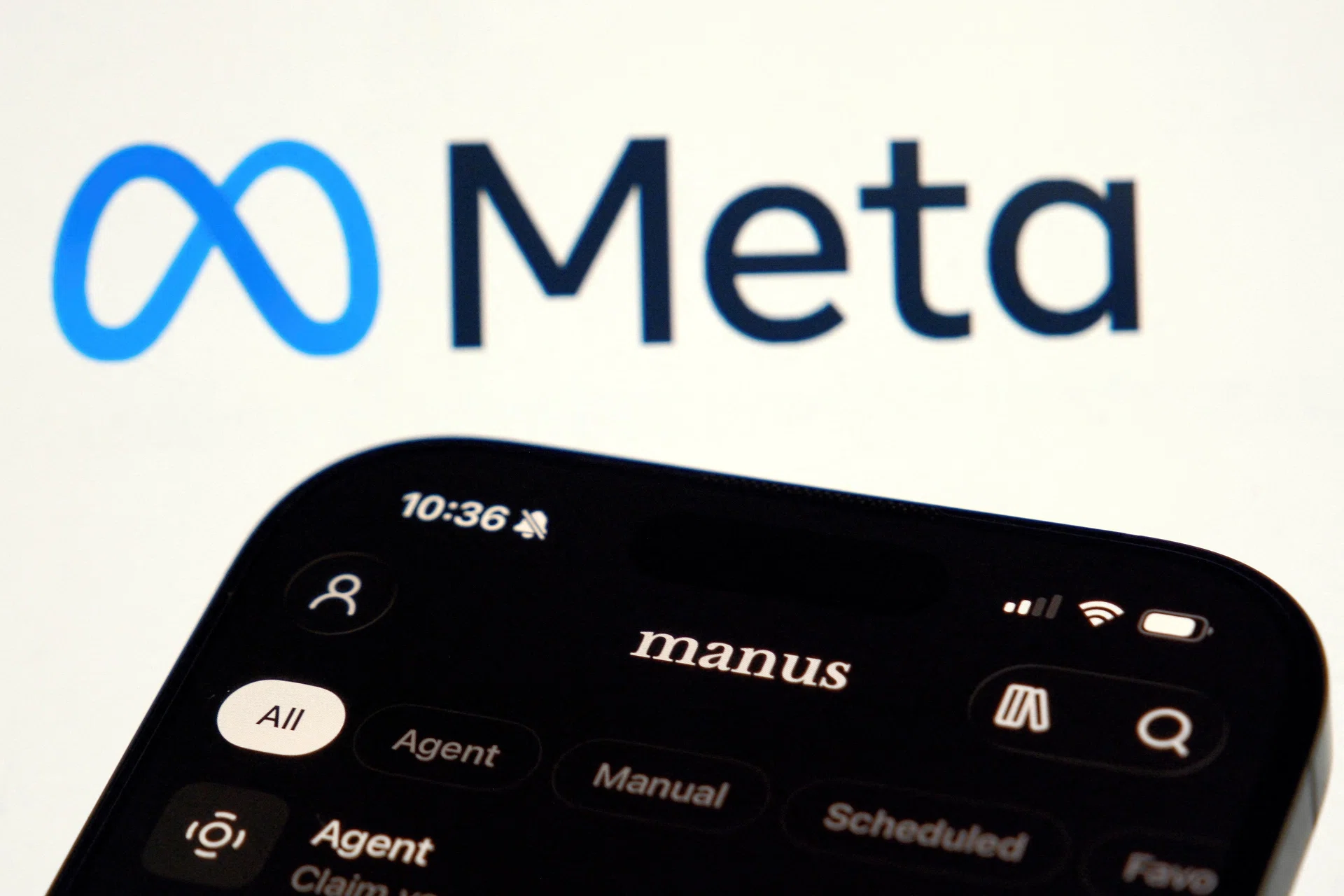
The startup’s fate raises questions about Chinese AI firms venturing abroad in search of a more neutral identity with which to tap foreign funds and expand globally
[SHENZHEN] Beijing’s intervention in the Manus-Meta deal has stoked caution for firms and investors while raising questions about the continued viability of a playbook in which Chinese tech companies use a Singapore identity to access global capital.
The authorities this week ordered the unravelling of the American tech giant’s US$2 billion (S$2.6 billion) purchase of Manus, a Chinese-founded artificial intelligence start-up that rebased in Singapore before the sale.
With this, analysts say Manus’ story – though an extreme case – is unlikely to recur as Beijing makes clear how far it will go to assert oversight of strategic technology developed in China, regardless of where firms are subsequently domiciled.
“For Chinese tech companies (looking) to disguise themselves as Singaporean companies – this road is over,” said Dr Dan Wang, China director at Eurasia Group, a geopolitical risk consultancy.
“If you use Chinese resources, start from China and then leave through Singapore, that’s not okay,” she told The Straits Times (ST).
Manus makes AI agents that can do complex tasks like create apps and websites with little supervision. First developed in China, it rose to fame in 2025 and was seen as an example of the country’s advances in AI.
Navigate Asia in
a new global order
Get the insights delivered to your inbox.
Following an investment from US venture capital firm Benchmark, Manus moved its headquarters to Singapore, shed its China operations, and then sold itself to Meta, which observers say ultimately triggered Beijing’s clampdown.
The Chinese government announced on Apr 27, after a security review, that it would bar foreign investment in Manus, and asked that the transaction be unwound.
State broadcaster CCTV said the next day that in blocking the deal, China was prohibiting the “non-compliant practice” of “washing-style” overseas expansion.
China’s intervention in the Manus deal has already stoked anxiety among Chinese AI start-ups eyeing global markets, said Dr Wang. Firms that had hoped to secure abundant US dollar financing and subsequently be bought out by American firms are now seeing that pathway called into question, she added.
“The unwinding order is causing a slowdown in the momentum of cross-border investments, with increased caution from all sides,” said Tan Yinglan, founding managing partner at Insignia Ventures Partners in Singapore.
Investors and acquirers will be accounting more for geopolitical risk in doing due diligence, he told ST, with Beijing signalling clearly that it will not tolerate the transfer of critical AI know-how overseas without government approval, regardless of where a company is incorporated.
The overseas path
Manus’ fate raises questions about Chinese AI firms venturing abroad in search of a more neutral identity with which to tap foreign funds and expand globally.
A growing number have been setting up shop in countries like Singapore. Dai Menghao, a partner at law firm King & Wood in Shanghai who advises Chinese companies heading overseas, says the bulk of his clients have their sights set on the Republic, with some also looking at Japan and South Korea.
“Singapore has been a go-to destination for Chinese AI founders seeking to access Western capital, frontier models from the US, and a global customer base,” said Insignia’s Tan. “The Manus decision undermines that playbook for companies that still maintain ties to China.”
Still, Manus is by no means representative of most Chinese AI firms seeking to expand overseas, said Associate Professor Brian Wong of the University of Hong Kong. To view it as a bellwether would be to “mistake an extreme outlier for the median”, he added, citing Manus’ “almost clinical effort at ‘origin-washing’” that went far beyond most Chinese firms’ strategy of simply establishing a dual-headquarter structure or spinning off an international subsidiary.
Dai notes that while companies are likely to be more careful going forward, Beijing’s scrutiny does not imply that firms will be barred from investing in or setting up a presence in places like Singapore.
“But when they do go overseas, they must balance between the US’ and China’s geopolitical concerns,” he told ST, highlighting that it would be impossible for Chinese-origin companies to cut ties with China.
In making an example of Manus, analysts say Beijing is seeking to ensure that strategic technologies remain firmly within its control as the US-China race for AI heats up – similar to Washington’s rules on ring-fencing its critical industries.
China also wants companies to remain firmly rooted at home.
The state-run Global Times, in an Apr 28 editorial, lauded advances in China’s AI industry and expressed hope that “more technology and innovation enterprises, including Manus, can find their place in this blue ocean in China”.
Yet observers point out that Chinese AI founders with global ambitions could well take a very different lesson from Manus’ experience. For one thing, they may decide to set up shop overseas from the outset – developing their products outside China – to sidestep potential entanglements with Beijing.
Matthias Hendrichs, a Singapore-based adviser to AI firms, expects to see more individual founders head out of the country earlier than they would have planned, wary of what might happen if they first incorporate in China and then try to move out.
“If they don’t leave China in time, they might never leave,” he told ST.
Chinese founders now face a harder choice, said Insignia’s Tan. They can either host assets within China and scale without having easy access to global capital markets or buyers, or genuinely relocate from day one, he said. THE STRAITS TIMES
Decoding Asia newsletter: your guide to navigating Asia in a new global order. Sign up here to get Decoding Asia newsletter. Delivered to your inbox. Free.