
When the world came to a halt in March 2020, Ping Yeh was in the middle of a Series B raise for StremoniX. He had launched the Minneapolis-based biotech company after exposure to intense chemotherapy threatened his life. Yeh wondered why treatment still involved so much risk. So, he founded StremoniX to test drugs on lab-grown human brain tissue.
Fresh off a win at the startup competition MN Cup a few years earlier, he had felt momentum was strong—until it wasn’t.
“Everything was going good for a startup and then all of a sudden, three weeks later, the world just shut down,” Yeh recalls. “I had 50 people in the company with families.”
Navigating the uncertainty became the defining leadership test of his career. He came out better able to solve problems, lead his team, and maintain a great work culture, he says.
Those lessons now inform his next act.
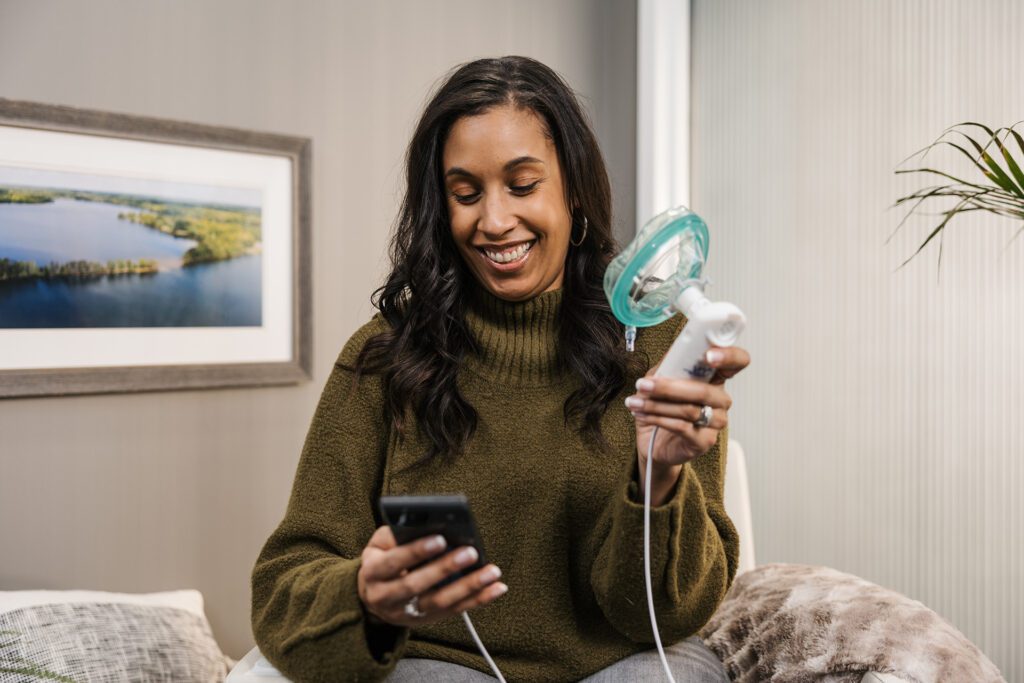
In 2022, Yeh created Vocxi Health, an Arden Hills-based medical device company focused on commercializing a handheld breath-sensor platform that can be used anywhere to detect diseases, including early stages of lung cancer, before symptoms begin. The device is about the size of a deck of cards.
A year later, he sold StremoniX to AxoSim, clearing the way to focus on Vocxi’s commercialization strategy.
A Device with the Nose of a K9
Yeh says scientists from both the University of Minnesota and Boston Scientific developed the idea for the breath device for years. Yeh got involved after the University of Minnesota asked him to lead the project toward commercialization, citing his track record with startups.
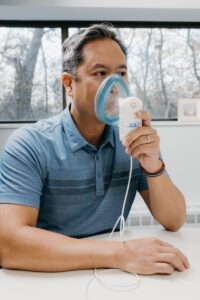
Yeh branded the platform MyBreathPrint. To use the device, a patient breathes into a mask. Then, the system uses chemical sensors to detect gaseous molecules and sends that data to a cloud-based analytics platform to spot disease-related patterns. Vocxi says results can be returned in one minute.
Those gaseous molecules are called volatile organic compounds (VOCs), which originate in the bloodstream and filter through the lungs every minute. The lungs expel these VOCs with every exhale.
Scientists have identified more than 1,000 VOCs detectable in human breath. They provide information regarding an individual’s health and “can serve as indicators of disease onset and progression as well as overall health status,” according to Vocxi Health’s website.
Dogs possess olfactory receptors thousands of times more sensitive than those of humans, capable of detecting substances at extraordinarily low concentrations. MyBreathPrint’s sensors are designed to mimic that sensitivity, identifying trace chemical signatures that might otherwise go unnoticed.
Scientists have discussed breath diagnostics for years, but other approaches “used existing equipment that was large and expensive,” Yeh says. “Coming out of the pandemic, we needed something that was more accessible for everyone [and] that could be done anywhere.”
And Yeh imagines people using his MyBreathPrint device everywhere: inpatient and outpatient care, doctors’ offices, and even at home. Most importantly, the company advertises that its device doesn’t require blood draws, imaging, or waiting in a doctor’s office. Plus, it’s more cost-effective than a CT scan.
Trials and Tribulations
Today’s health care system is largely reactive: Patients seek care once symptoms appear. Yeh believes breath diagnostics could flip that model. Because diseases produce distinct chemical signatures before symptoms emerge, MyBreathPrint could be used before someone is formally a patient—even detecting stage-zero cancers. “That’s a big deal,” he says.
In 2025, Vocxi Health advanced to the Startup World Cup grand finale, demonstrating positive reception of the device. Still, significant hurdles remain.
The startup has conducted multiple studies but has not completed formal clinical trials, and the device does not yet have FDA clearance. However, a company merger on Thursday is centering that goal for the near future, Yeh says.
A Merger Breathing New Life into the Startup
On Thursday, Vocxi Health will merge with Oncodea, a St. Paul-based company focused on accelerating AI applications in early cancer detection, to form a new entity: Person Health. The combined company will also rebrand its platforms, with new names currently in development.
“We saw the challenges to get to market, and that’s why Person Health is such a smart pivot for us. We realize you can have the most accurate breath in one minute, but if you aren’t managing patient behavior, you’re not getting to the outcomes” that you want, Yeh explains. “People are given health data but not taking action.”
The strategy reflects a broader ambition: not just to detect disease, but to influence what patients do next. Yeh describes Person Health as building an AI-driven operating system designed to guide users toward better health decisions, an effort he frames as creating trust and encouraging behavioral change.
Vocxi currently employs about 10 people, with hiring expected to follow the merger. The company raised $1 million in seed funding, Yeh says, and plans to pursue a Series A round after becoming Person Health this week. There is not an official date for commercialization yet.
Yeh’s interest in AI predates the current boom. With a background in nanotechnology and software development, he spent more than a decade at Seagate Technology before co-founding StremoniX. He has tracked the evolution of AI for years, though he acknowledges the financial challenge it presents for startups. Yeh’s answer is to build Person Health’s own in-house AI operating system, integrating diagnostics with patient engagement tools.
If he succeeds, the future of diagnostics may not begin in a lab or imaging suite, but with something simpler: a breath.
Source link