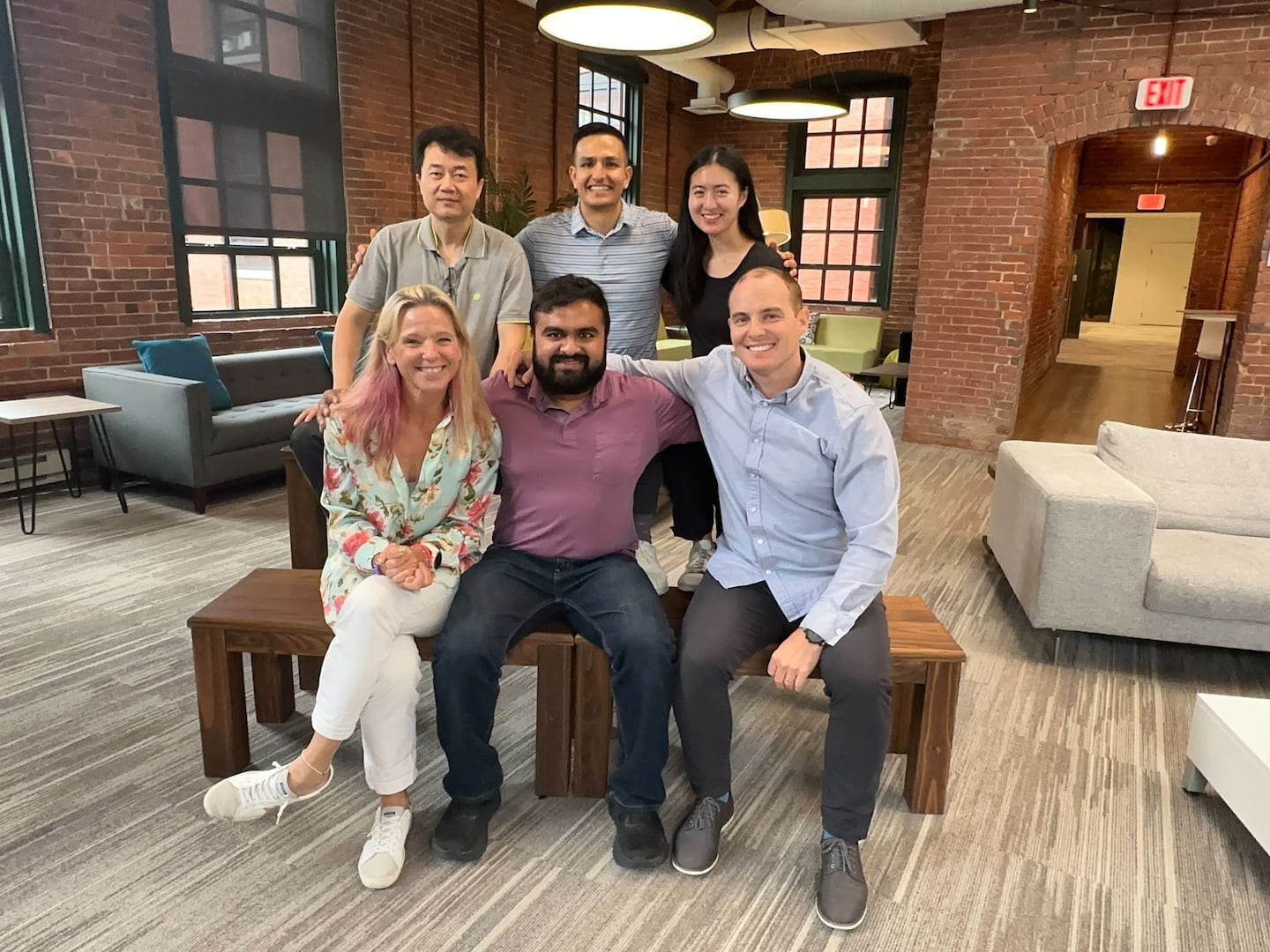


Elliott was a former Army Ranger and startup veteran before entering HBS, where he became friends with Pardeshi, who had spent seven years at AI chip pioneer Nvidia helping invent new ways to use generative AI technology (he holds more than 25 patents).
After graduating in 2024, the pair had to decide whether to move the company to Silicon Valley, home to many more AI startups including giants Anthropic and OpenAI.
“Conventional wisdom would have said, leave,” Elliott recalled in an interview on Tuesday. “But we believe that there’s a unique advantage out of the Boston ecosystem to build an enduring company, because people that join Blitzy stay here. They’re not mercenary, leaving every six or 12 months to go to the next hot thing.”
As seen in IBM’s one-day tumble, stock market investors are terrified that businesses will start writing their own software using AI tools like Anthropic’s Claude. But so-called “vibe coding” doesn’t easily produce programs that are as dependable, secure, and efficient as corporate America requires.
That’s where Blitzy comes in. Blitzy can use AI apps like Claude to perform coding tasks. But before any code is generated, the startup’s AI system probes all of a company’s existing software and maps out how it works and, importantly, how one piece of code may be dependent on other code. Potential customers pay up to $250,000 for an initial evaluation and then anywhere from $500,000 to $10 million a year or more for coding projects, with the price based on how many lines of code are involved, according to the company’s website.
“This is for the most complicated, largest, gnarliest code bases,” said Jeff Bussgang, who taught the founders in his startup class at Harvard and later invested in Blitzy at his VC firm, Flybridge Capital. “It’s a huge market, truly massive.”
Analyzing huge corporate software archives, containing code 25 or 30 years old, can take hours or even weeks for Blitzy’s software, Elliott said.
Blitzy could also help big software companies upgrade and improve their apps more quickly to fend off the vibe coding threat, Elliott said. “The reality is those companies are in a wonderful position … to create more products to ultimately delight their end customers,” he said.
Blitzy’s funding deal was led by Northzone, a VC firm based in New York and London. But other investors included Boston VC firms Battery Ventures, Flybridge, Link Ventures, and Venture Guides.
Unlike many AI startups, Blitzy “didn’t go west,” said John Werner, managing director at Link Ventures. “The company is filling a big need that AI can do, and they’re showing [Boston] can be the place.”
With big tech companies like Microsoft and Amazon cutting jobs, Blitzy is looking to build its staff, Elliott said.
“It’s almost safer nowadays to work for the fast-growing AI startup than the traditional big tech firm, which is just a complete reversal of how things were three or four years ago,” he said.
💸 Get ready to pay more for ChatGPT. Read more from tech columnist Hiawatha Bray.
🐶 Former iRobot CEO unveils his new venture: robotic pets for your home.
Read more from business reporter Jon Chesto.
♻️ Study shows 16 of the 20 biggest clean-tech companies have a Mass. presence. Read more from business reporter Jon Chesto.
💰 Private equity firm THL Partners in Boston raised $6.35 billion for its 10th investment fund. The fund aims to invest in companies in health care, financial technology and services, and technology and business solutions.
✈️ Autonomous flight company Merlin in Boston raised $80 million through a private sale of equity.
🩺 Health care tech startup Iterative Health in Cambridge raised $77 million in a deal led by Intrepid Growth Partners and GV (Google Ventures).
💵 AI engineering software startup JuliaHub in Cambridge raised $65 million in a deal led by Dorilton Capital and including General Catalyst, AE Ventures, and former Snowflake chief executive Bob Muglia.
🧠 Cambridge-based Axoft, developing a brain-computer interface, raised $55 million in a deal led by C.P. Group Innovation.
🏛️ Elon Musk took the witness stand last week in his lawsuit against OpenAI challenging the AI giant’s efforts to become a for-profit company. “It’s not OK to steal a charity,” Musk said.
🤝 Payments tech company WEX in Portland, Maine, reached a compromise agreement with activist investor Impactive Capital. Chief executive Melissa Smith will give up her role as board chair and the company will nominate Impactive cofounder Lauren Taylor Wolfe and two of the hedge fund’s other candidates to join WEX’s board.
Where the goblins came from (OpenAI)
How the internet’s favorite squirrel dad made the hottest camera app of 2026 (The Verge)
The Car That Watches You Back (Nobody Asked for This)
👋 Thanks for reading. We’ll be will be back next Tuesday.
❓ Have a tip? Email Aaron at [email protected].
✍🏼 If someone sent you this newsletter, you can sign up for your own copy.
Aaron Pressman can be reached at [email protected]. Follow him @ampressman.
Source link