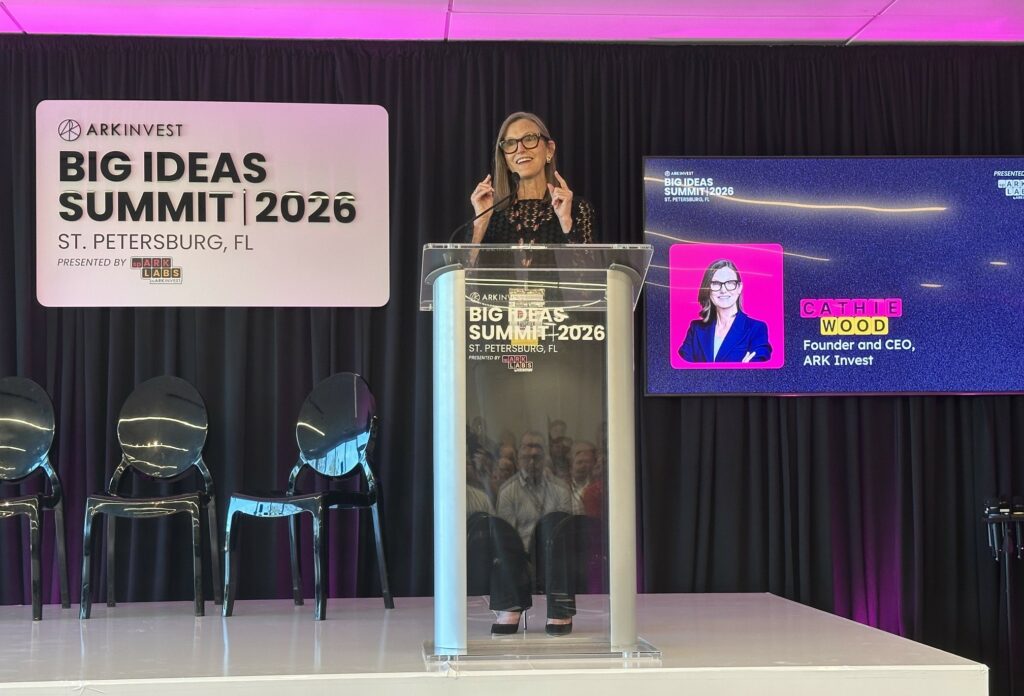

At the Big Ideas Summit in downtown St. Petersburg on Thursday, the conversations on stage sounded less like panel discussions and more like a blueprint for the future. At the center of it all was ARK Invest founder and CEO Cathie Wood, whose enthusiasm for the Tampa Bay region and the state framed the day with the urgency of someone convinced she is watching the next great innovation hub emerge in real time.
At the full-to-capacity conference, Wood recalled ARK Invest’s nationwide search for a new headquarters after leaving New York. Cities like Nashville, Austin, Miami, and the Research Triangle all made the shortlist. Yet she said the firm chose St. Petersburg because ARK believed it could help catalyze something much larger for the Tampa Bay area. What began as a relocation decision, she explained, has evolved into a conviction that the Tampa Bay region is approaching an inflection point similar to the early rise of Silicon Valley.
What surprised her most, Wood said, was the concentration of hidden strengths already embedded in the region: defense technology tied to SOCOM and CENTCOM, an R1 research institution in the University of South Florida, and a healthcare ecosystem embracing artificial intelligence at scale. She repeatedly returned to one example: the partnership between Palantir Technologies, which of course recently announced its headquarters move to Miami, and Tampa General Hospital (TGH). She described their pioneering partnership as evidence that Tampa Bay could become a global leader in transforming healthcare from “sick care” into true preventative healthcare.
The cornerstone of one on-stage discussion – one of several held throughout the day – centered on the multi-year relationship between Palantir and TGH. Wood praised TGH as the first hospital in the United States to adopt AI at scale through Palantir’s platform, a partnership she first discovered during an earnings call where Palantir leadership lauded TGH’s digital evolution.
John D. Couris, president and CEO of TGH, detailed how the hospital utilized Palantir’s AI platform to resolve systemic, fragmented healthcare challenges. Describing the traditional healthcare trajectory as unsustainable – marked by disjointed silos, escalating costs, and national quality metrics that rank near the bottom among industrialized economies – Couris explained that Palantir’s forward engineers effectively changed the hospital’s operational DNA.
“They fixed it. They did it correctly… and they did it fast,” Couris said, noting that solutions taking traditional systems years to implement were deployed by Palantir in mere months without jeopardizing quality.
To illustrate the human impact of predictive analytics, Couris shared a clinical success story regarding septicemia, the leading cause of death in American hospitals. By integrating predictive analytics into TGH’s operations, the hospital dramatically improved its ability to detect sepsis before it became fatal. Couris said the mortality rate for sepsis patients ranges from 15 to 18% in most hospitals, but TGH dropped its rate from 10 percent to 5.3 percent – a shift he translated into nearly 900 lives saved.
For Ted Mabrey, Palantir’s Head of Global Commercial, the partnership represented something bigger than software implementation. He argued that the age of AI will not be defined by replacing workers, but by augmenting human expertise. The key, he said, is “falling in love with the problem,” not the technology itself. Palantir’s engineers embedded themselves inside TGH, studying workflows and operational bottlenecks with the intensity of medical staff. In one example, the company even brought in engineers from the oil and gas industry to rethink hospital throughput and patient flow.
Amid the frequent news of steep jobs losses linked to AI, Mabrey’s broader message was optimistic. AI, he argued, expands human cognitive capacity in the same way industrial machines once expanded physical labor. Whether in hospitals, military operations, or supply chains, the technology allows experts to make faster, better decisions at scales previously impossible, he said.
Brian Cornell, Target’s executive chairman and former CEO, highlighted the broader economic horizon, noting that with less than 20% of small businesses currently utilizing AI, the opportunity for an entrepreneurial explosion and enhanced productivity remains entirely ahead for us. Cornell, also a startup mentor at the spARK Labs at ARK Invest incubator, believes AI means that jobs will evolve but will be better jobs, and work will be more enjoyable.
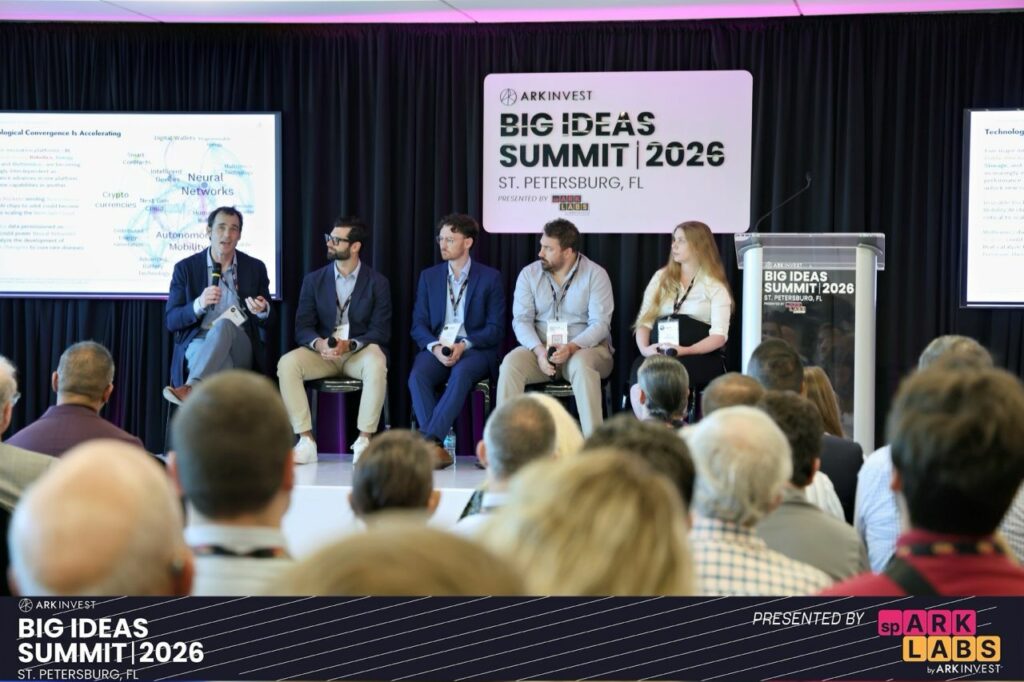
Throughout the day, the historic convergence of technologies we are now experiencing was a key theme of the day whether it was in panel discussions, spARK Labs startup pitches on stage and in the “Founder Village,” or discussion in the halls. For example, members of ARK Invest’s top research team took the stage to discuss some of the underlying themes in ARK’s recent Big Ideas report, including the convergence of technologies including AI, robotics, multiomics and crypto.
“We believe that these technologies, as the costs fall, are going to scale across sectors and industries, so we think the old way, the very siloed way of looking at the world, is going to give way to the way we’re doing things,” said Wood. “And something very important is it is necessary that analysts collaborate with one another, that these technology teams talk to one another, as these technologies converge and create massive opportunities.”
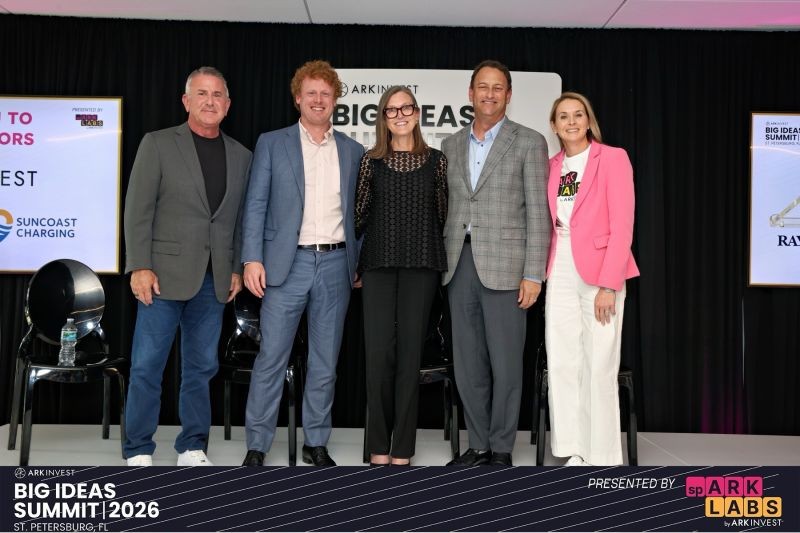
Pictured above: From left, Target executive chairman and former CEO Brian Cornell, Palantir Head of Global Commercial Ted Mabrey, ARK Invest founder and CEO Cathie Wood, Tampa General Hospital president and CEO John Couris and spARK Labs by ARK Invest CEO and president Becca Brown. Pictured below: The ARK Invest research team discusses the convergence of technologies.
READ MORE IN REFRESH MIAMI:
Source link