South Korea’s AI startup ecosystem is beginning to reveal a new pattern beyond chatbot launches and generative AI demonstrations. Companies that originally built AI systems for consumer commerce are now adapting those infrastructures for enterprise learning, workplace training, and personalized education environment.
The latest partnership between Buzzni and Korean corporate education company Hunet offers an early example of how recommendation engines, conversational agents, and multimodal AI systems developed for shopping platforms may gradually evolve into enterprise learning infrastructure.
Buzzni and Hunet Bring AI Case Learning Into MBA Education
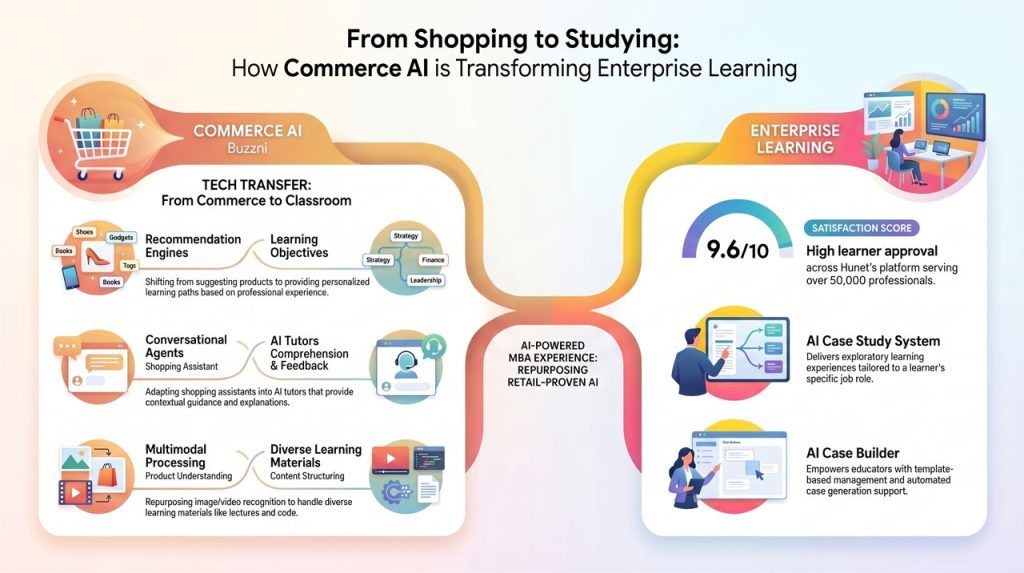
Buzzni recently completed the implementation of an AI-powered case study system for Hunet MBA, a premium business education program operated by Hunet. The project introduced an “AI Case Study” function designed to support contextual and exploratory learning experiences tailored to each learner’s job role and learning background.
The companies also built an “AI Case Builder” for education operators, allowing case generation support and template-based management functions. Hunet positions the system as part of its effort to modernize traditional business education through AI-assisted learning experiences.
Hunet’s MBA program, launched in 2003, says it has accumulated more than 50,000 learners and maintains an average learning satisfaction score of 9.6 out of 10. The company has increasingly integrated AI features into the platform, including AI tutors, AI note functions, personalized learning recommendations, and AI-generated learning reports.
The broader challenge is becoming increasingly visible across enterprise learning environments globally. Traditional online business education often struggles with passive participation, inconsistent learner engagement, and different levels of understanding among professionals with diverse industry backgrounds.
Hunet previously explained that its AI-powered case study system was designed partly to address those limitations by helping learners interpret the same business case through industry-specific and role-specific perspectives.
Why Commerce AI Capabilities Can Transfer Into Enterprise Learning
What makes the project significant is not simply the addition of AI features into education. The deeper shift involves how Korean AI companies are beginning to repurpose existing commerce intelligence infrastructure for learning environments.
In correspondence with KoreaTechDesk, Buzzni explained that two major assets made the transition possible: long-term experience operating large-scale consumer services and years of accumulated AI technologies spanning search, recommendation systems, conversational agents, and multimodal AI.
Buzzni operates HomeShoppingMoa, a Korean mobile home shopping platform that the company says has surpassed 15 million cumulative downloads.
Through the platform and its APlus AI commerce AI subscription business, the company has developed technologies including recommendation AI, shopping agents, AI summaries, chatbot interfaces, semantic search, product attribute extraction, and multimodal product understanding.
“Buzzni has continuously advanced technologies that understand user intent and context while recommending appropriate products and content,”
the company told KoreaTechDesk.
“Rather than simply displaying search results, we accumulated capabilities around designing personalized experiences based on user interests, behavior, and conversion potential.”
The company believes those capabilities can transfer naturally into enterprise learning environments because learners also require personalized guidance based on their experience level, interests, learning objectives, and comprehension.
Buzzni also noted that conversational shopping agents and AI learning assistants share similar operational logic. In commerce, the AI system needs to understand questions, organize complex information clearly, and recommend next actions. In education, those same interaction patterns can help learners receive explanations, contextual guidance, and suggested learning paths.
Multimodal AI Is Becoming More Relevant in Enterprise Education
Another important aspect of the project involves multimodal AI infrastructure.
Buzzni said its experience handling text, image, voice, and video data across commerce environments became highly applicable to education systems, where learning materials also exist across multiple formats including lecture videos, documents, images, audio, code exercises, and question-and-answer datasets.
“Educational content also exists in many different forms, including lecture videos, materials, images, voice, coding exercises, and Q&A data,”
Buzzni explained.
“The multimodal data processing and content structuring capabilities accumulated in commerce environments could therefore be effectively applied to education as well.”
That aligns with broader developments inside Korea’s AI education market. According to the Ministry of Education, around 11,683 learners participated in AI and digital intensive education programs for working adults during 2025 across sectors including finance, manufacturing, design, sales, and education. The ministry plans to expand participating universities to around 38 institutions in 2026 as AI workforce demand continues increasing.
Corporate learning demand is also shifting toward practical and immediately applicable AI skills. Korea Standards Association data previously showed that AI and digital transformation-related training demand increased sharply during 2025 as companies accelerated workplace AI adoption efforts.
Korean AI Companies Are Testing New Expansion Paths Beyond Commerce
Buzzni’s move into enterprise learning also reflects broader pressure inside South Korea’s AI startup ecosystem.
Many Korean AI companies originally built their businesses around narrow vertical categories such as commerce, advertising, customer service, or content automation. As enterprise AI adoption expands, those companies are increasingly exploring how existing AI infrastructure can be adapted into adjacent industries without rebuilding entirely new systems from scratch.
In Buzzni’s case, the company sees educational environments as another area where recommendation systems, conversational AI, and contextual personalization can operate effectively.
CEO Sanghyob Nam described the company’s education expansion as a strategic extension of technologies previously validated through HomeShoppingMoa and APlus AI.
“Buzzni’s expansion into edtech is not simply entering an entirely new sector,”
Nam told KoreaTechDesk.
“It is a strategic expansion that converts commerce AI, conversational agents, search and recommendation systems, multimodal content understanding, and automation-related technologies into learning experiences.”
The company said it is currently focusing on integrating AI-based functions into existing educational programs while gradually enhancing learning content itself through AI systems.
Enterprise Learning May Become an Important Testing Ground for Korean AI
The Hunet partnership may also signal how enterprise education could become an important experimentation layer for Korean AI companies.
Unlike consumer-facing AI environments that depend heavily on advertising, commerce conversion, or mass-market engagement, enterprise learning systems often operate inside structured business environments with clearer objectives around skill acquisition, participation, and measurable learning outcomes.
That creates opportunities for Korean AI companies to test how personalization engines, conversational systems, and multimodal interfaces behave in professional education settings where context accuracy and learner understanding become more important than transaction speed.
The shift remains early, indeed, and it is still unclear how widely Korean enterprise education providers will adopt AI-assisted learning infrastructure over the longer term.
Still, projects like the Buzzni-Hunet collaboration suggest that some Korean AI firms are beginning to view their technology stacks less as industry-specific tools and more as reusable behavioral infrastructure adaptable across multiple business environments.
What Korea’s AI Learning Experiments Could Mean Globally
South Korea’s AI startup ecosystem has often moved quickly in areas where high digital adoption, strong mobile infrastructure, and dense enterprise environments intersect. Enterprise learning may become another example of that pattern.
The Buzzni-Hunet project highlights how AI systems originally optimized for commerce recommendation and user interaction may gradually evolve into tools for professional learning and enterprise education.
If similar transitions continue, Korea’s next wave of AI competition may not be defined solely by building new foundation models. It may increasingly depend on how effectively companies can repurpose existing operational AI infrastructure into entirely new business environments.
Key Takeaway
- Buzzni implemented AI-powered case study and case-building systems for Hunet MBA, bringing personalized and exploratory AI learning functions into enterprise education.
- The project demonstrates how Korean commerce AI infrastructure is expanding into learning environments, particularly through recommendation systems, conversational AI, and multimodal content understanding.
- Buzzni’s experience operating HomeShoppingMoa and APlus AI became foundational for the education transition, especially in user intent analysis, personalization, and interactive AI systems.
- Multimodal AI is becoming increasingly relevant in enterprise education, as learning environments combine text, video, audio, images, coding exercises, and conversational interaction.
- South Korea’s enterprise AI education market continues expanding, supported by government-backed AI workforce programs and rising corporate demand for practical AI skills.
- The Buzzni-Hunet collaboration reflects a broader Korean AI ecosystem trend, where companies are adapting proven AI infrastructure into adjacent business sectors rather than remaining limited to single-industry verticals.
🤝 Looking to connect with verified Korean companies building globally?
Explore curated company profiles and request direct introductions through beSUCCESS Connect.
– Stay Ahead in Korea’s Startup Scene –
Get real-time insights, funding updates, and policy shifts shaping Korea’s innovation ecosystem.
➡️ Follow KoreaTechDesk on LinkedIn, X (Twitter), Threads, Bluesky, Telegram, Facebook, and WhatsApp Channel.
Source link