



PROVO — Entrepreneurship in Utah and across the United States has remained strong in recent years, but the latest statistics show a slight decrease in participation in Utah’s collegiate entrepreneurial programs.
Utah is one of the nation’s leading states for new business creation, with startup activity well above pre-pandemic levels. While entrepreneurship appears to be thriving across the state, participation in one of Utah’s largest collegiate entrepreneurship programs is not, raising questions about how young people are pursuing innovation today.
Americans filed nearly 5.5 million new business applications in 2023, compared to roughly 3.5 million in 2019 before the pandemic-era startup boom, according to the U.S. Chamber of Commerce’s latest data. Utah has also emerged as one of the nation’s leading startup hotspots, with 71,877 new business applications filed in 2023 — ranking sixth per capita.
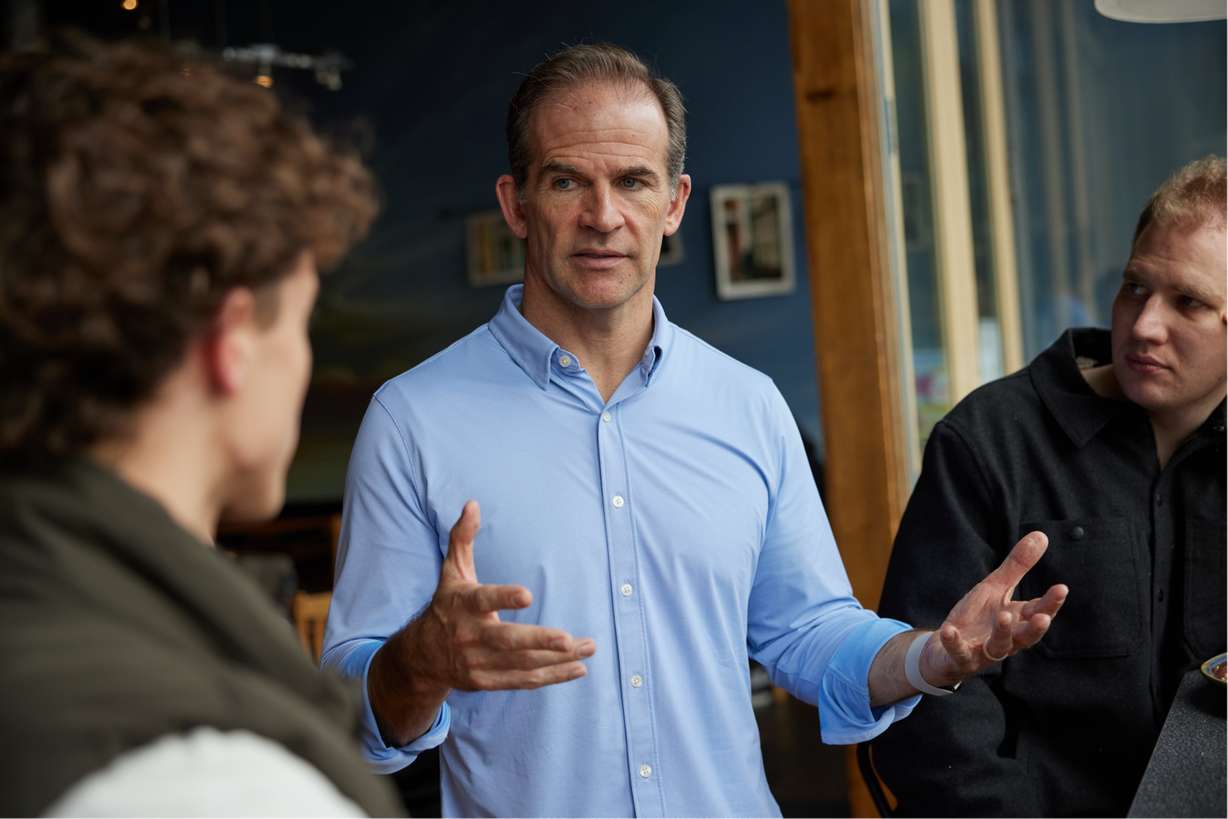
Utah entrepreneur and former Utah Business Magazine CEO of the Year, Case Lawrence, said Utah’s entrepreneurial culture is one of the biggest reasons young people continue turning toward startups and side businesses.
“I think it is truly and purely a cultural phenomenon that there is entrepreneurship in the Utah culture,” Lawrence said. “There’s a willingness and a cultural paradigm that allows, honors and respects taking risks in our community.”
National rankings have also helped bring attention to Utah’s entrepreneurship programs. The University of Utah Lassonde Entrepreneur Institute was recently ranked among the top 10 in the nation by U.S. News & World Report.
Lawrence said Utah’s economy and startup success stories have helped create an environment where entrepreneurship feels more accessible to younger generations.
“Entrepreneurship is contagious,” he said.
As younger adults faced an increasingly competitive job market, Lawrence said more people began to create opportunities for themselves rather than waiting for traditional career paths.
“A lot of it is out of necessity — people are forced to hustle and make something happen,” Lawrence said.
That broader trend makes the recent decline in participation at Lassonde particularly notable.
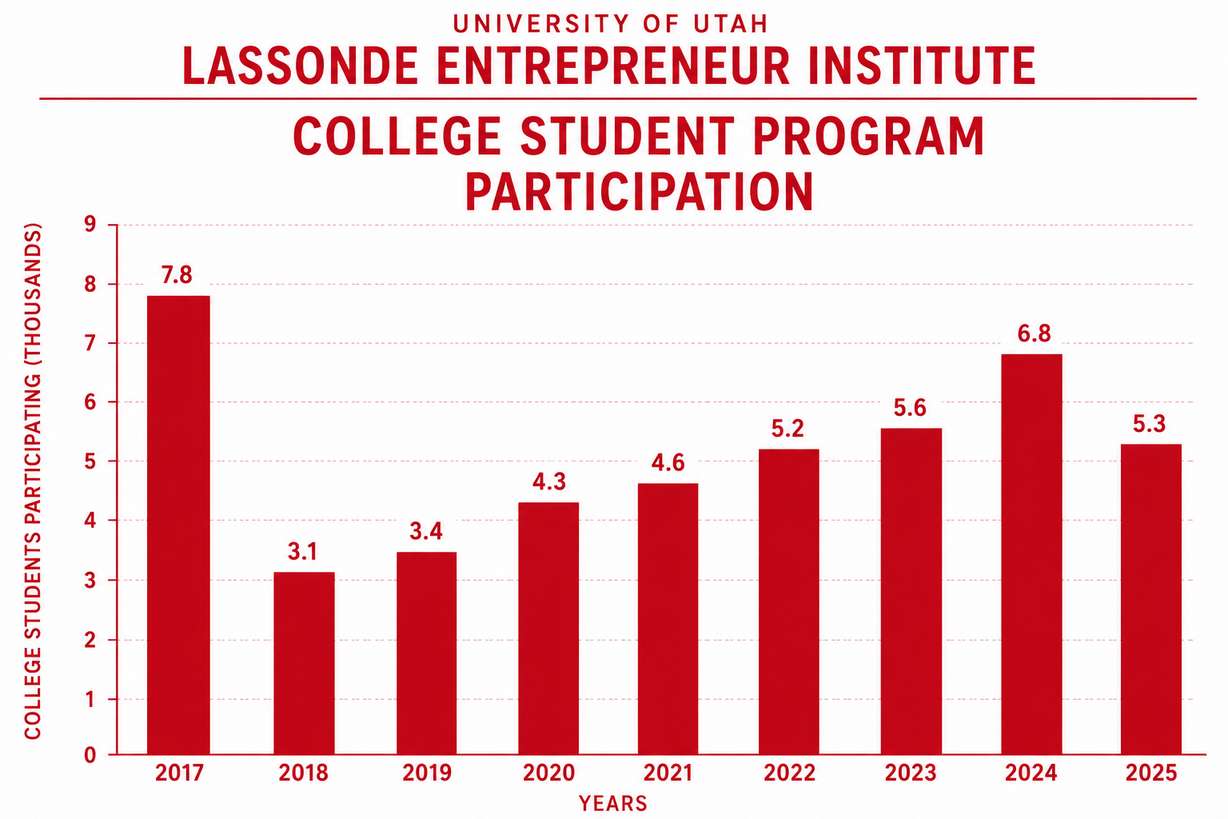
According to a 2025 program report, participation in entrepreneurship programming at the U. surged over the past decade as entrepreneurship education became more mainstream among younger generations. In recent years, however, growth has slowed, and participation has declined from its recent peak.
Scott Holley, executive director at Lassonde, cautioned against interpreting the decline as a sign that entrepreneurship is losing momentum among young people.
“The fact that we’re serving several thousand students per year is just one data point,” Holley said. “What we’re really looking for is how much impact and transformation that we have for those students.”
He said student startup teams have remained relatively stable in recent years and that overall interest in entrepreneurship has continued to grow.
“I can tell you that the overall interest in entrepreneurship and in starting teams has increased this year,” Holley said.
Seth Jenson, senior director at the Baugh Entrepreneurship Institute at Utah Valley University, said entrepreneurship education remains a topic of debate in higher education and noted that as of now, UVU doesn’t even offer an entrepreneurship major.
“There’s always this broader conversation of: does it make sense to go get an entrepreneurship degree?” Jenson said. “There’s a lot of mixed feelings. We personally don’t have an entrepreneurship major.”
Instead, Jenson said many students pursue entrepreneurship through minors, certificates, hands-on programs and startup experiences that complement degrees in business, technology, and other fields. He said entrepreneurship is often viewed as a skill set that can be applied across a variety of careers rather than a standalone academic discipline.
The age of AI
Holley also said entrepreneurial education has become increasingly important as artificial intelligence reshapes parts of the workforce and lowers barriers to starting businesses.
Despite recent backlash surrounding AI during graduation season and in discussions about the future workforce, Holley said many students still see the technology as something that excites them about innovation.
“AI is creating excitement around building, and it’s reducing barriers to building,” Holley said. He pointed to the institute’s new DevLab program, which allows students to build AI-enabled software businesses. He said the program saw strong early participation during its first year.
In addition to AI, Holley said students have access to other technological tools that allow them to launch ideas faster than ever before, even without extensive technical backgrounds.
“We definitely are seeing an uptick in interest in entrepreneurship and founding companies,” he said. Holley said Utah’s entrepreneurial success has created a cycle in which founders continue to invest back into younger generations.
“There’s a pay-it-forward mentality and mindset that we have here,” he said.
‘Build it yourself’
For some entrenched in Utah’s startups, entrepreneurship was a way to combine creativity, flexibility and independence into a career path of their own — all without the involvement of schooling.
Other young business owners, like University of Utah student Ethan McQuarrie, founder of Stormin LLC and OCOVES, said mentorship and community connections played a large role in helping them grow businesses while still in school.
McQuarrie said collaboration among students has helped create an environment in which young founders constantly exchange ideas and support each other’s businesses.
“We’re always collaborating and building that mastermind,” McQuarrie said.
Lilly Moore, a BYU student, is currently building a floating sauna business in Utah after being inspired by a trip to Norway.
“The University of Utah has grown into almost this incubator,” said McQuarrie, who recently launched multiple startup companies while attending school.
“There is a really strong entrepreneurial spirit in Utah and so many amazing resources to help people getting started,” Moore said. She said building her own business has taught her lessons she believes could never fully be learned inside a classroom.
“My advice is: do it, because I have learned more from the process of building a business than I did just from sitting in classes,” Moore said. “If you can’t find the job that you want, then just create it. Build it yourself.”
The Key Takeaways for this article were generated with the assistance of large language models and reviewed by our editorial team. The article, itself, is solely human-written.
Source link