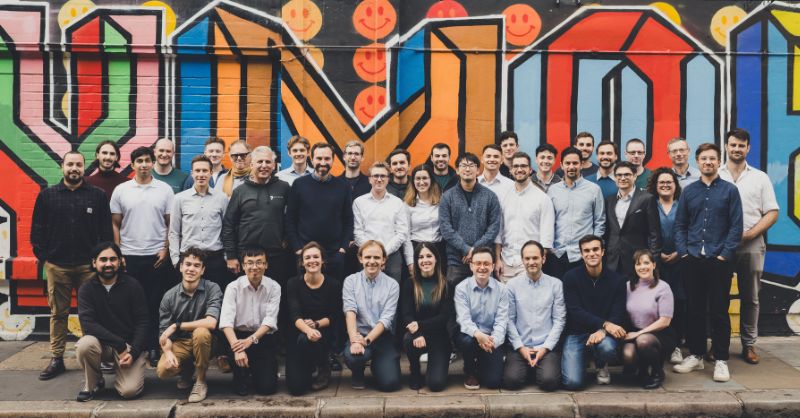
- PhysicsX has raised a $135M Series B led by Atomico, bringing total funding to nearly $170M, to scale AI software that compresses weeks of engineering simulation into minutes.
- The London startup has more than quadrupled revenue since its $32M Series A in November 2023 and grown its team to over 150.
- Siemens and Applied Materials joined as strategic investors. Both are also customers whose tools PhysicsX competes against in some cases.
Standard tools for designing aircraft engines, semiconductor chips, and electric vehicle parts, including Ansys, Siemens NX, and OpenFOAM, run physics simulations that can take hours or days per design iteration. Engineers can test only a few options before committing to a direction.
PhysicsX uses deep learning models trained on high-quality simulation data to predict aerodynamics, heat behaviour, and structural stress in seconds, acting as a physics surrogate model, meaning an AI stand-in for a traditional simulation run. A team designing a turbine blade can now explore thousands of options in the time it used to take to test just one.
The UK startup has closed a $135M Series B led by Atomico, with strategic investment from Siemens, Applied Materials, and Temasek, bringing total funding to nearly $170M.
The company was co-founded in 2019 by Robin Tuluie, now chairman, who served as head of R&D at Renault (Alpine) F1 and Mercedes F1, then as vehicle technology director at Bentley Motors, and Jacomo Corbo, now CEO, who co-founded QuantumBlack, the AI consultancy later acquired by McKinsey, and worked as chief race strategist at Renault F1. Nicolas Haag, the third co-founder, is director of simulation engineering.
“The tectonic plates of the whole global economy are being reshaped by industrial manufacturing. Geopolitical currents and the questions of sovereignty and supply chain resilience are most strongly felt here. At the same time, innovation within these fields has never been more urgent. We’re building into that unmet need,” Corbo says.
Strategic capital with teeth
The investor list carries weight beyond the cheques. Siemens, whose Xcelerator simulation tools sometimes compete with and sometimes complement PhysicsX, is now a shareholder. Applied Materials, one of the world’s largest semiconductor equipment companies, is also in.
“PhysicsX is unlocking a new engineering paradigm. By fusing frontier AI research with deep industrial expertise, the team is building tools for the sectors that underpin the global economy,” says Laura Connell, partner at Atomico.
General Catalyst, which led the $32M Series A in November 2023, returned for this round.
Managing director Paul Kwan notes the company has scaled its team and solutions since that round. July Fund, NGP, Radius Capital, Standard Investments, and Allen & Co also participated.
What the $135m buys
Since the November 2023 Series A, PhysicsX has grown from over 50 people to more than 150 and says revenue has more than quadrupled. No base figure has been disclosed, which makes it difficult to judge the absolute scale of that growth.
The platform connects with tools engineers already use, such as Ansys, CATIA, OpenFOAM, and Siemens Star CCM+, so customers do not need to rebuild workflows they have spent years building.
The new funding will support global expansion, with North America as the primary focus given its concentration of aerospace and defence spending. It will also fund the development of larger physics foundation models: general-purpose AI tools that let the platform serve new industries without retraining from scratch.
The global simulation software market stood at $19.95 billion in 2024 and is projected to reach $36.22 billion by 2030, growing at a 10.4% CAGR, according to MarketsandMarkets. PhysicsX is not the only one chasing it.
Quanscient raised €10M in 2026 to build multiphysics simulation software that runs up to 100 times faster than on-premises alternatives. BeyondMath raised $8.5M for a comparable AI-powered simulation platform. Rescale secured $115M in April 2025 to modernise high-performance computing infrastructure.
If the foundation model works, PhysicsX could become the backbone for many different physical industries.