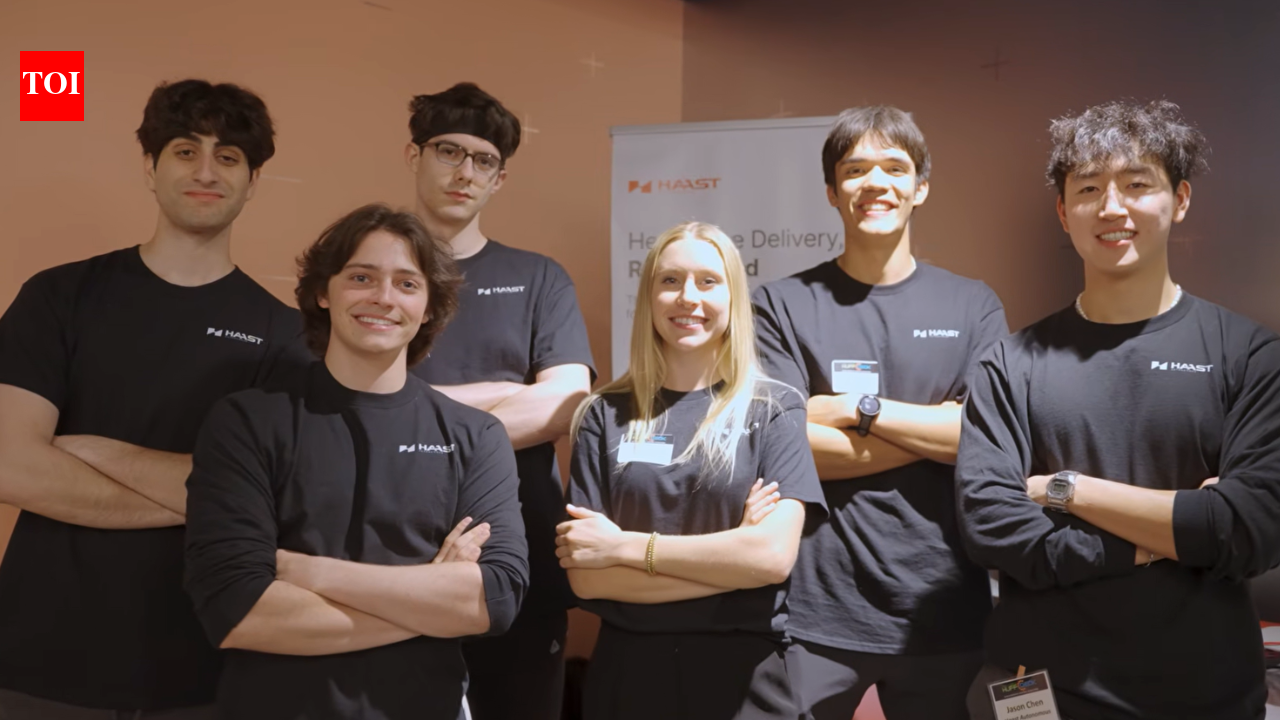
Seven Rice University students in Texas have turned a classroom project into a startup with ambitions to transform healthcare logistics. Their company, Haast Autonomous, has secured $1.85 million in pre-seed funding to develop a drone-based transport system designed to move critical medical supplies quickly and safely between hospitals. The team believes existing healthcare networks rely too heavily on ground couriers and expensive air transport, creating delays for sensitive cargo. Their solution combines custom-built aircraft with software that manages dispatch and tracks deliveries in real time. The founders plan to spend their first year after graduation working full time on the venture, with pilot trials expected to begin in early 2027.
How seven college students built a life-saving startup
Haast Autonomous was founded by graduating seniors Ege Halac, Jason Chen and Santiago Brent. The trio first developed the idea through Rice University’s Liu Idea Lab for Innovation and Entrepreneurship Summer Venture Studio and later built prototypes at the Oshman Engineering Design Kitchen.They were joined by fellow engineering students Felix Hasson, Ethan Javedan, Kenna Sanders and Caden Schmidt. Together, the seven-member team transformed a capstone design project into a startup focused on mission-critical logistics.As healthcare systems become increasingly centralised, many specialised laboratories, blood banks and diagnostic services are concentrated in fewer locations. However, transporting biological samples and emergency supplies between facilities still depends largely on road couriers or costly aircraft.The founders say this creates a need for faster and more reliable transport. Their platform aims to reduce delays and ensure critical materials reach doctors and patients when time matters most.
How the life-saving drone system works
Haast’s aircraft can take off and land vertically, allowing it to operate from existing hospital facilities. Once airborne, it transitions into horizontal flight to cover longer distances efficiently.The current prototype can travel between 50 and 62 miles while carrying at least five pounds of cargo. Its payload compartment regulates temperature, pressure, vibration and tilt, making it suitable for transporting patient samples, antivenom, poisoning kits and specialised therapies.According to co-founder Jason Chen, the drone itself is only one part of the system. Hospitals will be able to request flights, track shipments in real time and maintain detailed chain-of-custody records.Behind the scenes, software manages aircraft availability, flight telemetry and airspace restrictions. The company eventually plans to operate an entire fleet rather than individual drones.Working from Rice University’s engineering facilities, the team produced 13 aircraft iterations in just 16 weeks. Using 3D printing technology, they managed to keep the cost of each prototype below $1,000.The founders adopted an approach focused on rapid testing and continuous improvements, allowing them to refine the aircraft design while maintaining affordability.
Awards and growing industry interest
The project has already attracted recognition. At the 2026 Oshman Engineering Design Showcase and Competition, the team received the award for Best Aerospace or Transportation Technology and finished third for the Willy Revolution Award for Outstanding Innovation.Haast also won the Chan-Kang Family Prize for Bold Ambition and the Healthcare Innovations Prize at the 2026 H. Albert Napier Rice Launch Challenge. Beyond campus, the startup has spoken with hundreds of prospective customers, secured letters of intent and partnered with Airspace Link to support autonomous flight operations.Bigger ambitions beyond organ transportThe founders initially envisioned transporting transplant organs, though they soon realised the technology could address a much broader challenge. Their platform could eventually support mission-critical transport across multiple industries.With $1.85 million in fresh funding, the company plans to launch pilot trials in early 2027 before moving towards commercial deployment later that year. The team believes its combination of aircraft and logistics software could help create one of the fastest and most secure transport networks for sensitive cargo.