

OAKLAND – Nicolas Bejar’s earliest engineering memories date back to his third-grade classroom in San Diego, where he built robots with LEGO Mindstorms.
But Bejar, who is now a third-year mechanical engineering student at Northeastern University, said that his nascent passion for robotics – sparked by the LEGO Mindstorms – was interrupted when he reached middle school. Not because his interest in circuitry and hardware went away, he said, but because there wasn’t a similar, widely available STEM teaching tool for students of that age.
“In middle school, unless you take an active interest and join a robotics club or take advanced physics classes, you’re not truly introduced to circuitry in any way,” he said.
Now at Northeastern University, Bejar and fellow mechanical engineering student Mason Kim have created a product that could fill this hole in the education technology market.
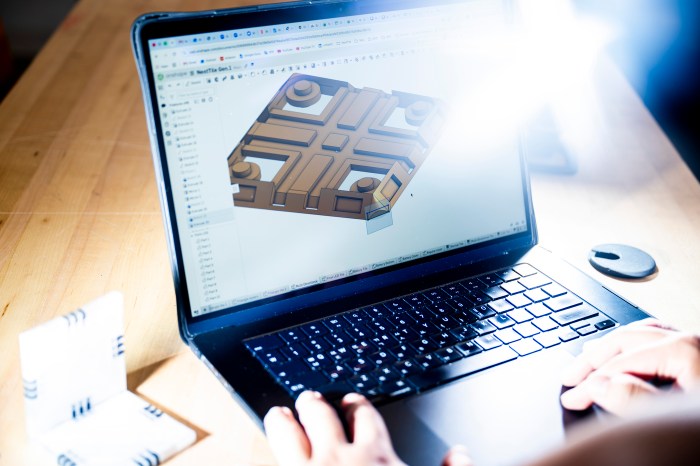
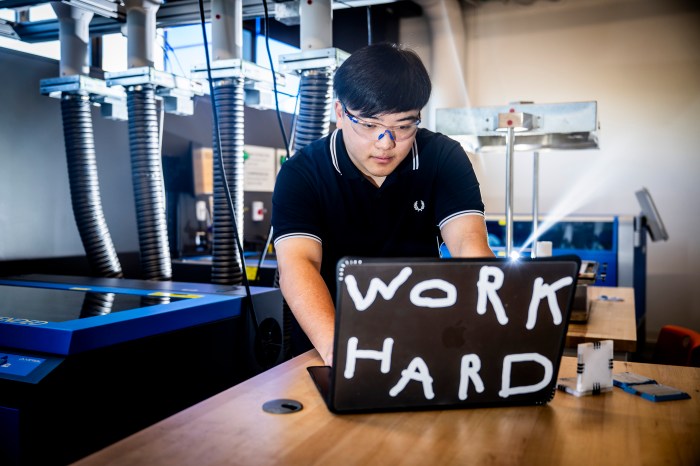
Using the Makerspaces on Northeastern’s Oakland and Boston campuses, the pair came up with a prototype of a modular STEM toy called NextTile. The battery-powered toy, made up of magnetic squares that can be connected in dozens of orientations to produce different visual results, are a hands-on alternative to the theory-based curriculum typical in grade school, the students said.
Tomás Galguera, professor of education at Northeastern University, said children actively construct knowledge while engaging in play, testing theories while developing valuable cognitive skills.
“We know that playing with toys and games can help students feel more comfortable with technical domains, spatial skills, computational thinking and design,” he said. “Preserving ample time and space for children to tinker … is one of the best things we can do to maximize the probability of future scientists.”
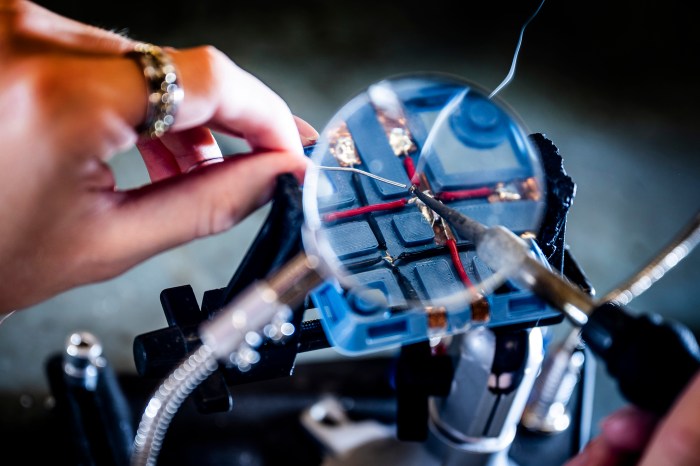
In Oakland, Kim and Bejar crafted 3-inch square modules, using 3D printers and laser cutters to shape them before inserting small magnets, circuitry and LED lights by hand. The magic happened when they were connected to the dedicated battery tile and powered on, Bejar said, displaying a number of dazzling visual effects that also conveyed foundational scientific concepts.
One tile contains crisscrossed red and black wires on opposite corners inside, Kim explained. When users place them such that the magnets’ polarities match, they will form a longer, same-colored wire running all the way through the tile arrangement and delivering power.
Another contains small lights that will change color depending on which side of the tile is being fed power, Bejar said. And the magnets installed on all four sides of the tiles mean they can be connected to one another in any number of ways, even vertically.
Kim and Bejar dreamt up the idea as part of their first-year cornerstone engineering course at Northeastern’s Oakland campus in 2025, then continued refining the concept in Boston. Their objective was to develop a toy that taught some aspect of STEM and that could be trialed in kindergarten and first-grade classrooms at the campus’s Children’s School.
When Kim and Bejar visited the elementary school classroom, they watched as the students thought up ideas even they hadn’t considered, such as magnetizing the tiles to a whiteboard to try a vertical orientation instead of placing them on a flat, horizontal surface.
“It’s pretty cool that they kind of invented their own way to play with it within the first 20 minutes,” Kim said.
Fostering interest in STEM at an early age could go on to have ripple effects, including encouraging more Americans to seek science and engineering degrees, reducing the vast disparity between science and engineering graduates in the U.S. and those in India and China, they said.
In 2020, 2.4 million Indian students and 2 million Chinese students earned science and engineering bachelor’s degrees or their international equivalent, according to the U.S. National Science Foundation. Fewer than 890,000 students in the U.S., meanwhile, were awarded such a degree, a reflection of the significantly slower increase in such degrees over the last decade compared to India and China, the NSF reported.
Even with more advanced degrees, the U.S. is lagging. In 2022, for instance, the U.S. awarded the second highest number of doctoral STEM degrees behind China. China’s growth of STEM doctoral degrees has also been steadier than the U.S.’ since 2015, according to the NSF.
Kim argued one reason the U.S. appears to be behind is the very lack of hands-on learning opportunities that NextTile seeks to remedy.
“That’s the reason why we want to focus on our future generation as engineers,” he said. “We could be a new solution to the lack of interest in STEM in general.”
NextTile is now a patent-pending startup that has the backing of Northeastern’s IDEA venture accelerator, which gives students funding toward building prototypes and assists them with creating a business plan.
Northeastern Global News, in your inbox.
Sign up for NGN’s daily newsletter for news, discovery and analysis from around the world.
Stephen Golden, professor of entrepreneurship and innovation, said that while the toy industry is highly competitive, NextTile shows serious potential. Though STEM toys represent only about 6% of the global toy market by retail sales, they are growing about twice as fast as the overall toy industry, he said.
“That’s a category that teachers love, parents love,” said Golden, one of nearly 10 D’Amore-McKim School of Business professors at Northeastern advising Kim and Bejar. “Any time you see something that’s going to teach kids something and entertain them, that’s not on the screen, there’s value.”
As they work toward completing their undergraduate degrees, Kim and Bejar are continuing to prototype new iterations of the tiles, experimenting with adding microcontrollers, screens, motors, push buttons and more.
“I think we’re really close to what we want to pursue for the next milestone, which is bringing it to the consumer market and seeing how the users and consumers work with our product,” Kim said. “We want to pursue this idea and make it sustainable after our graduation.”
Source link