Spiro, the Dubai-headquartered electric vehicle company that has become Africa’s most heavily funded e-mobility platform, has closed a $270 million funding round — its largest yet — capping a rapid fundraising sprint that is reshaping who backs clean transport on the continent.
The final piece of the round is a $55 million investment from NewTrails Capital, a Chinese growth-stage fund with operations in Shanghai, Shenzhen, and Lagos.
The broader round also includes backing from Impact Fund Denmark, Equitane, and the Fund for Export Development in Africa (FEDA), Afreximbank’s investment arm, which led a separate $100 million raise last October.
A Chinese Fund Enters the Picture
The NewTrails investment is notable for what it signals beyond the dollar figure. Chinese capital has flowed steadily into African infrastructure and commodities for years, but backing for African-led electric mobility startups at this scale is newer territory.
NewTrails is positioning itself as a long-term partner, citing Spiro’s vertically integrated model — covering vehicles, batteries, swap stations, payments, and service networks — as the draw.
“We believe Spiro is driving a profound energy revolution across mobility use cases in Africa,” said Yufan Zhang, Founding Partner of NewTrails Capital. The fund also flagged the role of Chinese supply chains in the continent’s green transition, a line that reflects Beijing’s broader interest in anchoring Africa’s energy hardware pipeline.
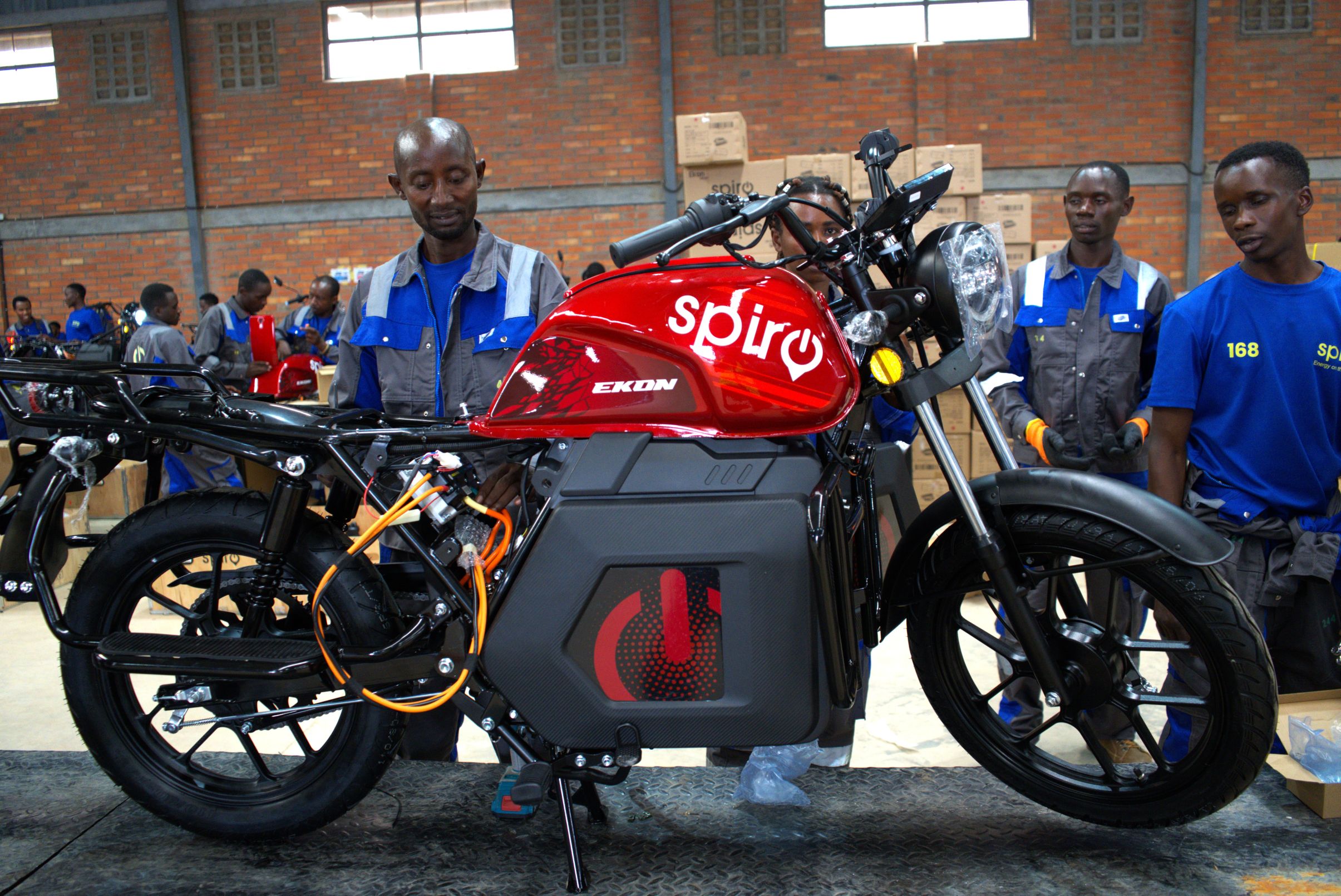
For Spiro, the partnership has a practical purpose: accelerating the localization of manufacturing and supply chains, particularly with Chinese component suppliers. The company currently operates assembly plants in Kenya, Rwanda, and Uganda, and a battery recycling facility in Nigeria.
100,000 EVs and Counting
Spiro now operates across seven African markets — Kenya, Rwanda, Uganda, Togo, Benin, Nigeria, and Cameroon — with plans to expand into the Democratic Republic of Congo and Ethiopia. The company says it has deployed 100,000 electric vehicles and 2,500 battery-swap stations, a milestone that founder Gagan Gupta used to mark the end of Spiro’s proof-of-concept phase.
For riders, the economics are compelling: operating a Spiro electric vehicle can reduce daily mobility costs by up to 40%, generating savings of up to $2 per day compared to fossil-fuel motorcycles. A third-party lifecycle assessment in Kenya found that Spiro’s e-bikes deliver a 72% reduction in climate impact compared to petrol motorcycles, equivalent to roughly 19 tons of CO₂ avoided over a vehicle’s lifespan.
The battery-swapping model — where riders exchange depleted packs for charged ones at swap stations rather than waiting for charging — has been central to Spiro’s pitch. In markets where motorcycle taxi drivers work 10 to 12 hours a day and cannot afford downtime, the swap model offers a practical workaround to the range anxiety and charging infrastructure gaps that have stalled EV adoption elsewhere.
The Funding Math
Spiro’s capital stack has grown through a steady series of raises: a $63 million debt package in 2023, a $50 million Afreximbank loan in 2024, the $100 million FEDA-led equity round in 2025, and a $50 million debt facility closed earlier this year.
Adding the latest $270 million, the company says it has raised more than $415 million since 2023 — a figure that places it in rare company among African tech startups and comfortably ahead of any peer in two-wheel electric mobility on the continent.
What stands out is that investors are backing more than motorcycles. They are backing the full system around them — from bikes to swap stations, battery stock, and the local assembly required to keep operations moving.
What Comes Next
Spiro is signaling ambitions that stretch beyond urban motorcycle transport. The company is actively expanding beyond urban transport into a distributed clean-energy utility network that supports national renewable energy goals while reducing dependence on imported fossil fuels. Its R&D center employs more than 150 engineers and holds over 30 proprietary patents.
The harder questions remain. A growing footprint still needs to translate into durable margins across markets with different regulatory environments, currency pressures, and adoption curves — a challenge where many mobility startups discover that building a network is only half the battle.
Whether $270 million is enough to clear that hurdle across a continent of 54 countries is the bet investors are now making.